What should you look for when buying?
First decide what role the rice cake should play alongside other snacks. Then compare the ingredients and nutritional information for the specific products, rather than starting with a protein claim.
| Criterion |
What to check |
Who it matters most to |
| Rice products and variety |
Check how often other rice products feature on the menu alongside rice cakes, and vary the types of grain you serve. |
If rice porridge or other rice snacks are already on the menu at home, I don’t want to rely on rice regularly for snacks as well. This variety would be the main concern for around 50% of consumers. |
| Protein claim |
Compare protein per 100 g and, if stated, per serving; also check the ingredients and the salt and sugar information. |
When a snack is marketed as high in protein, I want to know whether that claim really matters for my toddler’s meal. Around 30% of consumers would look at this first. |
| Ingredients and role as a snack |
Read the current ingredients and allergen information, and plan to serve the rice cake as a defined snack. |
I need to check the ingredients on the specific pack and don’t want to offer the snack constantly for nibbling. For around 20% of consumers, this combination of checking ingredients and planning meals would be the priority. |
The German Nutrition Society gives a protein reference value of 1.0 g per kg of body weight per day for children aged 1 to under 4; the figure of 14 g per day is based on the reference body weight used. This doesn’t mean that a rice cake marketed as high in protein offers a particular benefit to an individual child. A rice cake made from maize and pulses is also not the same as a rice cake made from rice. For example, REWE sells a Verival Protein Waffle containing 18.4 g of protein per 100 g, which the retailer says is made mainly from maize and pulses. This nutritional value alone doesn’t tell you whether it’s suitable as a snack for a toddler.
Rice cakes for occasional snacks
Here you’ll find an apple rice cake described as a snack for young children. When deciding whether to buy it, check the labelling on the specific pack, consider the eating situation and vary it with other rice products.
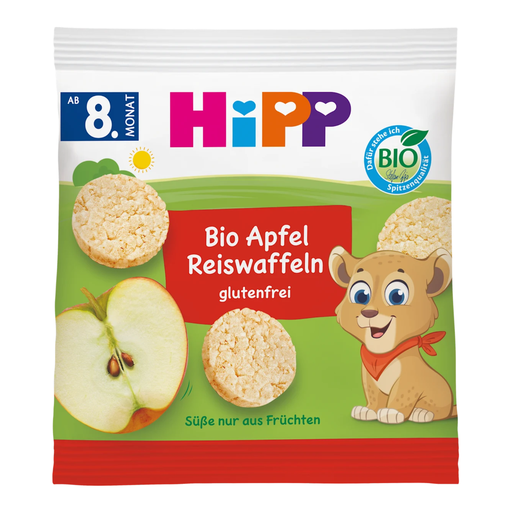 Image unavailable
Hipp apple rice cakes from 8 months, 30 g
This apple rice cake, labelled as suitable from 8 months, may be an option for an occasional snack if your child is developmentally ready to eat rice cakes. Before offering it, check the ingredients and allergen information on the current pack, supervise your child while they eat, and vary rice products with other types of snack and grain.
View at Joybuy
Frequently asked questions
Does my toddler need a high-protein rice cake?
A protein claim alone isn’t a reason to choose a rice cake specifically for a toddler. The German Nutrition Society gives a reference value for total daily protein intake for children aged 1 to under 4; the protein content of one snack doesn’t demonstrate any particular benefit for sport or recovery.
Can rice cakes be a snack for toddlers?
Rice cakes can occasionally be part of a snack, but shouldn’t become the everyday go-to. The German Federal Institute for Risk Assessment notes that rice products may contain inorganic arsenic; consumer advice centres recommend varying the types of grain, particularly for toddlers.
Are all rice cakes gluten-free?
No – the term “rice cake” isn’t enough to tell you. Rice itself is gluten-free, but a specific product may contain other ingredients, so check the current ingredients and allergen information.
When does a crunchy snack fit into the daily routine?
Offer it as a planned snack rather than leaving it available all the time. The Healthy Start Network recommends regular meals and snacks for toddlers, with breaks from eating in between.


