For anyone keeping an eye on protein
If you want the cake itself to add protein to your office snack, it’s worth comparing lentil cakes and lentil crackers with classic rice cakes — both per 100 g and per portion you actually eat.


If you want the crisp base itself to add plenty of protein to your office snack, lentil cakes may be a better choice than the classic rice cakes compared here: REWE lists 25 g of protein per 100 g for its organic lentil cakes, while EDEKA lists 8.7 g per 100 g for its plain organic rice cakes. If you prefer a neutral-tasting base to top yourself, you can pair rice cakes with a suitable topping. For ready-to-eat lentil crackers, portion size and salt content matter too.
If you want the cake itself to add protein to your office snack, it’s worth comparing lentil cakes and lentil crackers with classic rice cakes — both per 100 g and per portion you actually eat.
If you choose your own topping, you need a cake as a base rather than a ready-seasoned cracker. Whether you can pack the topping separately is also worth considering when choosing a practical option for the office.
If you have an allergy or coeliac disease, the labelling on the specific pack is what matters. You can’t tell whether a product is suitable from the words ‘rice cake’ or ‘lentil cake’ alone.
First, decide whether you want the cake itself to provide protein or mainly to serve as a base for toppings. Then compare lentil, rice or maize-and-pulse cakes that you can top yourself with ready-to-eat lentil crackers, taking portion size, salt and ingredients into account.
| What to consider | What to check | Who it matters to |
|---|---|---|
| Protein in the cake | Compare protein per 100 g and in the portion you actually eat; distinguish between cakes and small bags of crackers. | If you want the crisp base itself to provide a meaningful amount of protein, the amount per portion you eat is what counts. Around 42% of consumers prioritise this. |
| Suitability for toppings and preparation | Check whether the product is intended to be topped or portioned as a ready-to-eat cracker. | If you put your own snack together, you need a base for your topping. If you don’t have time to prepare anything, a ready-made cracker may fit your routine better. For around 25% of consumers, this practical consideration comes first. |
| Ingredients and allergens | Read the ingredients list and allergen information on the current pack, especially if you have an allergy or coeliac disease. | If I need to avoid certain ingredients, I can’t rely on the name of a food category. This is the main buying consideration for around 17% of consumers. |
| Variety and nutritional values | For savoury products, check the salt per portion and avoid making rice products your only snack base. | For a snack I take with me regularly, I want to consider salt and the range of snack bases available, as well as protein. Around 16% of consumers focus on this. |
The type of product makes a difference: REWE lists 25 g of protein per 100 g for its organic lentil cakes. For Verival organic protein cakes made from maize and pulses, which are suitable for adding toppings, the REWE product page lists 18.4 g per 100 g. According to REWE, the ready-to-eat Risbellis High Protein Tomato & Pepper Cracker contains 10 g of protein and 0.58 g of salt per 40-g portion. These figures apply to the products in question and don’t replace checking the size of your own portion.
The products considered here differ considerably: EDEKA lists 8.7 g of protein per 100 g for its plain organic rice cakes, while REWE lists 25 g per 100 g for its organic lentil cakes. Lentil cakes are not rice cakes.
Compare nutritional information on the same basis. If you choose classic rice cakes, think about how much protein you want your topping to provide.
According to REWE, the Risbellis High Protein Tomato & Pepper Cracker contains 10 g of protein as well as 0.58 g of salt per 40-g portion. Protein alone doesn’t give you the full picture.
Check both protein and salt per portion, and use the same basis when comparing products.
According to the German Federal Institute for Risk Assessment, rice is gluten-free. However, a finished product may contain other ingredients or carry a ‘may contain’ warning. For example, EDEKA says its plain organic rice cakes may contain traces of sesame.
If you have an allergy or coeliac disease, make your decision based on the ingredients and allergen information on the specific pack, not the product category name.
The German Federal Institute for Risk Assessment notes that rice cakes and other rice products can contain relatively high levels of inorganic arsenic. This doesn’t tell you the level in any individual pack.
Vary your snack base rather than relying solely on rice cakes at the office.
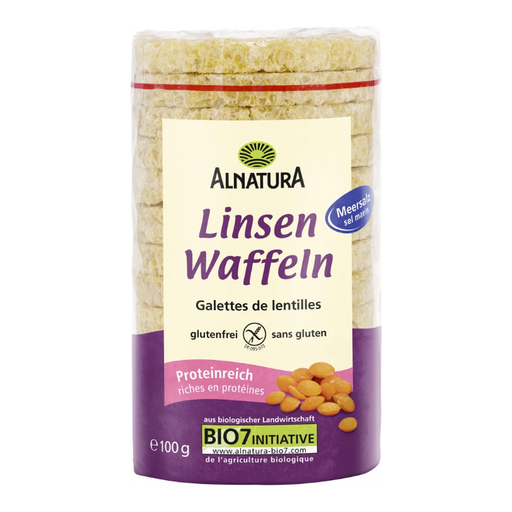
The organic lentil cakes with sea salt are a lentil-based option that you can top yourself, for anyone wanting to compare the protein content of the cake itself.
Risbellis High Protein Tomato & Pepper is a seasoned lentil cracker that’s ready to eat, rather than a cake to top yourself.
The organic protein cakes are a maize-and-pulse option that you can top yourself, rather than pure rice cakes.
The plain rice cakes are a classic, neutral-tasting base that you can top yourself.
The salted organic rice cakes are another classic rice option to compare with lentil products.
These lentil cakes are a good fit if you’re looking for a crisp base to top yourself for an office snack. Compare the nutritional information for the portion you eat, and check the current pack if you have any intolerances.
 No image available
Lentil cakes can make a good base for a snack you top yourself. The pack contains 100 g. When comparing them with rice or other lentil cakes, check the protein per 100 g and per portion you eat.
If you need to avoid soya or are concerned about gluten, check the current ingredients and allergen information before buying.
No. According to the German Federal Institute for Risk Assessment, rice itself is gluten-free. To find out whether a particular rice cake is suitable for someone with coeliac disease or an allergy, check the ingredients and allergen information on the current pack. The fact that it contains rice alone doesn’t tell you about the whole product.
You can’t tell from the name ‘lentil cake’ alone. It depends on the portion you actually eat, its nutritional information and what else is in your snack. If you add a topping, check its nutritional information separately.
Because the protein figure doesn’t tell you anything about the salt content. For Risbellis High Protein Tomato & Pepper, REWE lists 10 g of protein and 0.58 g of salt per 40-g portion. For other products, compare the same portion size or the same 100-g basis.
The German Federal Institute for Risk Assessment advises against relying on a limited range: rice cakes and other rice products can contain relatively high levels of inorganic arsenic. Vary your snack base, without assuming this means a particular level in any individual product.
No. Whether it suits your snack also depends on the portion you eat, the rest of its nutritional information, the ingredients and whether you’re looking for a cake to top yourself or a ready-made snack. The Verbraucherzentrale also points out that an authorised marketing claim doesn’t automatically make a food necessary or a good choice.