
Lieferung heute & morgen

Qualitätsgarantie

Willkommens-Angebote freischalten: KOSTENLOSE Lieferung | Bis zu 80 % RABATT | Kostenlose 30-Tage-JoyPlus-Testphase
App herunterladen
A pulse oximeter can quickly display two readings at home, while travelling or during sport: the peripheral oxygen saturation of the blood, usually shown as SpO₂, and the heart rate. However, choosing the right device is about more than a low price or an eye-catching display. The key factors are a suitable design, clear technical specifications and correct use.
Terms such as “highly accurate” or “professional” have limited value without specific measurement ranges, tolerances or product documentation. An SpO₂ monitor should clearly state which readings it records and under what conditions it is intended to be used. Its classification as a medical device should also be clearly identifiable in the product description and the accompanying instructions.
A small display with poor illumination can be impractical for older people, relatives or measurements taken in low light. A rotating display and adjustable brightness make readings easier to see. An OLED pulse oximeter can show high-contrast figures, although you should also consider the font size and the way the readings are arranged.
Cold fingers, movement, nail polish, artificial nails or a fingertip that has not been inserted fully can affect light transmission. As a result, readings may fluctuate or appear implausible. A fingertip pulse oximeter is therefore only as reliable as the conditions in which the measurement is taken. If unusual readings persist or you experience symptoms, seek medical advice. These devices are not a substitute for diagnosis or treatment.
A typical blood oxygen monitor displays oxygen saturation as a percentage and pulse rate in beats per minute. Some models also show a bar or waveform. These graphical displays can help you assess whether the reading is stable or fluctuating, but they do not replace medical evaluation.
Look for specific information about the measurement range. For example, the medisana PM 100 specifies an SpO₂ range of 70 to 100 per cent and a pulse range of 30 to 235 beats per minute. It also offers six display views and ten brightness levels. Information like this is more useful for comparison than general advertising claims.
The device should hold your finger securely without applying uncomfortable pressure. For regular use at home, one-button operation is convenient. Automatic shut-off helps reduce battery consumption if the device is not switched off manually after the measurement.
A rotating display is particularly useful when several people use the device or when the left and right hands are used alternately. On the Treesmile GX5, the display can be positioned in four directions, and the backlight can also be adjusted.
Check whether batteries are included and which battery size is required. A low-battery warning prevents the device from unexpectedly losing power during a measurement. For hiking, travel or everyday use, a low weight, carrying strap or storage pouch are practical features to consider.
If you are looking for a pulse oximeter for sport and travel, you should also look for one-handed operation and a compact design. When used during sport, bear in mind that readings may fluctuate while you are moving. For a comparable reading, keep your hand still and take the measurement after a short recovery period.
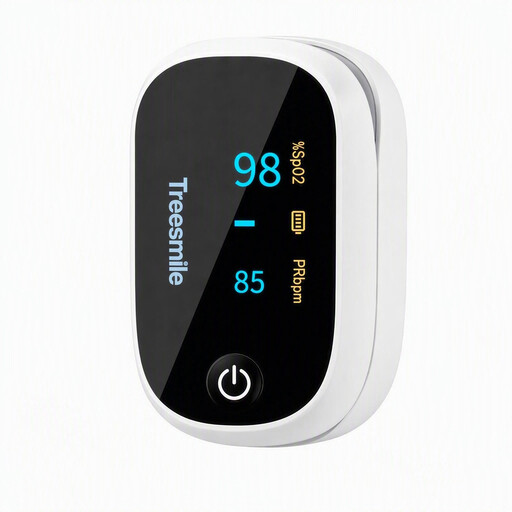
Why this product suits this profile: This compact fingertip device focuses on displaying SpO₂ and pulse rate, and can be operated with one hand. The four display orientations and adjustable backlight make it easy to use every day.
Both readings are shown together on the display. A low-battery warning and automatic shut-off address common problems caused by flat batteries and unnecessary power consumption.
Lightweight fingertip clip design, four-way rotating display, adjustable brightness and automatic shut-off.
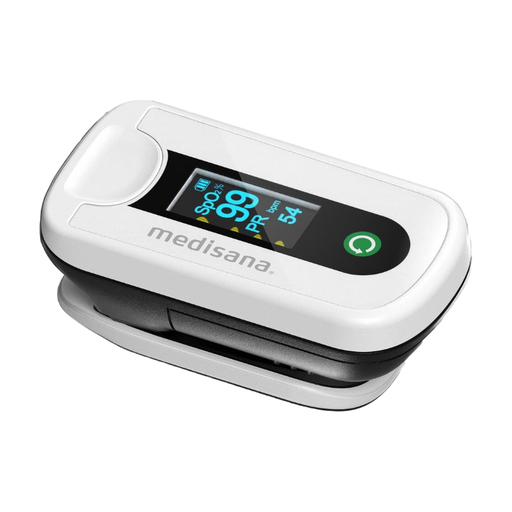
Why this product suits this profile: This model records SpO₂ and pulse rate, and features an OLED display with bar or waveform mode. The display can be rotated in four directions, making it easy to read from different viewing angles.
The product specifications state the specific display modes, automatic shut-off after eight seconds and a low-battery warning, rather than relying solely on general performance claims.
OLED display, bar and waveform modes, weight of 36 grams including battery, plus carrying strap and storage pouch.
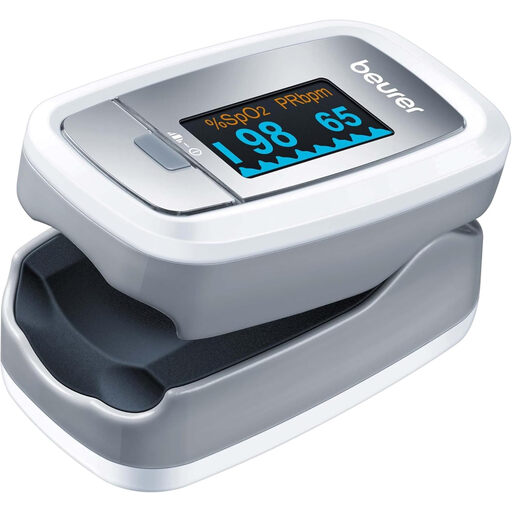
Why this product suits this profile: This device is designed for occasional measurements at home and while out and about. Automatic display orientation and the colour display can be useful when viewing the screen from different angles.
One-button operation reduces unnecessary steps. The manufacturer's guidance that it is intended for individual measurements clearly defines its use and distinguishes it from continuous monitoring.
Colour display, automatic orientation, bar or waveform display, low-battery warning and automatic shut-off.
We have put together a complete, regularly updated list of products that fully meet these strict selection criteria and the safety regulations applicable in the EU.
For the most consistent measurement possible, follow these steps:
The device uses light of different wavelengths, which is passed through the finger. An SpO₂ reading is calculated from the absorption of light. Movement, cold fingers, nail polish and an unsuitable position can affect the result.
Its service life depends on build quality, battery replacement, cleaning and storage. Models with automatic shut-off help preserve battery life. Store the device in a dry place, protected from direct sunlight and extreme temperatures. If it will not be used for an extended period, remove the batteries according to the instructions.
For battery-powered devices, ongoing costs are mainly limited to replacement batteries. Check the required battery size, automatic shut-off function and low-battery warning. Regular cleaning with a slightly damp cloth can help keep the device suitable for everyday use; do not immerse it in liquid.