Households eating at different times
If you roast larger quantities and serve portions later, you’ll need a reliable way to keep them warm or reheat them. An oven function alone doesn’t confirm the temperature of the food.


If you regularly cook several trays of pumpkin wedges and have a suitable built-in space, a built-in oven with explicitly specified multi-level fan cooking could be a good option. For smaller portions and no built-in space, a countertop oven may be a better fit. A keep-warm function doesn’t confirm the temperature of the food or guarantee that the wedges will stay crisp. Also check the tray area, timer functions, installation dimensions and energy consumption per standard cycle.
If you roast larger quantities and serve portions later, you’ll need a reliable way to keep them warm or reheat them. An oven function alone doesn’t confirm the temperature of the food.
If you want to cook pumpkin wedges on several trays, compare the specified heating method and number of levels for the exact model.
For smaller portions, the space available on your worktop and the oven’s internal dimensions may matter more than a large capacity. Check that your tray or dish will fit.
A good fit if: You regularly cook several portions and have a suitable built-in space.
Consider: The oven’s dimensions and capacity need to suit your kitchen and the tray size you plan to use. The manufacturer’s specifications aren’t a substitute for comparing roasting results with fully loaded trays.
A good fit if: You want to keep cooked portions in the oven until they’re served soon afterwards, and can check their temperature.
Consider: The label ‘keep warm’ doesn’t confirm the temperature of the food. Keeping it warm for longer may also affect the roasted texture you’re after.
A good fit if: You usually cook just one small portion, don’t want a built-in oven and your tray will fit inside.
Consider: Capacity, shelf positions and heating methods vary considerably between models.
| What you need | What to check before buying | Who is it important to? |
|---|---|---|
| Keeping portions hot until they’re served later | The BfR recommends keeping food that is actually being held hot at a temperature of at least 60 °C throughout. Check how you can monitor the temperature as part of your routine. | If you serve food at different times, you need a reliable routine rather than just a function name; around 36% of consumers prioritise being able to serve food safely at different times. |
| Cooking on several trays | Compare the heating method, the stated number of levels, the tray dimensions and what’s included with the specific model. | If you want to fit several portions into one cooking cycle, the specified multi-level function matters; around 29% of consumers mainly look for space for several trays. |
| Cooking small portions without a built-in oven | Check the internal dimensions, whether your dish or tray will fit, shelf positions, heating methods and timer. | If you cook small quantities and don’t have built-in space, finding a suitable freestanding appliance is key; around 21% of consumers make this their main consideration. |
| Checking installation requirements and running costs | Check that the appliance and recess dimensions suit your kitchen, and compare the energy label’s kWh per standard cycle and oven capacity. | If fit and ongoing energy consumption are your priorities, check the dimensions, accessories and specific energy label figures; around 14% of consumers put these points first. |
The Verbraucherzentrale notes that the energy label gives consumption figures for standard cycles using certain heating methods. These figures don’t directly show how much energy your specific cooking and keep-warm routine will use.
To keep food hot, it needs to reach the required temperature throughout. An oven setting or keep-warm function doesn’t confirm that it has.
Plan to check the temperature of the food rather than relying solely on the oven setting. The Federal Institute for Risk Assessment recommends a temperature of at least 60 °C throughout the food.
The number of levels, heating method and included accessories are separate specifications. A manufacturer’s claim about multi-level fan cooking isn’t an independent test using densely packed trays of pumpkin.
Check the specifications for the exact model and what’s included. For large quantities, you may need to plan separate cooking cycles.
Depending on the model, you may need to buy compatible extra trays or pull-out rails.
The energy label describes standard cycles, not your whole cooking routine, including portion size and any time spent keeping food warm.
Compare the stated kWh per standard cycle and oven capacity with how you plan to use it. The Verbraucherzentrale explains how to compare household ovens on this basis.
Frequent or extended use can increase energy consumption; how much depends on your specific routine.
The built-in ovens mentioned offer different specified heating methods. The HBA571BB4 lists 3D Hotair for up to three levels, while the HBG7764B1 also lists a keep-warm function. Bosch Hausgeräte Deutschland specifies these functions for the individual models.
Siemens lists 4D Hotair, keep warm and steam boost for the HR776G1B1. These functions alone don’t prove it will produce better results for pumpkin wedges served at different times.
AEG says the ring heating element in the BEE43511AB lets you cook on up to three levels and lists an oven capacity of 65 l.
For the B59CR31Y0, NEFF lists Circo Therm for up to three levels and includes keep warm as a heating method.
The BG 1550 is a freestanding countertop oven. Rommelsbacher lists a 30 l capacity, fan-assisted cooking and four shelf positions.
The models below include built-in ovens with specified fan cooking, as well as freestanding ovens for smaller portions. Compare the actual dimensions and functions of each model with your needs.
 No image available
A built-in option for cooking several portions, if you have a suitable recess.
71 l capacity; 3D Hotair; pyrolytic self-cleaning.
 No image available
A built-in option if you’re looking for an oven with a timer and specified heating functions.
70 l; 60 cm; 3 kW; timer with LED display; ECO mode; grill and pizza functions.
 No image available
A built-in option if you’re looking for an oven with 3D Hotair and an Air Fry function.
60 cm; 3D Hotair; Air Fry; pyrolytic self-cleaning.
 No image available
A freestanding oven for smaller portions, if your tray or dish fits inside.
32 l; 1,600 W; temperature range 100 to 250 °C; timer; crumb tray; for baking and grilling.
 No image available
A freestanding combination appliance if you’re looking for an oven with a roasting function and have enough worktop space.
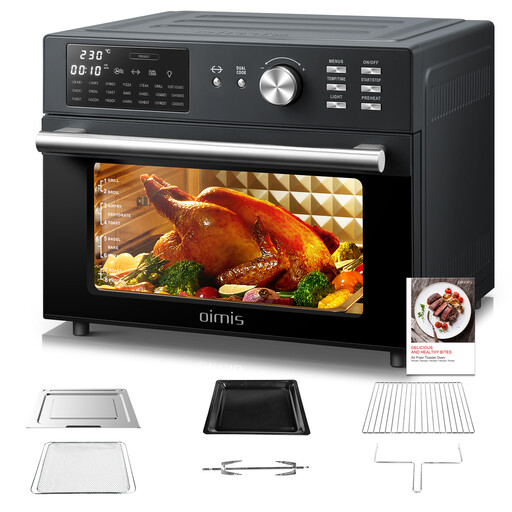
30 l; 1,800 W; 21 presets; rotisserie and dehydrator functions; specified for pizzas up to 13 inches.
No. The Federal Institute for Risk Assessment recommends keeping food that is actually being held hot at a temperature of at least 60 °C throughout. A heating method or the oven’s set temperature doesn’t confirm the temperature of the food, so check it as part of your planned routine.
Not necessarily. AEG distinguishes between fan-assisted cooking and fan cooking with a ring heating element, stating that the latter can be used on up to three levels. The specifications and instructions for the specific appliance are what matter; they don’t guarantee identical results on densely packed trays of pumpkin.
Check that the dimensions of the appliance and recess, connection requirements and included accessories for the specific model are suitable for your kitchen. Specifications for one model can’t be applied to other ovens.
The energy label for household ovens lets you compare specified standard cycles and also shows the oven capacity. It doesn’t state how much energy your portion size, cooking time or keep-warm period will use. Compare the specific kWh figures and take your routine into account.
No. When you buy as a consumer in Germany, you have statutory rights against the seller; a guarantee is an additional voluntary service with its own terms and conditions. If you’re considering an optional protection plan, check exactly what extra cover it provides.