
Lieferung heute & morgen

Qualitätsgarantie

Willkommens-Angebote freischalten: KOSTENLOSE Lieferung | Bis zu 80 % RABATT | Kostenlose 30-Tage-JoyPlus-Testphase
App herunterladen
Push-along toys for babies and toddlers should encourage movement, provide entertainment and suit the child’s stage of development. In practice, however, products are often bought that look appealing but are not stable enough for everyday use, quickly lose the child’s interest or are unsuitable for their age.
“From 1 year” is not a general recommendation for every child. What matters is whether the child can already sit independently, stand securely or walk unaided. A push-along walker is suitable for different stages of development than an activity centre for a seated baby or a movement toy for children aged 2 and over.
You should therefore check:
A push-along walker with activities may appear to offer plenty of features at first glance. However, it is important to consider whether the games develop different skills, such as grasping, turning, sorting, pushing or throwing. A simple, easy-to-reach developmental toy for toddlers may be more suitable for everyday use than an overloaded model with numerous electronic functions.
Wheels should move smoothly without allowing the toy to roll uncontrollably fast. Rubberised wheels can reduce noise and help protect delicate flooring. An adjustable brake is also useful on a doll’s pushchair designed for learning to walk, particularly if the child is not yet walking confidently. Before every use, check the screws, wheels, frame and connecting parts.
A stable push-along walker from 1 year should have a sufficiently wide base and an easy-to-reach handle. Check whether the product stands securely on the intended flooring and whether the handle is suitable for the child’s height. Compact dimensions make storage easier, but may limit the size of the base.
With a wooden push-along walker, rounded edges, a smooth surface and neatly finished wheels are important points to check. The material alone does not determine how practical a product is for everyday use. The overall construction, workmanship and manufacturer’s instructions are what matter.
An activity walker may include manual elements such as cogs, sliders or rotating components. Electronic models often require batteries. For example, the Chicco Multisport League requires two AA batteries, which are not included. Before buying, check whether the batteries will need to be replaced regularly and whether the electronic components may only be cleaned with a slightly damp cloth.
Toys for children aged 9 months to 5 years are often used on the floor and sometimes outdoors. Plastic surfaces can generally be cleaned with a soft, slightly damp cloth. Electronic parts must not be immersed in water. With every model, small parts, damaged wheels and loose components should also be checked immediately.
For children under 3, pay particular attention to small parts that could be swallowed. The manufacturer’s specific warnings are binding and should not be replaced by the general age recommendation.
The following selection groups the products according to different usage profiles. This makes it easier to identify whether a model is suitable for first steps, shared role play or active movement indoors and outdoors.
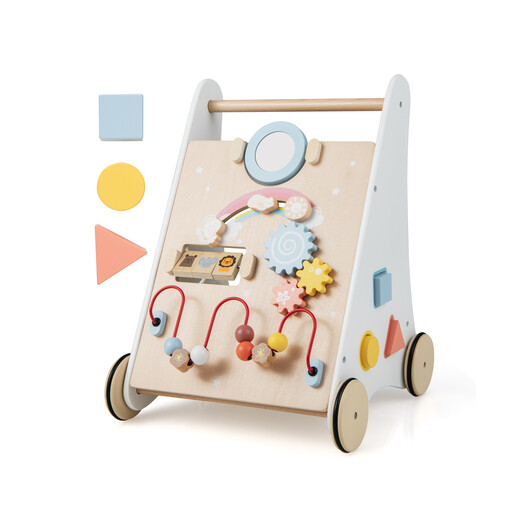
Why this product suits this profile: This wooden push-along walker is designed for children aged 12 months and over, combining a push-along function with seven integrated activities.
The age recommendation, overall dimensions of 34.5 × 32.5 × 45 cm and weight of 2.2 kg make it easier to assess whether it is suitable for your home.
Wooden construction, rubberised non-slip wheels, rounded edges and a basket for toys.
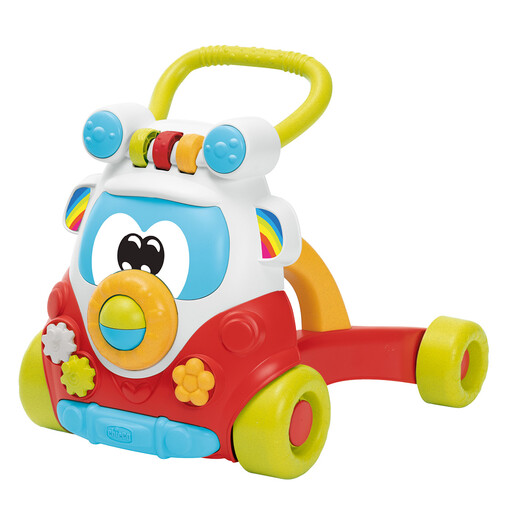
Why this product suits this profile: This Chicco push-along walker combines walking support with five manual activities and, according to the product information, is intended for children aged 9 to 24 months.
The clearly stated age range and weight limit of up to 20 kg, together with warnings about stairs, thresholds and sloping surfaces, define clear usage limits.
Four large wheels, manual games and BPA- and phthalate-free materials according to the product information.
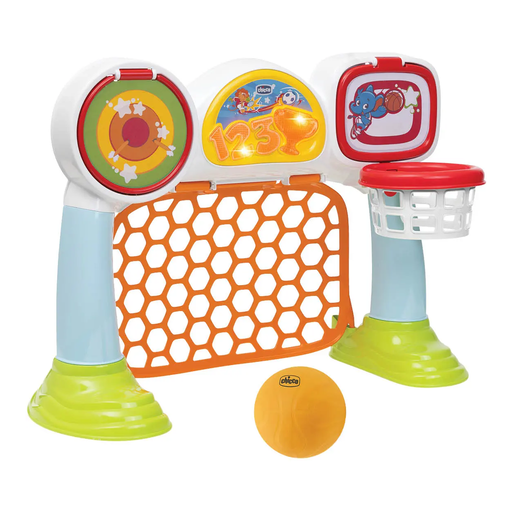
Why this product suits this profile: For children aged 2 to 5, this 3-in-1 activity game offers football, basketball and target throwing for indoor and outdoor use.
The age recommendation of 2 years and over prevents this movement toy from being mistakenly used as a walking aid for younger babies.
Three game modes, ball included, sensors with light and sound effects, and plastic suitable for indoor and outdoor use.
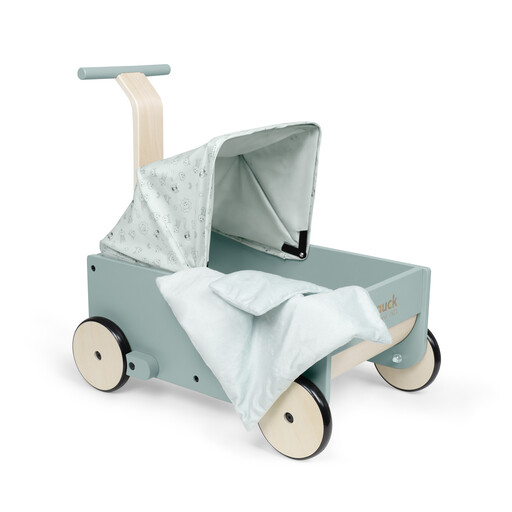
Why this product suits this profile: This doll’s pushchair for learning to walk is aimed at children who want to include their dolls or cuddly toys in active play.
The individually adjustable brake and height-adjustable handle, from 45 to 49 cm, allow the product to be adapted to the child’s confidence and ability.
FSC-certified wood according to the product information, rubberised wooden wheels, washable bedding and an adjustable handle.
Regardless of the model, parents, grandparents and carers should:
A baby walker with an activity centre can provide extra entertainment, but it is not a substitute for age-appropriate supervision. With electronic toys, the battery compartment and casing should also be checked regularly for damage.
We have put together a complete, regularly updated list of products that fully meet these strict selection criteria and the safety regulations applicable in the EU.
This depends on the individual model and the child’s stage of development. Some products are intended for children aged 9 months and over, while others are suitable from 12 months. The manufacturer’s information is decisive, as is the child’s ability to sit independently and pull themselves up securely.
The usable life depends on the age and weight limit, the design and the child’s interest. An activity centre may remain engaging while the child is seated, whereas a push-along walker is mainly used during the stage between pulling themselves up and walking confidently without support.
Electronic models may require batteries. The Chicco Multisport League requires two AA batteries, which are available separately. Models with manual activities only do not incur battery costs during use.