
Lieferung heute & morgen

Qualitätsgarantie

Willkommens-Angebote freischalten: KOSTENLOSE Lieferung | Bis zu 80 % RABATT | Kostenlose 30-Tage-JoyPlus-Testphase
App herunterladen
A pushchair accompanies many families for several years. Even so, buyers often pay for features that offer little practical benefit. A large hood is no substitute for good ventilation, a small folded size says nothing about how easy the pushchair is to handle, and suitability “from birth” must match the intended lie-flat position.
This guide explains which details you should check before buying a pushchair or buggy. The selection is based on clear, comparable data such as recommended age, weight limit, weight, folded dimensions, features and intended use.
A pushchair from birth should have an expressly approved lie-flat position or a separate carrycot. A backrest that is merely slightly reclined is not automatically suitable for newborns. The manufacturer’s usage instructions are what matter, not just the marketing statement on the product page.
With combination models, you should also check whether the carrycot is included or must be purchased separately. This affects the actual total price.
A compact pushchair may save space when folded but still have a wide frame in everyday use. Before ordering, you should therefore compare both sets of dimensions:
A foldable pushchair with a self-standing function can make storage easier. However, air travel is subject to the requirements of the relevant airline; dimensions described by the manufacturer as suitable for hand luggage do not guarantee that the item will be accepted for carriage.
“Up to 22 kg” normally refers to the permitted weight of the child. The shopping basket, changing bag and additional bags have their own load limits. These figures must not be added together unless the manufacturer expressly permits this.
With a pushchair up to 22 kg, the harness system, backrest, footrest and seat width are also important. Different limits may apply to each seat depending on the model. A twin pushchair or sibling pushchair should therefore be chosen according to the seat arrangement, approved ages and maximum load for both seats.
For babies, a flat lie-flat position or a suitable carrycot is a key criterion. A model with a pushchair with lie-flat position may be approved for use from birth, depending on its design. Buggies are often intended for use from around six months, once the child can sit unaided. The manufacturer’s specific age and weight information is decisive.
A reversible seat unit allows parents and children to face each other or lets the child face forwards. This is practical, but it is not available on every model.
A lightweight pushchair is easier to lift onto public transport or carry up stairs. Very compact travel buggies often have smaller wheels and less storage space than larger combination pushchairs. For cobbled streets, park paths or uneven pavements, you should consider wheel size, wheel material, front-wheel swivel and suspension.
A travel buggy often weighs considerably less than a sibling model. However, the seat may be narrower and the shopping basket may have less capacity. Your choice should therefore be based on your actual daily needs, not just the transport weight.
An adjustable sun canopy with a ventilation window can shield the seating area from the sun and wind. Information such as UPF 50+ describes the material’s stated UV protection; it is not a substitute for general sun protection.
Important features include:
An electric pushchair also requires careful attention to the battery, charger, brakes and the operating limits specified by the manufacturer. Electric assistance is no substitute for safe handling and should not be confused with a fully self-propelled drive system.
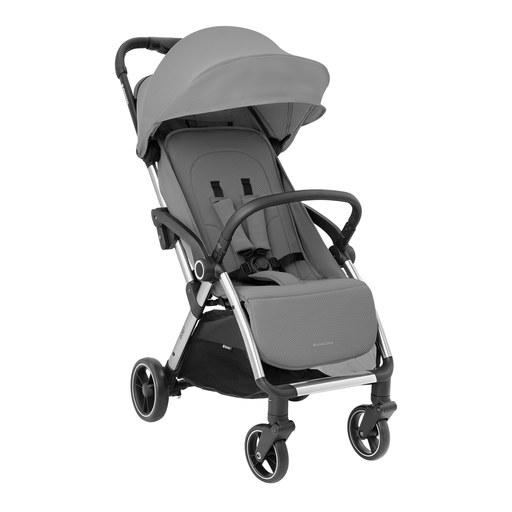
Why this product suits this profile: According to the product information, this buggy is suitable from birth up to 22 kg and combines a weight of 7.8 kg with an automatic one-touch folding system.
The specifications state both the lie-flat position and the folded dimensions. This makes it easier to assess suitability from birth and storage requirements.
4-position adjustable backrest, 2-position adjustable footrest, 360° front wheels and rain cover included.

Why this product suits this profile: According to the manufacturer, the modular system offers more than 20 combinations for one or two children and is designed for use from birth to around four years of age.
The data sheet lists the child weight and storage capacity separately: up to 22 kg per child and a total of 23 kg for the two baskets.
One-hand harness system, lie-flat position, adjustable handlebar and combinable seat or infant-carrier solutions.
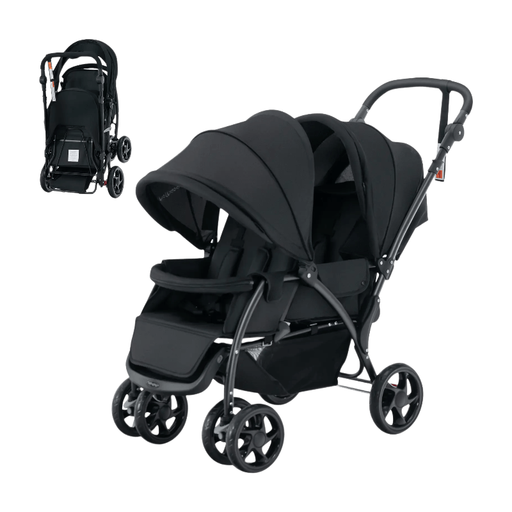
Why this product suits this profile: This model is designed for families with two young children and offers two seats with separate age and load specifications.
The front seat is specified for six to 36 months, while the rear seat is suitable from birth to 36 months. Each seat supports up to 15 kg.
Two 5-point harness systems, adjustable backrests and footrests, parking brakes and a foldable frame.
We have put together a complete, regularly updated list of products that fully meet these strict selection criteria and the safety regulations applicable in the EU.
That depends on the model. Many buggies are intended for use from around six months. For younger babies, consider a pushchair with a lie-flat position, a carrycot or an expressly approved combination system. The manufacturer’s information on the age range and seating position is decisive.
Many models are approved for use up to around four years of age or until the child reaches a specified weight. Depending on its design, a pushchair up to 22 kg may be used for longer than a model with a lower load limit. The harness, wheels, brakes, locks and fabric parts should be checked regularly for signs of wear.
In addition to the purchase price, you may need to pay for a rain cover, footmuff, car seat adapter, replacement wheels or additional seats. With an electric pushchair, you also need to consider charging times, battery care and, where applicable, a future battery replacement. It is therefore worth checking what is included and which accessories are available before buying.