
Lieferung heute & morgen

Qualitätsgarantie

Willkommens-Angebote freischalten: KOSTENLOSE Lieferung | Bis zu 80 % RABATT | Kostenlose 30-Tage-JoyPlus-Testphase
App herunterladen
A pushchair needs to do more than simply look good in everyday life in the UK. It should fit through narrow doorways, be easy to handle on public transport and offer your child a suitable seated or lying position depending on their age. At the same time, models can differ considerably in folded dimensions, weight, load capacity, suspension and accessories.
If you focus only on marketing claims such as “ultra-compact” or “suitable for all terrains”, you may overlook important details. Three common purchasing pitfalls are particularly relevant:
For a pushchair from birth, the manufacturer’s recommendation should be checked carefully. A combination pushchair with a carrycot and a later seat unit is designed to accommodate different stages of development. Models with a reversible seat unit also allow you to transport your child facing you at first and facing forwards later on.
For a buggy from around six months, a forward-facing seat unit is usually sufficient. An adjustable backrest and leg rest make everyday use more comfortable. A fully or almost flat position is particularly important if the manufacturer states that the model can already be used from birth.
A lightweight pushchair is easier to lift into the boot or carry up stairs. However, weight alone says little about how easy it is to handle. You should also check:
For air travel, a compact pushchair with a folded size suitable for hand luggage may be worth considering. However, you should still check the airline’s specific requirements before travelling.
An adjustable 5-point harness, a reliable parking brake and a sturdy safety bar are among the key features. Before every use, check the locks, harness, wheels and brakes. Children must not be left unattended in a pushchair.
A pushchair with a baby car seat adapter can make transitions between the car and pushchair easier. However, not every adapter is universally compatible. The brands and models explicitly listed are what matter. If accessories are sold separately, compare the costs and contents before buying.
The following selection categorises models not according to generalised quality judgements, but according to specific everyday situations and the available product information.
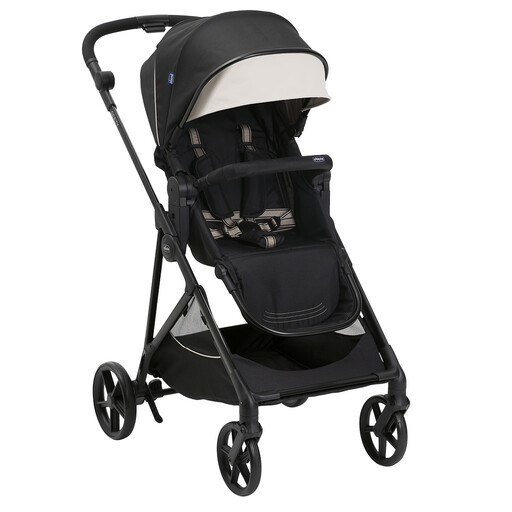
Why this product suits this profile: Designed for urban use, this pushchair combines a stated weight of approximately 7 kg with one-hand folding and an integrated carry handle.
The product information states that it can be used from birth to approximately four years of age and has a continuously adjustable backrest. This makes it easier to check the age suitability before buying.
50+ UV protection, water-repellent hood, mosquito net, plus shock absorbers and ball bearings on all four wheels.

Why this product suits this profile: This 2-in-1 set is designed for families looking for a carrycot and a later seat unit in one package.
The product information states that it can be used from birth up to 22 kg, offers two facing directions and includes a carrycot. This makes the key usage limits easier to understand.
Air-filled tyres, 4-point suspension, 50+ UV protection, mosquito net, footmuff, cup holder and car seat adapter according to the contents supplied.

Why this product suits this profile: This travel pushchair is designed to be lightweight and fold down particularly small.
The stated folded dimensions of 59 × 21,5 × 46,5 cm and weight of 5,5 kg make the transport specifications easy to verify. However, airline rules must still be checked separately.
One-hand folding, transport rucksack, fully adjustable backrest, 50+ UV protection and compatibility with the Chicco Kory i-Size car seat.

Why this product suits this profile: According to the product information, this modular pushchair is designed for one child, siblings or twins, with more than 20 configurations.
The maximum load capacity is specified separately: up to 22 kg in single mode and up to 2 × 22 kg in double mode. This makes it easier for growing families to plan ahead.
XXL storage space with a stated total capacity of 23 kg, flat lying position, 50+ UV protection and a compactly folding frame.
We have put together a complete, regularly updated list of products that fully meet these strict selection criteria and the safety regulations applicable in the EU.
This depends on its design and the stated load limit. Many models are designed for use up to around four years of age or up to 22 kg. The earlier point always applies: once the weight limit is reached or your child can climb out independently, the model should no longer be used.
A combination pushchair often includes a carrycot and a later seat unit, making it suitable for use from birth. A buggy is generally lighter and more compact, but is often intended for children from around six months. Models with a flat lying position may differ; in such cases, the relevant manufacturer’s recommendation applies.
Additional costs may include a baby car seat adapter, a separate baby car seat, replacement covers, rain accessories or new wheels. Air-filled tyres also require regular checks and may need to be pumped up from time to time. Before buying, it is worth checking the contents supplied, the availability of spare parts and the care instructions.