What should you look for when buying?
First, count the mains sockets you’ll need for your computer, screen and accessories. Then you can compare the specifications, devices you already own and potential future upgrades more effectively.
| Buying priority |
What to check |
Who is this important to? |
| Sockets for your study setup |
Count the plugs for your computer and screen together; only plan to power a device via USB if this is documented for the exact combination. |
If I want to run my computer and display using as few sockets as possible, I need to consider the complete setup. For around 36% of consumers, the number of sockets required is the top priority. |
| Get started without assembling hardware |
Check the installed operating system, RAM and SSD, as well as whether a keyboard and mouse are included with the exact version. |
If you don’t want to install components or an operating system before setting up Python, pay particular attention to what’s included. For around 29% of consumers, a computer that’s ready to use straight away is the main priority. |
| Keep using devices you already own |
Check that the video connections and cables are compatible with your monitor, and consider its power supply separately. |
If I want to keep using my monitor or input devices, their connections and power supply need to work with the setup I choose. For around 21% of consumers, reusing existing devices is the main priority. |
| Future upgrades |
Check the available and occupied memory slots, as well as the specifications for the exact model number. |
If you want to customise your computer later, distinguish between components already installed and possible upgrades. Around 14% of consumers put future changes to the specification first. |
Joybuy products for your study setup
The Joybuy picks below are mini PCs for study setups with an existing monitor. Before buying, check that the connections, operating system and specifications suit the setup you have in mind.
 No image available
SOYO Y5Pro Mini PC, Intel Core i5-8250U/8350U, 8 GB RAM, 256 GB SATA SSD
For a study setup with an existing monitor; you’ll need to connect the screen separately and provide its power supply.
Windows 11; two HDMI outputs and four USB ports are listed for this selection. The product name specifies Intel Core i5-8250U/8350U processor options.
Joybuy
 No image available
MaxMini B3 Mini PC, Intel N4100, 8 GB LPDDR4, 256 GB SSD
For a compact study setup with a separately connected monitor; remember to factor in its power supply.
The product name lists a processor speed of up to 2.4 GHz and two HDMI ports.
Joybuy
 No image available
BMAX B6 Mini PC, Intel Core i3-8109U, 12 GB RAM, 256 GB SSD
A mini PC option for learners who already have a suitable monitor and can connect it separately.
The product name lists HDMI and DisplayPort. You’ll need your own monitor to use it.
Joybuy
 No image available
BMAX B7A Plus Mini PC, AMD Ryzen 5 6600H, 12 GB LPDDR5, 512 GB NVMe SSD
For a study setup with an existing monitor; the mini PC doesn’t replace a screen.
The product name lists two HDMI outputs and two M.2 slots for NVMe drives.
Joybuy
 No image available
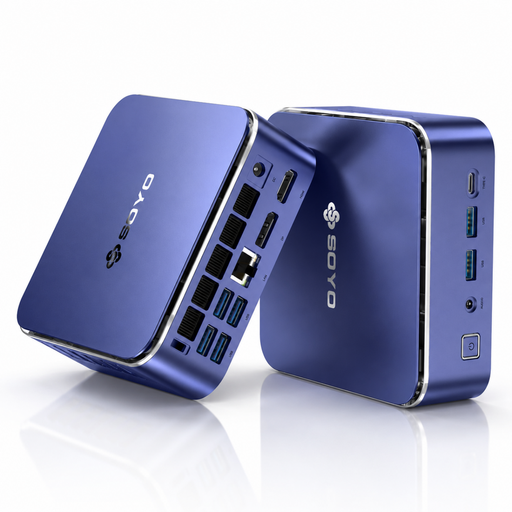
SOYO S5Air Mini PC, AMD Ryzen 5 7535HS, 16 GB LPDDR5, 512 GB NVMe SSD
For a workspace with an existing monitor, provided its video input is compatible with one of the listed connections.
Windows 11 Pro; listed connections include HDMI 2.0, DisplayPort 1.4 and a USB-C video output. A separate monitor is required.
Joybuy
Frequently asked questions
Do I need a particularly powerful desktop for my first Python exercises?
The published requirements for Visual Studio Code alone don’t suggest you do: Microsoft recommends a processor running at least 1.6 GHz and 1 GB RAM for the editor. Python is available for Windows, Linux and macOS; other programmes you use at the same time may have their own requirements.
Can I run my computer and screen from just one mains plug?
For the Raspberry Pi 500 and Raspberry Pi Monitor combination, Raspberry Pi documents that the monitor can be powered via a USB port on the Pi; brightness and volume are limited in this setup. You can’t assume the same applies to other mini PCs or monitors. With an all-in-one, the computer and screen are integrated into one device.
What should I consider before setting up when I have few sockets?
Count the mains sockets you’ll need, including those for the screen and power supplies. ELEKTRO+ warns against connecting several multi-socket extension leads to one another, as this can increase the risk of overloading and fire. If you’re consistently short of sockets, a qualified electrician can advise you on a suitable installation.
What are my rights if I buy a faulty product online in Germany?
For a consumer purchase from a trader, European Union consumer information states that you have a legal guarantee of at least two years from receiving the goods; this is separate from any voluntary manufacturer’s warranty. Distance purchases generally come with a 14-day right to cancel. Check the specific conditions and any exceptions before you buy.
What does the CE marking mean on a desktop PC?
The CE marking is the manufacturer’s declaration that a product complies with relevant requirements; it isn’t an independent quality mark. Within its area of responsibility, the German Federal Network Agency checks electrical and electronic equipment for matters including labelling, product identification and required documentation. For a specific device, check the marking and the associated information.


