
Lieferung heute & morgen

Qualitätsgarantie
App herunterladen
Kategorien
By a Joybuy Product Recommendation Officer
QD-OLED monitors combine the core advantages of OLED panels—self-emissive pixels for perfect blacks and infinite contrast—with Quantum Dot technology to achieve higher peak brightness and a wider color gamut. For gamers, this results in superior image quality, complemented by extremely fast response times, often under 0.1 milliseconds (ms). This combination addresses the key requirements of demanding PC gamers: visual precision and a responsive display.
Selecting the right model depends on an analysis of specific technical parameters. Your decision should be based on your primary use case and existing hardware, especially your graphics card.
The balance between resolution and refresh rate is a critical factor.
QD-OLED panels are characterized by a gray-to-gray (GtG) response time of typically 0.03 ms. This virtually eliminates all visible motion blur (ghosting). To prevent screen tearing, synchronization technologies like G-Sync (NVIDIA) and FreeSync (AMD) are essential. Models with "G-Sync Compatible" or "FreeSync Premium Pro" certification guarantee validated, smooth synchronization between the graphics card and the monitor.
An HDR Gaming Screen with QD-OLED technology benefits from its self-emissive pixels. The VESA DisplayHDR True Black 400 certification guarantees high dynamic range with deep blacks and precise highlights. High coverage of the DCI-P3 color space (often over 99%) ensures vibrant and accurate colors, which is beneficial for both gaming and media content creation.
Based on technical specifications and intended use cases, we have analyzed the following models.
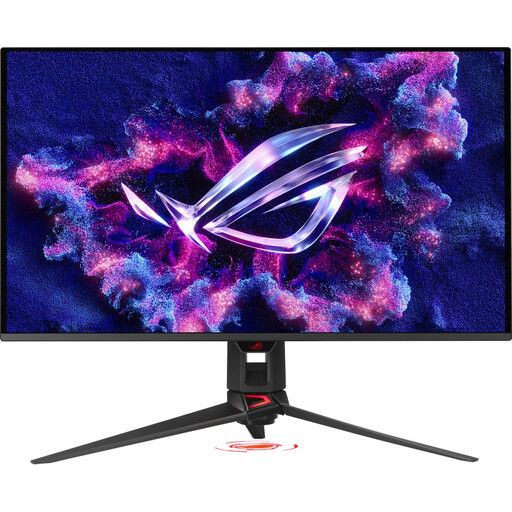
Why We Recommend This Product The ASUS ROG Swift OLED PG32UCDMR is an option for users who want to make no compromises between resolution and speed. The combination of 4K UHD resolution and a 240 Hz refresh rate on a 32-inch panel delivers high visual fidelity for immersive single-player titles, while also providing the fluidity needed for fast-paced games. Its versatile connectivity, including DisplayPort 2.1 and HDMI 2.1, ensures compatibility with current and future hardware.
Pros
Who It's For PC enthusiasts and gamers with a high-end graphics card who are seeking the pinnacle of visual quality in 4K without sacrificing a high refresh rate.
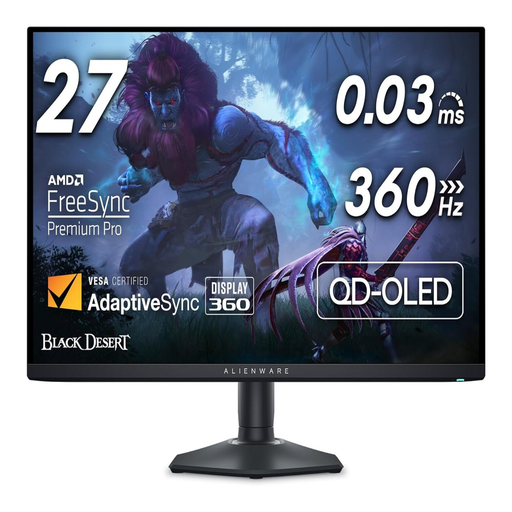
Why We Recommend This Product The Alienware AW2725DF is engineered specifically for competitive gaming. Its 360 Hz refresh rate at QHD resolution (2560x1440) minimizes system latency and enables extremely smooth motion rendering. Combined with its 0.03 ms response time, this monitor provides the technical foundation for rapid reactions in esports titles. AMD FreeSync Premium Pro and VESA AdaptiveSync ensure a tear-free visual experience.
Pros
Who It's For Esports professionals and competitive players for whom maximum refresh rate and minimal response time are top priorities to gain an edge in fast-paced multiplayer games.
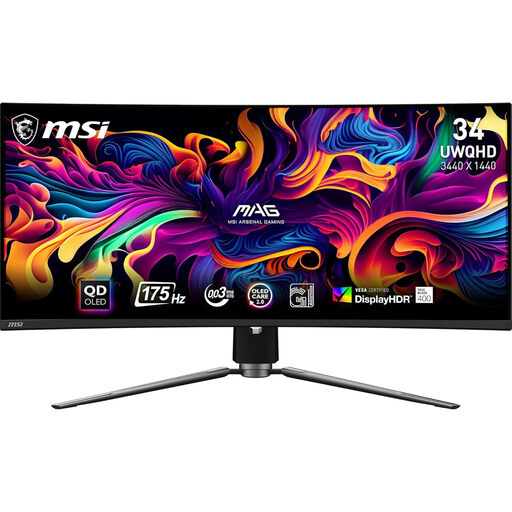
Why We Recommend This Product With its 34-inch, 21:9 panel and an 1800R curvature, the MSI MAG 341CQPDE offers an immersive widescreen experience. The UWQHD resolution (3440x1440) strikes an excellent balance between image sharpness and performance demands. With a 175 Hz refresh rate and 0.03 ms response time, the monitor is well-suited for fast-paced games, while its wide format truly shines in simulations and open-world titles.
Pros
Who It's For Gamers seeking the most immersive experience and who want to leverage the wider field of view in genres like racing sims, flight simulators, RPGs, or strategy games.
The models presented here cover specific use cases. If you are looking for different sizes, resolutions, or specific features that better suit your needs, you will find a wider selection of devices in our main category. The decision to buy a gaming monitor should always be based on a balance of personal preferences and technical requirements.
Discover All QD-OLED Monitors on Joybuy.de
What is the difference between QD-OLED and conventional OLED (WOLED)? QD-OLED panels use a blue OLED light source, which passes through a layer of Quantum Dots to be converted into red and green light. This allows for high color purity and brightness without the need for a white sub-pixel. WOLED (White OLED) panels use white OLEDs with color filters, which can result in slightly lower color volume at high brightness levels.
How can you prevent burn-in on a QD-OLED monitor? Modern QD-OLED monitors have built-in protection mechanisms. These include "Pixel Refresh" cycles, which run automatically or manually after a certain period of use to compensate for pixel aging. "Pixel Orbiting" or "Pixel Shift" moves the image imperceptibly by a few pixels to vary static image elements. Features like automatic brightness reduction for static logos (Logo Detection) also contribute to panel longevity.
Is a 4K 240Hz gaming monitor worth it? A monitor with 4K resolution and a 240 Hz refresh rate is aimed at users with extremely powerful hardware. To achieve frame rates near 240 fps in current games at 4K resolution, an absolute top-of-the-line graphics card (e.g., an NVIDIA GeForce RTX 4090 or a successor model) is required. For users who have the necessary GPU and want to combine the highest visual fidelity with maximum fluidity, this class of monitor represents the pinnacle of current technology.