
Lieferung heute & morgen

Qualitätsgarantie

Willkommens-Angebote freischalten: KOSTENLOSE Lieferung | Bis zu 80 % RABATT | Kostenlose 30-Tage-JoyPlus-Testphase
App herunterladen
Selecting a new television requires an analysis of technical specifications tailored to specific use cases like gaming or home cinema. A QLED 4K TV combines several key technologies to meet these demands: high resolution, enhanced colour reproduction through Quantum Dots, and modern connectivity. This article breaks down the crucial parameters to consider when choosing such a device for 2026.
A television's performance is determined by the synergy between its panel, processor, and connectivity. For demanding users, the following criteria are of particular importance.
A high native refresh rate is essential for the fluid display of fast motion, as seen in video games or sports broadcasts. Models with 144Hz offer visibly smoother visuals than the 60Hz standard. In combination with HDMI 2.1, other features relevant to gamers are enabled:
A dedicated Game Mode or "Game Bar" consolidates these settings and provides quick access to game-relevant information such as the current frame rate (fps) or VRR status.
A 4K UHD TV has a resolution of 3840 x 2160 pixels, ensuring high image sharpness and detail. QLED (Quantum Dot Light Emitting Diode) technology uses a layer of nanocrystals (Quantum Dots) to convert the light from an LED backlight into purer primary colours. This results in higher colour volume and greater brightness compared to conventional LCD TVs.
HDR (High Dynamic Range) formats are crucial for the contrast range. Dolby Vision and HDR10+ are dynamic formats that provide metadata for each individual scene or even frame, allowing for optimal adjustment of brightness and colour values. This leads to a more nuanced representation in very bright and very dark areas of the image.
Modern televisions are media hubs. A Smart TV with Google TV integrates content from various streaming services into a centralised interface and provides personalised recommendations. The integration of Google Assistant enables voice control for searching content, managing TV functions, or operating compatible smart home devices.
In addition to HDMI 2.1, connectivity includes dual-band Wi-Fi for stable streaming connections and Bluetooth for connecting headphones or external speakers.
While slim TVs often have limited space for speakers, technologies like Dolby Vision Atmos enhance the audio experience by simulating three-dimensional, object-based sound. Some models integrate high-quality speaker systems, sometimes with a dedicated subwoofer, developed by audio specialists like Onkyo.
A frameless TV maximises the screen area and blends seamlessly into the living space. Adjustable stands also offer placement flexibility, for example, to position a soundbar underneath the unit.
Based on the aforementioned technical criteria, we present three models that cover different requirements for size and feature sets.
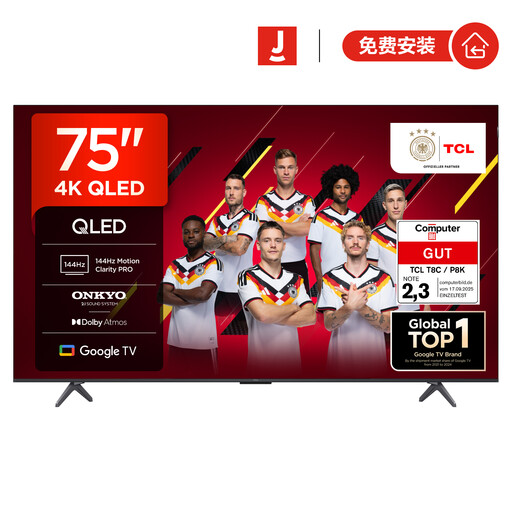
Why we're featuring this product: This model combines a large 75-inch screen diagonal with a comprehensive feature set for gaming and home cinema. Its native 144Hz refresh rate and full HDMI 2.1 support make it a high-performance choice for demanding applications.
Technical Features:
Who it's for: Users seeking an immersive experience on a large screen who want to leverage both current-gen game consoles and high-resolution film and series content with maximum performance.
View Product: TCL 75T8C 75-inch

Why we're featuring this product: The CHiQ U43QM10E offers the core benefits of QLED technology in a compact 43-inch size. It's an excellent option for rooms with limited space, without sacrificing key smart TV and essential gaming features.
Technical Features:
Who it's for: Users looking for a secondary TV for a bedroom or office, or those wanting a cost-effective entry into the 4K QLED world with a full-featured smart TV system.
View Product: CHiQ U43QM10E 43-inch
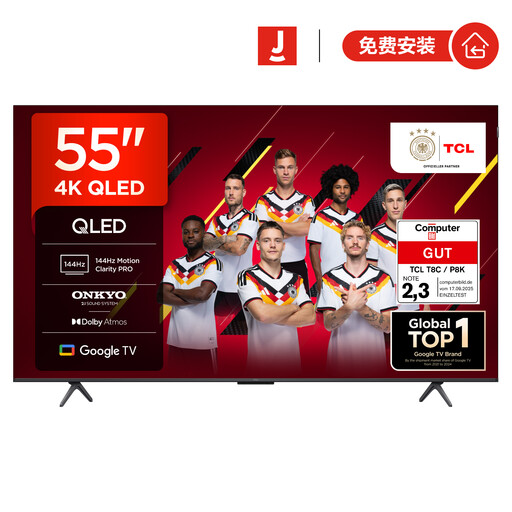
Why we're featuring this product: This model offers the identical high-end technology of the 75-inch model in the highly popular 55-inch size. It represents an excellent balance of screen size and technical features for most living rooms.
Technical Features:
Who it's for: Users who demand high technical performance for gaming and home cinema in a standard living room size and are unwilling to compromise on refresh rate and connectivity.
View Product: TCL 55T8C 55-inch
If the featured models do not precisely meet your requirements for size or specific functions, the market offers a wide range of alternatives. Different panel technologies and feature variations allow for a precise match to your individual usage profile.
Discover more models in our Smart HD TVs category.
1. What is the advantage of 144Hz on a QLED 4K TV? A 144Hz refresh rate allows for the display of 144 frames per second. This results in significantly smoother and sharper motion compared to the 60Hz standard. This particularly benefits fast-paced video games by improving response time and reducing motion blur, as well as enhancing the viewing experience for sports broadcasts.
2. Do I absolutely need a TV with HDMI 2.1 for gaming? To unlock the full potential of modern game consoles (PlayStation 5, Xbox Series X) and high-performance gaming PCs, HDMI 2.1 is essential. Only this standard provides the necessary bandwidth to transmit 4K signals at 120Hz or 144Hz, as well as for features like VRR (Variable Refresh Rate) and ALLM (Auto Low Latency Mode). Without HDMI 2.1, playback is typically limited to 4K at 60Hz.
3. What is the difference between QLED and OLED? The two technologies differ fundamentally in how they generate light. QLED TVs use an LED backlight, the light from which is filtered through a layer of quantum dot nanoparticles to create colours. This allows for very high peak brightness and a large colour volume. OLED (Organic Light Emitting Diode) TVs, on the other hand, use self-emissive pixels that can be turned on and off individually. This results in perfect black levels and an infinite contrast ratio, as there is no backlight bleed.