What to look for when buying
Built-in oven for whole cakes
A good fit if: you have a suitable kitchen space and regularly bake a whole cake in a springform tin.
Things to consider: The oven’s dimensions and connection must be suitable for your kitchen; a claim of multi-level fan cooking doesn’t in itself prove that it will bake a single cake well.
Larger countertop oven for a whole springform cake
A good fit if: you don’t have space for a built-in oven but want to bake a whole cake. Rommelsbacher says the BG 1805/E can accommodate tins up to 31.5 cm in diameter.
Things to consider: Rommelsbacher requires a surface at least 55 cm wide for this model, including the feet; other requirements depend on the appliance.
Compact countertop oven for smaller tins
A good fit if: you’re baking smaller quantities or using smaller tins, and you’ve checked their dimensions against the oven’s capacity. Severin gives the TO 2068 a capacity of around 20 litres.
Things to consider: Severin specifies minimum clearances of 12 cm at the sides and rear, and 30 cm above the TO 2068. Always check the instructions for the specific model you’re considering.
| Priority |
What to check when buying |
Who it matters most to |
| Baking to the recipe |
Check for fan and conventional heating, and make sure you can set the temperature to suit the recipe. |
When I bake a tall quark cheesecake, I want to be able to set the heating function and temperature according to the recipe. Around 33% of consumers prioritise being able to bake to the recipe. |
| Tin and available space |
Measure your tin and compare it with the usable interior dimensions; for countertop ovens, also check the footprint and required clearances. |
When I need to use a whole springform tin, I want to know that it will fit in the oven with the required clearance, and that the oven will fit in the space I’ve chosen. Around 27% of consumers prioritise tin fit and kitchen space. |
| Suitable baking capacity |
Decide on the tin and number of portions you need, and consider the usable baking area and the oven’s internal height. |
When I’m preparing cake portions for several lunch breaks, I want to choose an oven size that suits the amount I actually need. Around 20% of consumers prioritise a suitable portion size. |
| Energy use and cleaning |
For ovens covered by energy-labelling requirements, compare consumption per standard cycle and check the appliance’s cleaning method and accessories. |
When I use my oven regularly, energy information and the work involved in cleaning up after baking both matter to me. Around 20% of consumers pay particular attention to energy use and cleaning. |
Dr. Oetker gives different temperature ranges for cheesecake depending on the heating function, and a baking time of around 50–80 minutes. The German Environment Agency and the German Consumer Advice Centre explain that the energy information on the label relates to standardised cycles; it isn’t a measure of energy use for your specific recipe.
Joybuy product selection
The Joybuy appliances below include built-in ovens and a compact fan oven for smaller baking projects. Before buying, check that your tin dimensions, installation requirements and recipe needs are compatible with the model you choose.
 No image available
Bosch HBA571BB4 Series 2 built-in oven
An option for regular baking in a built-in oven, provided you have a suitable space.
71-litre capacity; 3D Hotair; pyrolytic self-cleaning; AutoPilot 10. Specified niche dimensions: 560–568 mm wide, 585–595 mm high and 550 mm deep.
View at Joybuy
 No image available
Comfee built-in oven, 60 cm, 70 l
A built-in option for fan-assisted baking, provided the appliance fits your existing space.
Listed in the product name: 70 l, 3 kW, AquaClean steam cleaning, LED display with timer and energy class A. Described as a 60 cm built-in oven.
View at Joybuy
 No image available
Bosch HBG578ES3 Series 6 multifunction oven
Another built-in option, provided the dimensions are right and the listed features suit the way you bake.
Listed in the product name: 60 cm wide, 3D Hotair, AirFry and pyrolytic cleaning.
View at Joybuy
 No image available
Haier H6 ID23T3HTB built-in oven, 78 l
For larger baking projects in a built-in oven, provided your space and installation are suitable.
Listed in the product name: 78 l, 9 cooking functions and energy class A+. Specified niche dimensions: 590 × 560 × 560 mm; a suitable power supply and installation are required.
View at Joybuy
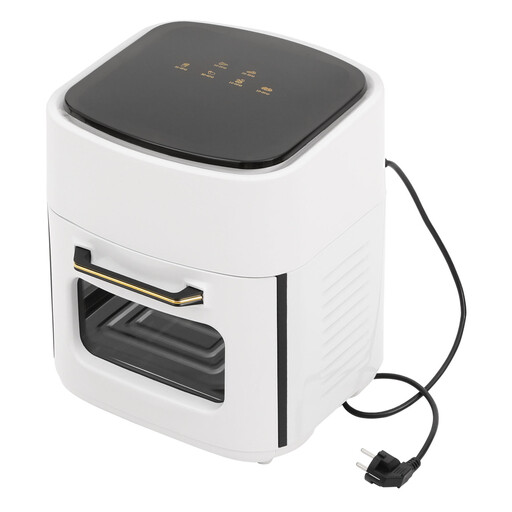 No image available
15-litre smart air fryer oven, 1,400 W
Described as a compact appliance for smaller baking projects; check that your tin fits the oven before buying.
Listed in the product name: 15 l, 1,400 W, 360° fan heating and a baking function. The timer runs for up to 65 minutes; Dr. Oetker’s recipe calls for around 50–80 minutes of baking, so you may need to reset the timer for longer bakes.
View at Joybuy
Frequently asked questions
Does quark cheesecake have to be baked using the fan setting?
No. Dr. Oetker gives instructions for its cheesecake recipe using both conventional and fan heating, with different temperature ranges for each. Follow the recipe and use the heating function available on your oven, rather than applying one fan temperature to every cake.
Can I put the cake portions in my lunchbox in the morning without chilling them?
Plan to keep them chilled until they’re ready to eat. The German Federal Institute for Risk Assessment points out that inadequate temperatures during transport and storage can allow harmful bacteria to survive and multiply. It doesn’t provide a general safe time limit for keeping quark cheesecake portions unrefrigerated.
What should I check before setting up a freestanding oven?
Check the instructions for the specific model and measure the space where you plan to put it. Severin specifies a minimum clearance of 12 cm at the sides and rear, and 30 cm above the TO 2068. Rommelsbacher requires a surface at least 55 cm wide, including the feet, for the BG 1805/E; these requirements don’t automatically apply to other appliances.
How can I compare the energy use of different ovens?
For ovens covered by energy-labelling requirements, compare the standardised energy consumption per cycle and check the heating function used. The German Environment Agency explains that the energy label also shows the efficiency class and oven capacity; the standard figure isn’t a measure of energy use for your particular cheesecake.
Does a countertop oven need the same EU energy label as a built-in oven?
Not every countertop oven is covered by the energy-labelling rules for domestic ovens. The European Commission lists small and portable ovens as exempt. The absence of this label on a suitable countertop appliance doesn’t, by itself, show that it uses more energy.


