For a quick breakfast with as little salt as possible, start by comparing the salt content per 100 g of each porridge, rather than relying on a claim such as ‘reduced salt’. Preparation time and portion size will then help you decide whether a mix is convenient on the go. Check that the ingredients, allergens and other nutritional values suit the specific variety.
Who is this comparison useful for?
Shoppers who compare salt content first
If you’re short on time in the morning and want to keep an eye on your salt intake, you can compare porridges using the nutritional information per 100 g. Preparation instructions will then help you decide whether a product is suitable for your commute, the office or university.
Those looking for individual portions or protein
A single-portion pack can be a deciding factor when you’re on the go. If you’re also comparing protein content, check the salt content of your chosen variety separately: a protein claim won’t tell you how much salt it contains.
Shoppers with specific ingredient requirements
If you need to avoid milk, almonds or particular grains, for example, check the ingredients list and the allergen and may-contain information for the specific variety. A low salt content doesn’t replace these checks.
What should you look for when buying?
First, compare salt levels using the same basis. Then check that the preparation method and ingredients suit your breakfast routine.
| Criteria |
What to check |
Who it matters to |
| Salt content |
Compare salt per 100 g on the same basis; for portioned products, also consider the amount you’ll actually use. |
If I mainly want to limit my salt intake, I need a comparable figure rather than a marketing claim. Around 45% of consumers would choose salt content as their most important purchase criterion. |
| Preparation and portion size |
Check the soaking time, whether it can be prepared with cold or hot liquid, and the pack format. |
For breakfast on the go, the preparation method needs to work with the time and liquid I have available. Around 33% of consumers would consider this practical aspect first. |
| Ingredients and nutritional values |
Read the ingredients list and allergen and may-contain information; compare sugar and protein per 100 g if needed. |
If I want to avoid certain ingredients or compare sugar and protein, the salt content alone isn’t enough. These requirements would be the main priority for around 22% of consumers. |
Common misconceptions
-
Assuming ‘reduced salt’ means a low salt content
A reduced-salt claim refers to comparable products. On its own, it doesn’t tell you how much salt your chosen porridge contains.
Also check the salt content per 100 g and compare products on the same basis.
-
Taking ‘no added salt’ to mean ‘salt-free’
A product can still contain salt even if none has been added, as shown in the nutrition table. Kölln lists 0.04 g of salt per 100 g for its Fruit Oat Porridge.
Use the recipe information as an additional guide, but make your decision based on the salt content.
-
Choosing a protein porridge based on its protein claim alone
Seitenbacher lists 30 g of protein for its Chocolate Protein Porridge, but it also contains 0.2 g of salt per 100 g. The protein content doesn’t tell you how much salt it contains.
Check the protein, salt, sugar and ingredients of the specific variety separately.
-
Overlooking allergen and may-contain information
Porridge mixes can differ in their ingredients and may-contain information. The product category alone won’t tell you whether a variety meets your requirements.
Before buying, read all the information on the pack you’ve chosen.
Brands to help you choose
Kölln
Kölln offers porridge mixes as well as a high-protein range. It’s worth comparing the specific variety and pack format when deciding which to choose.
- Kölln says no salt is added to its Fruit Oat Porridge, although the declared salt content is 0.04 g per 100 g.
- For the high-protein range, check the salt content and ingredients of your chosen variety separately.
Seitenbacher
Chocolate Protein Porridge is a useful point of comparison if you’re looking at protein and sugar as well as salt.
- Seitenbacher declares 30 g of protein per 100 g for this variety.
- The same variety contains 0.2 g of salt and 19 g of sugar per 100 g. A protein claim doesn’t mean the product is low in salt.
REWE Beste Wahl / REWE Bio
Apple Cinnamon Porridge and Bio Basic Porridge show why it’s worth comparing salt content, preparation and ingredients for each variety.
- REWE lists 0.01 g of salt per 100 g for Beste Wahl Apple Cinnamon and 0.02 g per 100 g for Bio Basic. REWE also gives instructions for preparing Apple Cinnamon with cold liquid, with a soaking time of three minutes.
- Bio Basic contains almonds, spelt and barley, among other ingredients. Check the ingredients for the specific variety you choose.
EDEKA Herzstücke
Haferhimmel Berry Porridge has a declared salt content and preparation instructions for milk or water.
- EDEKA24 lists 0.02 g of salt per 100 g and a preparation time of five minutes for this variety.
- This variety may contain traces of other ingredients. Check the labelling if you need to avoid certain ingredients.
Products for breakfast
This selection includes porridge mixes and oats that can be used as a base for porridge. For a quick breakfast, compare the preparation instructions and salt content on the same basis, as well as the ingredients.
 No image available
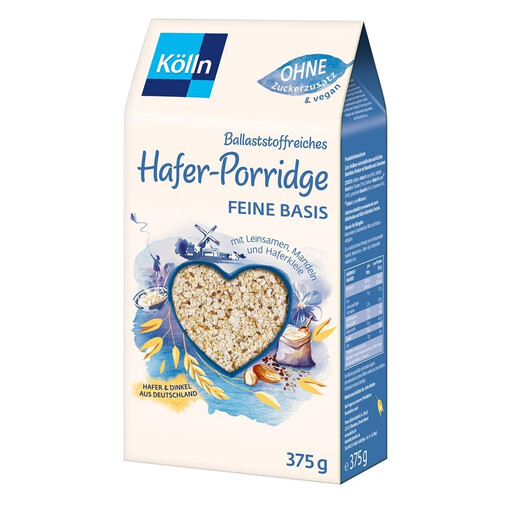
Kölln Pure Rolled Oat Porridge 375 g
A porridge base for anyone who wants to create their own mix. If you’re planning to take it with you, check the preparation instructions, ingredients and allergen information on the pack.
View on Joybuy
 No image available
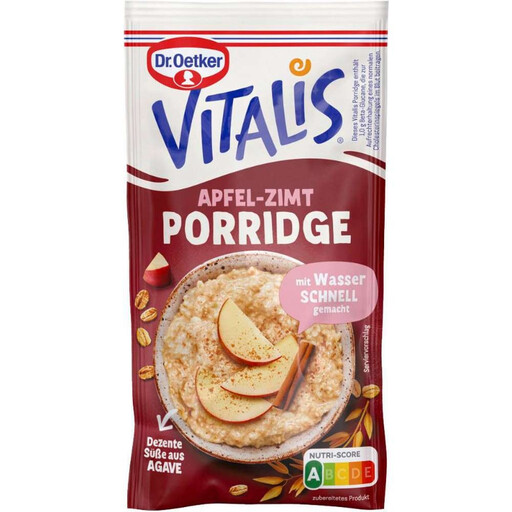
Dr. Oetker Vitalis Apple & Cinnamon Porridge 58 g
The 58 g pack is an option if you prefer a measured breakfast portion. Compare its salt content directly with other mixes only if the figures refer to the same preparation method, and check the pack format too.
View on Joybuy
 No image available
Kölln Fine Rolled Tender Oat Flakes 500 g
Fine oats for making your own porridge. Whether they fit into your morning routine depends on the instructions on the pack and what you can manage when you’re on the go.
View on Joybuy
 No image available
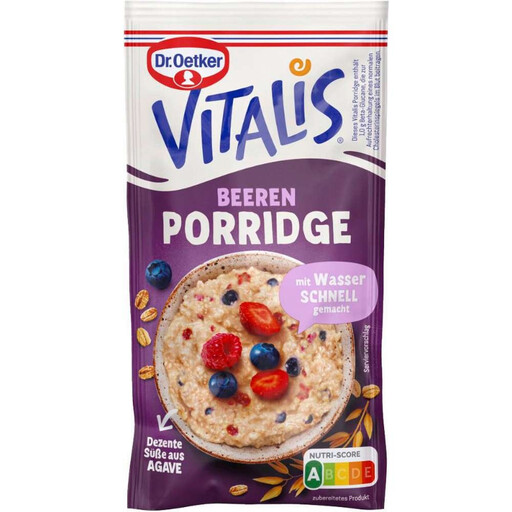
Dr. Oetker Vitalis Berry Porridge 53 g
The 53 g pack may suit you if you want a set breakfast portion. Before comparing salt content, check whether the nutrition information on the pack refers to the dry or prepared product.
View on Joybuy
 No image available
Kölln Coarse Rolled Oat Flakes
Coarse oats for making your own porridge. Before buying, check the pack weight and preparation instructions, especially if you need a specific quantity or are planning breakfast on the go.
View on Joybuy
Frequently asked questions
Is porridge with no added salt automatically salt-free?
No. ‘No added salt’ doesn’t necessarily mean the salt content is 0 g. Kölln describes its Fruit Oat Porridge as made without added salt, while also listing 0.04 g of salt per 100 g. The nutrition table is what matters when comparing products.
What does ‘reduced salt’ mean on porridge?
It indicates a reduction compared with similar products; it doesn’t in itself mean the product has a particularly low salt content. Lebensmittelklarheit explains the difference between these types of salt claims. Also compare the salt content per 100 g on the same basis.
Can I prepare porridge cold when I’m on the go?
Yes, if the mix is designed for it. REWE gives instructions for preparing Beste Wahl Apple Cinnamon Porridge with cold liquid, with a soaking time of three minutes. For other varieties, follow their own preparation instructions.
Is protein porridge automatically lower in salt?
No. The protein content doesn’t tell you how much salt the product contains. Seitenbacher lists 30 g of protein and 0.2 g of salt per 100 g for its Chocolate Protein Porridge. Compare both figures for the variety you’re thinking of buying.


