
Lieferung heute & morgen

Qualitätsgarantie

Willkommens-Angebote freischalten: KOSTENLOSE Lieferung | Bis zu 80 % RABATT | Kostenlose 30-Tage-JoyPlus-Testphase
App herunterladen
The search for a new vacuum cleaner can quickly become overwhelming. Especially when the requirement is "quiet," many encounter vague marketing promises and technical data that confuse more than they clarify. A loud appliance not only disrupts household peace but can also be an indicator of inefficient technology. This guide will help you identify the crucial features and avoid common purchasing pitfalls, enabling you to make an informed decision for a quiet bagged vacuum cleaner.
Before we turn to the solutions, it's important to understand the most widespread misconceptions that often lead to a poor purchase.
To avoid the pitfalls mentioned above, you should focus your attention on three objective metrics. These provide reliable information about the actual performance and convenience of a device.
The noise level of a vacuum cleaner is measured in decibels (dB). The scale is logarithmic, which means a reduction of 10 dB is perceived as a halving of the loudness.
Pay attention to the official manufacturer's specification. A quiet bagged vacuum cleaner should ideally have a value below 70 dB.
For allergy sufferers and health-conscious households, a canister vacuum with a HEPA filter is a sensible choice. HEPA stands for "High-Efficiency Particulate Air."
The operating radius determines how much area you can clean from a single power outlet. A value of 10 metres or more is comfortable for most apartments and houses. Also, pay attention to the included accessories. A parquet nozzle protects delicate hard floors, while a mini turbo brush effectively removes pet hair from upholstery.
Here are some models tailored to specific needs that meet the criteria mentioned above.
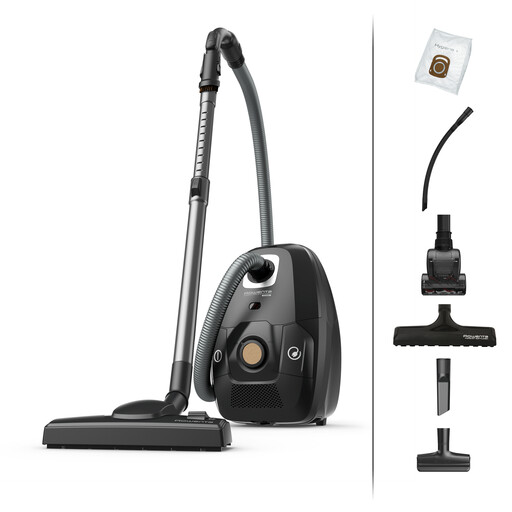
Why it's a great fit: This model combines extremely quiet operation with a HEPA filtration system and a very large operating radius, making it ideal for noise-sensitive households and allergy sufferers with large living spaces.
With a power consumption of just 400 watts, it debunks the wattage myth. The HEPA filtration (99.98% according to the manufacturer) ensures clean exhaust air, and the 12-metre operating radius prevents frequent outlet switching.
Exceptionally quiet at only 64 dB. Large 4.5-litre dust bag for less frequent changes.
Why it's a great fit: The Rowenta RO6189 is an excellent choice for removing pet hair from carpets and upholstery, thanks to the included mini turbo brush and sofa nozzle. Its quiet operation is also less likely to disturb sensitive pets.
Specialised accessories ensure effective cleaning where it's needed, rather than relying on raw wattage. The HEPA filtration reliably captures pet allergens.
Includes a mini turbo brush for pet hair removal and a parquet nozzle for delicate floors.
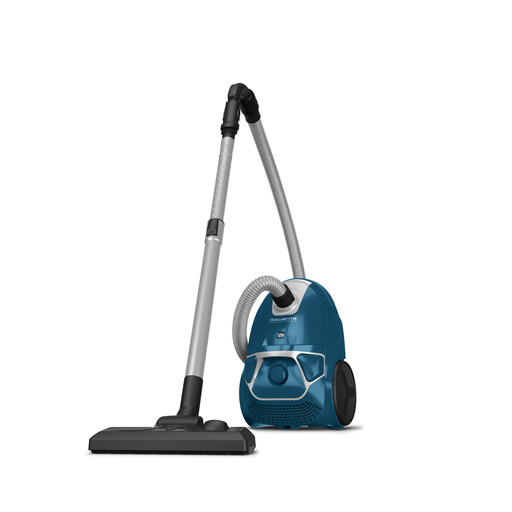
Why it's a great fit: This compact model offers a solid set of basic features for cleaning hard floors and carpets. It's a pragmatic choice for small to medium-sized apartments where budget is a key factor.
At 79 dB, it's not whisper-quiet, but the value is clearly declared, allowing for an informed decision. The 8.8-metre operating radius is sufficient for many apartments and prevents frustration from a cord that's too short.
Compact design and an included parquet nozzle for gentle cleaning of delicate hard floors.
We have compiled a complete, up-to-date list of products that fully meet these strict selection criteria and German safety regulations.
The frequency depends on usage, household size, and the presence of pets. Most devices have a bag-full indicator. To maintain consistently high suction power, it is recommended to change the bag when it is about two-thirds to three-quarters full. Models with a large bag capacity (e.g., 4.5 litres) require less frequent changes.
Yes. Modern motor technology and an aerodynamically optimised nozzle design are more crucial for suction power than the raw wattage number. An energy-efficient motor can achieve high cleaning performance with significantly less electricity. Therefore, don't rely on the wattage rating, but on the combination of the motor, nozzle, and filtration system.
Even for non-allergy sufferers, a HEPA filter noticeably improves indoor air quality. It captures fine dust, bacteria, and other microscopic particles that simpler filters cannot retain. The result is fresher air and less dust settling back onto furniture after vacuuming.