Lieferung heute & morgen

Qualitätsgarantie

Willkommens-Angebote freischalten: KOSTENLOSE Lieferung | Bis zu 80 % RABATT | Kostenlose 30-Tage-JoyPlus-Testphase
App herunterladen
There is a special quality to the silence of a warm summer afternoon. Light streams through the tall windows of a period apartment, dust motes dance in the sunbeams, and the world seems to pause for a moment. In these moments, every sound is amplified—the ticking of a clock, the distant murmur of the city. The heat that gathers in the rooms demands a solution, yet the thought of disturbing this tranquillity with the monotonous drone of a fan feels out of place. The quest for coolness thus becomes a search for balance: how can one achieve thermal comfort without compromising the acoustic harmony of the space?
The answer lies in a deeper understanding of air circulation and the technology that drives it. A traditional fan often moves air directly and turbulently. The result is a cooling effect, but one that is confined to a limited area and accompanied by a constant operational noise. A modern, thoughtfully designed approach pursues a different goal: the gentle, even circulation of all the air in the room. This is where the air circulator comes into play. Instead of just blowing air, it creates a coherent airflow that reflects off walls and ceilings, thereby creating a continuous, barely perceptible circulation throughout the entire room. This equalises temperature differences and creates a pleasant climate without producing a direct, strong breeze.
The crucial component for a quiet fan is the motor. Devices with direct current (DC) motors are often the preferred choice here. They are not only an energy-efficient fan compared to their alternating current (AC) counterparts, but they also allow for more precise control over rotational speed. At low settings, they can produce a noise level that, according to manufacturer specifications, is below 25 decibels on some models—a value comparable to the rustling of leaves. This characteristic makes them an ideal solution for a bedroom fan or in environments requiring concentration.
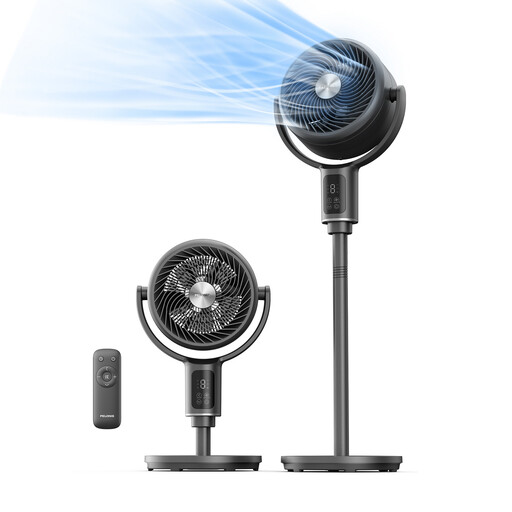
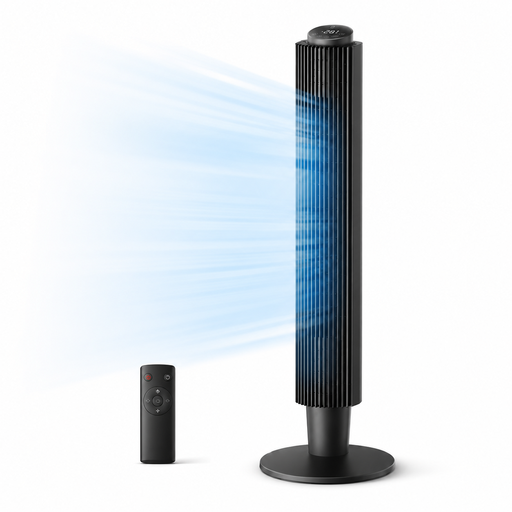
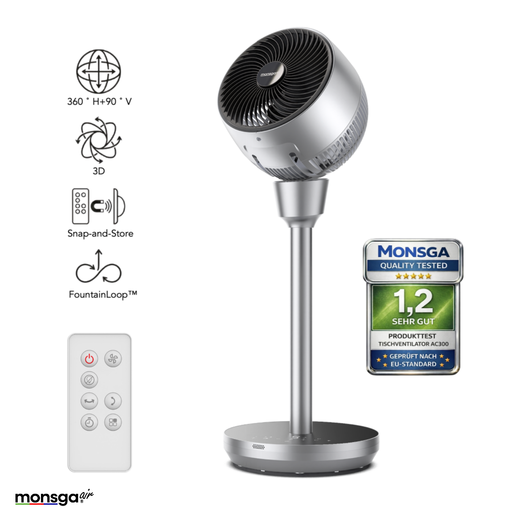
The form of the device also plays a role. A slim tower fan that operates quietly integrates discreetly into the living space and often distributes air along a vertical axis. A classic pedestal fan designed to be quiet, on the other hand, offers flexibility in height and tilt. An oscillating fan that moves horizontally or even vertically ensures dynamic air distribution and prevents any single spot in the room from becoming overly cooled. The thoughtful combination of motor, blade design, and oscillation mechanism defines the quality and effectiveness of a modern air circulator.
Selecting a fan today is less a purely technical decision and more a curatorial one. It's about finding an object that seamlessly fits into the aesthetics and functional requirements of a space. For environments where an unobtrusive presence is desired, models like the Haverland HYPE_K Pedestal Fan are an excellent choice. Its minimalist white design and twelve speed settings allow for fine-tuning of the airflow, while it remains visually in the background. Similarly understated, but with a vertical orientation, is the AIRMATE Ultra-Quiet Slim Tower Fan, whose slim form is particularly advantageous in smaller rooms or offices.
In spaces where the design object itself is meant to be a statement piece, other solutions can be found. The ProfiCare 40 cm Floor Fan in matte black metal evokes classic industrial design, becoming a functional statement on the floor of a loft or a creatively designed workspace. It deliberately forgoes digital displays, focusing instead on robust materials and a clear design language. The Dyson Cool CF1 Table Fan takes a completely different approach. Its bladeless technology is not just a safety feature but also an expression of technological innovation. The airflow is accelerated through a narrow ring, which creates a smooth, consistent breeze. According to Dyson, it operates in sleep mode with minimal noise, qualifying it for the bedside table.
The most advanced devices combine multiple functions to holistically improve the indoor climate. An example is the ProfiCare Fan with Humidifier, which uses ultrasonic technology to generate a fine mist. This combination of air movement and humidification can further enhance well-being on dry summer days. Control of such devices is often managed via a discreet fan with a remote control, allowing adjustments to be made from a desk or bed without interrupting the quiet of the moment.
For those who wish to explore a broader selection of objects designed according to these principles, the complete directory of High-Velocity Floor Fans offers further inspiration.