
Lieferung heute & morgen

Qualitätsgarantie

Willkommens-Angebote freischalten: KOSTENLOSE Lieferung | Bis zu 80 % RABATT | Kostenlose 30-Tage-JoyPlus-Testphase
App herunterladen
The search for effective cooling on warm days often leads to a compromise: you either endure the heat or the loud hum of a fan. A noisy fan can be particularly disruptive in a bedroom or office, where concentration and quiet are essential. This article serves as a guide to help you find a pedestal fan that operates silently while providing pleasant air circulation. We will introduce various models and their key features to help you make an informed decision.
When choosing a quiet fan, some technical specifications are more important than others. Instead of relying on marketing claims, objective criteria help in assessing the actual performance and noise level.
A fan's loudness is measured in decibels (dB). A lower dB value means quieter operation. Levels around 20-30 dB are considered very quiet, comparable to a whisper or the ticking of a watch, making them ideal for a bedroom fan.
A crucial factor for noise generation is the motor type. Many modern, quiet fans use a DC motor fan. Compared to conventional AC motors, DC motors are often not only quieter but also more energy-efficient and allow for more precise control over speed settings.
An oscillating fan distributes air evenly throughout the room with sweeping movements, rather than blowing at a single point. Modern devices often offer 3D oscillation, which combines both horizontal and vertical movements to ensure comprehensive air circulation.
Additional convenience is provided by features such as a fan with a remote control or a timer function. A smart fan can even be controlled via an app or voice command (e.g., through Alexa or Google Assistant), enabling seamless integration into a modern home environment.
Some models are referred to as an air circulator. Unlike a classic fan that primarily creates a direct airflow, an air circulator is designed to move the entire volume of air within a room. This helps to balance the room temperature and can support the efficiency of air conditioners or heaters by distributing tempered air more effectively.
Here is a selection of models that stand out for their specific features and meet different requirements.
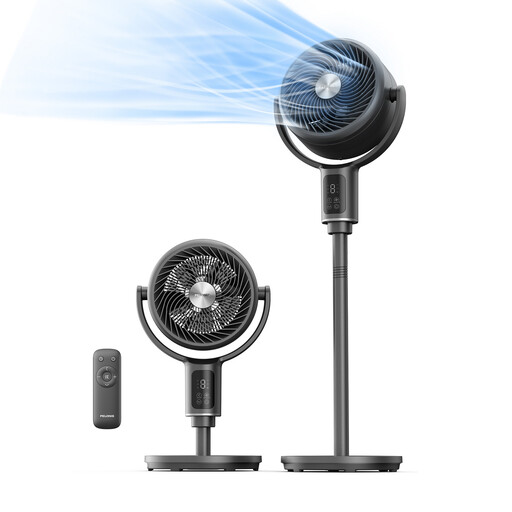
Why it stands out: This model combines very quiet operation with powerful air circulation. The energy-efficient DC motor allows for an operating noise of just 20 dB on its lowest setting, making it an excellent choice for noise-sensitive environments.
Key Benefits:
Best suited for: Individuals looking for an extremely quiet yet powerful pedestal fan for the bedroom or living room, who value the convenience of a remote control and flexible settings.
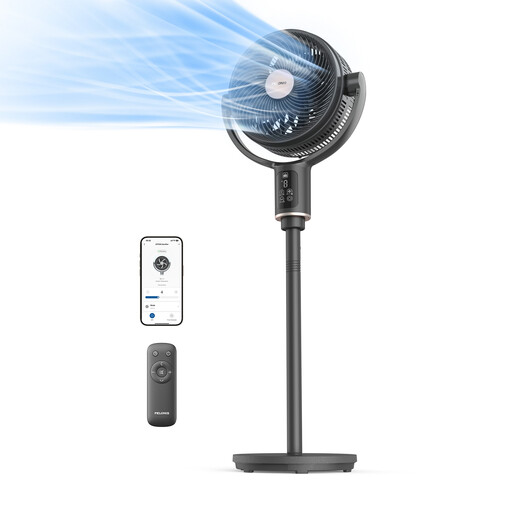
Why it stands out: As a smart fan, this model can be fully integrated into a smart home system. Control via app or voice command offers maximum convenience. The patented dual-blade technology ensures a powerful yet pleasant airflow.
Key Benefits:
Best suited for: Tech-savvy users who want seamless integration into their smart home and are looking for a versatile, powerful fan that can be used as both a pedestal and a table fan.
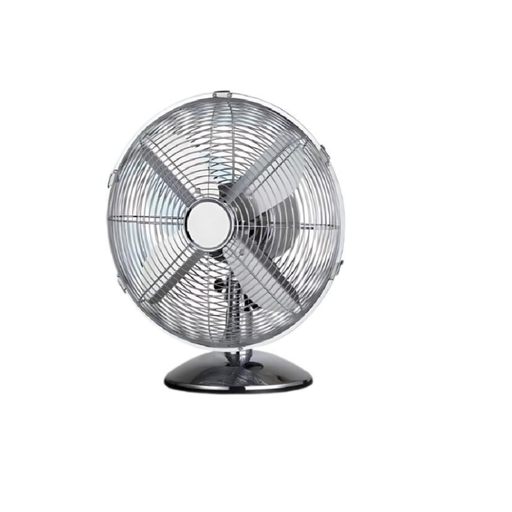
Why it stands out: While not a pedestal fan, this model is a durable and compact alternative for direct use at a workstation or on a bedside table. The all-metal housing and aluminium blades give it excellent durability and a classic design.
Key Benefits:
Best suited for: Users who prefer a durable, straightforward, and stylish cooling solution for a localised area like a desk or workbench and do not require a pedestal fan.
The selection of fans is vast, and individual needs vary. If the models presented here don't quite match your requirements, you may find a suitable alternative in our broader assortment.
Discover more models in our selection of bladed fans and find the solution that perfectly fits your needs.
Decibel (dB) is the unit of measurement for sound pressure level, i.e., loudness. For fans, the dB value indicates how loud the device is during operation. A lower number signifies a quieter noise. For reference: 20 dB is equivalent to a soft whisper, while 50 dB is similar to a normal conversation. For a quiet fan, values below 35 dB on the lowest setting are recommended.
Yes, as a rule, fans with DC (direct current) motors are quieter than those with AC (alternating current) motors. This is due to their construction, which generates less friction and vibration. Additionally, DC motor fans are often more energy-efficient and offer more speed settings, allowing for finer adjustment of airflow and volume.
For use in the bedroom, several features are particularly useful: