
Lieferung heute & morgen

Qualitätsgarantie

Willkommens-Angebote freischalten: KOSTENLOSE Lieferung | Bis zu 80 % RABATT | Kostenlose 30-Tage-JoyPlus-Testphase
App herunterladen
The search for a new mechanical keyboard can quickly become overwhelming. Manufacturers advertise a wide array of features, but not all of them actually enhance the typing or gaming experience. Certain marketing terms often obscure practical drawbacks that only become apparent after purchase. This guide will help you identify the crucial features and avoid common purchasing traps, enabling you to make an informed decision.
Before we dive into the important specifications, let's look at two widespread issues that often lead to disappointment:
To make a future-proof choice, you should carefully examine three technical aspects. These fundamentally determine the performance, typing feel, and longevity of your keyboard.
A modern Tri-Mode keyboard should offer three stable connection types, each optimised for different scenarios:
The way the PCB is mounted inside the case has a significant impact on the typing sound and feel. A Gasket Mount structure is a hallmark of higher-quality models. Instead of screwing the PCB directly to the case (Tray Mount), it is clamped between gaskets made of silicone or Poron. This isolates vibrations and creates a more cushioned, softer, and acoustically consistent typing experience. It reduces harsh bottom-out and provides greater comfort during long typing or gaming sessions.
A hot-swappable keyboard offers the freedom to customise the typing feel by swapping out the mechanical switches. Ensure that the PCB supports both 3-pin and 5-pin switches to guarantee the widest selection of future upgrades. Equally important is a full German QWERTZ layout, especially if the keyboard will also be used for productivity tasks. A model with a number pad is often advantageous for data entry or for assigning macros in games.
Here are some models that represent a considered choice for different user groups based on the criteria mentioned above.
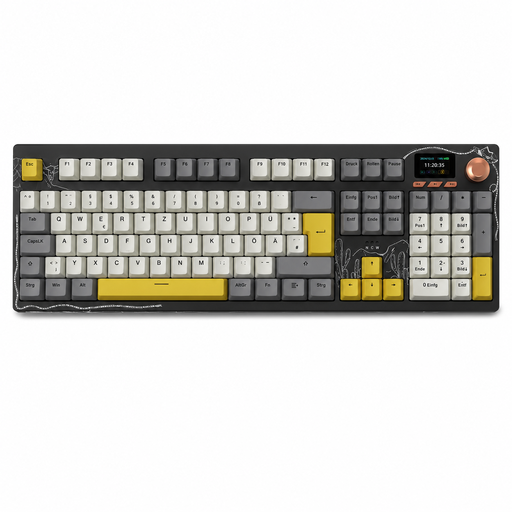
Why It's a Match: This model is ideal for users who want a single keyboard for both productive work and demanding gaming. The full German QWERTZ layout with a number pad, flexible Tri-Mode connections, and Gasket Mount structure cover all the bases.
The keyboard offers a dedicated 2.4 GHz connection for latency-free gaming, thus bypassing the issue of unreliable Bluetooth connections. Its hot-swap capability is clearly specified, and the integrated TFT display serves as a useful status indicator, not just a gimmick.
The combination of a full German layout, a Gasket Mount structure for a pleasant typing feel, and a functional display is a rare find in this form factor.
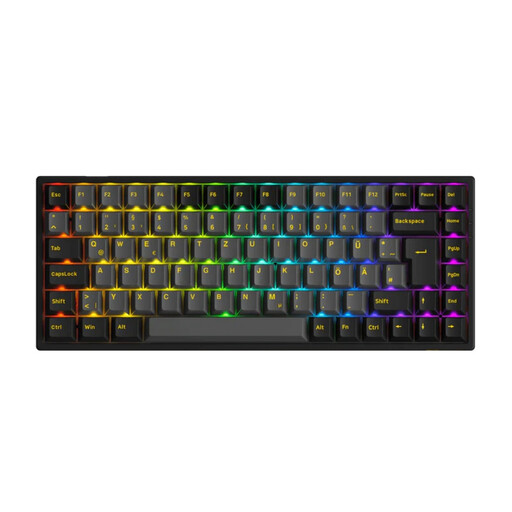
Why It's a Match: Perfect for users who value a clean desk but don't want to compromise on functionality. The compact 75% layout (ISO-DE) saves space while retaining the essential function keys. Ideal for a minimalist setup with Mac or Windows.
The product description clearly states that it supports both 3-pin and 5-pin switches, avoiding the trap of limited hot-swap compatibility. The focus is on core features like high-quality keycaps and switches rather than superfluous gimmicks.
The combination of durable PBT double-shot keycaps and factory-lubed Akko V3 Cream Yellow Pro switches provides a premium typing experience right out of the box.
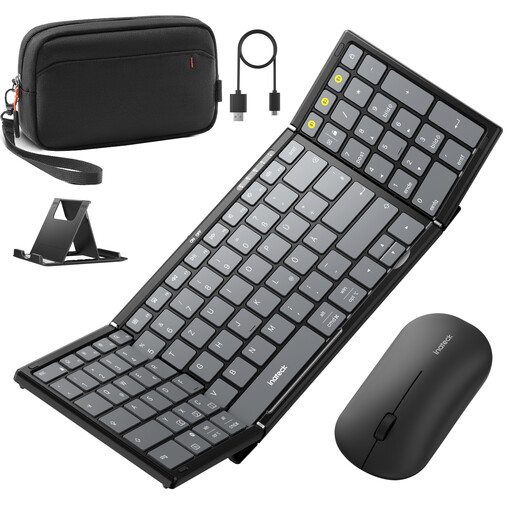
Why It's a Match: This set is designed for users who work on the go with tablets, smartphones, and laptops. The foldable keyboard with a full QWERTZ layout including a number pad, the included mouse, stand, and carrying case create a complete mobile office.
This product has a clear focus on portability and multi-device productivity. It doesn't try to be a high-end gaming keyboard, thus avoiding the trap of exaggerated promises. Its functionality is geared towards practical, on-the-go use.
A complete, thoughtfully designed kit for mobile work. The integration of a number pad into a foldable keyboard is a significant advantage for productivity on the move.
We have compiled a complete, up-to-date list of products that fully meet these strict selection criteria and German regulations.
1. What is the difference between a Gasket-Mount and a Tray-Mount keyboard? In a Tray-Mount keyboard, the PCB is screwed directly into the bottom case. This is a rigid construction that transmits vibrations directly and can lead to a harsher typing feel. With a Gasket-Mount design, the PCB is "suspended" between gasket materials (like silicone or foam). This isolates the PCB from the case, dampens vibrations, and creates a softer, quieter, and more consistent typing experience.
2. Can I use any mechanical switch with any hot-swap keyboard? No, not necessarily. Compatibility depends on the PCB. Most mechanical switches have either 3 or 5 pins. 3-pin switches are the basic standard. 5-pin switches have two additional plastic legs that provide better alignment and stability on the PCB. A PCB that only supports 3-pin switches cannot accommodate 5-pin switches unless you clip off the extra plastic legs. A PCB with 5-pin support is more flexible as it can accept both types.
3. How important is the polling rate on a wireless mechanical keyboard for gaming? The polling rate, measured in Hertz (Hz), indicates how often the keyboard sends its status information to the computer. A higher rate means lower input lag. For gaming, a polling rate of 1000 Hz (1 millisecond response time) is the standard. On a wireless mechanical keyboard, it's crucial that this rate is achieved in 2.4 GHz mode. In Bluetooth mode, the polling rate is often lower (e.g., 125 Hz), which is sufficient for office work but not ideal for fast-paced gaming.