
Lieferung heute & morgen

Qualitätsgarantie

Willkommens-Angebote freischalten: KOSTENLOSE Lieferung | Bis zu 80 % RABATT | Kostenlose 30-Tage-JoyPlus-Testphase
App herunterladen
A race track is more than just a toy – it's a gateway to thrilling duels, creative construction, and hours of driving fun. But the selection is vast and overwhelming. Many well-intentioned gifts quickly turn out to be bad purchases that bring more frustration than joy. As your Joybuy Product Recommendation Officer, I'll help you navigate the common pitfalls and make an informed decision that perfectly matches the recipient's needs.
Before we dive into the details, let's identify the costliest mistakes made when purchasing a toy race track. Avoiding these is the first step toward making the right choice.
To avoid these traps, focus on three objective criteria. These will help you see through the marketing hype and assess a set's technical suitability.
The most fundamental decision concerns the system. The classic slot car track, like a Carrera track, guides the vehicles in a slot. This allows for high speeds and precise racing. A further distinction is made here:
Alternatively, there are systems like the Hot Wheels track, where the cars roll more freely or are accelerated by boosters. Here, the focus is often on creative track construction. The scale (e.g., 1:43 or 1:24) determines the size of the cars and the track's footprint. Larger scales offer more detail but also require significantly more space.
For a race track for ages 3 and up, simple, ergonomic hand controllers that fit well in small hands are crucial. The speed control should not be too sensitive. For a remote-controlled race track for older children or adults, more precise controllers are needed that allow for fine-tuned control of speed and braking. Also, check how complex the track assembly is. Simple click-together systems are better for children than delicate connections that can easily break or come loose.
A good kids' car race track must be durable. Pay attention to the quality of the plastic and the stability of the track connectors. Wobbly tracks or uneven transitions lead to constant interruptions as cars get stuck or lose contact. Sturdy supports for flyovers and curves are also a hallmark of quality that ensures long-lasting fun.
Instead of making a one-size-fits-all recommendation, we have selected sets for different user profiles. This way, you can find the perfect gift for boys and girls, from toddlers to demanding hobbyist racers.
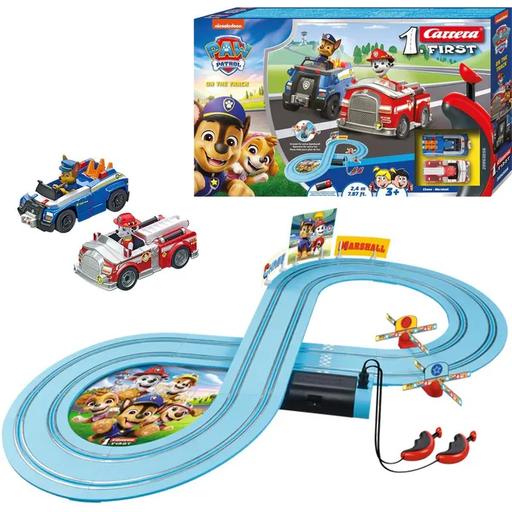
Why This Fits Their Persona: This set is specially designed for children aged 3 and up. The popular Paw Patrol characters create instant recognition. Assembly is straightforward, and the controls are tailored to the motor skills of young children.
It bypasses the complexity trap by being precisely targeted at its audience. The ergonomic hand controllers and moderate speed prevent frustration. Battery operation ensures safety without a mains plug.
Strong thematic connection through a well-known license. Robust, child-friendly construction. Long playtime of up to 6 hours per set of batteries (according to the manufacturer).

Why This Fits Their Persona: For kids who prefer building and experimenting over just racing. This set puts creativity front and centre. It's all about designing and testing new, daring track layouts again and again.
It solves the problem of incompatibility and lack of expandability. The entire Track Creator system is modular and designed to be combined with countless other Hot Wheels sets.
Promotes problem-solving skills and creativity. High replay value due to unlimited building possibilities. Compatible with the vast Hot Wheels universe.
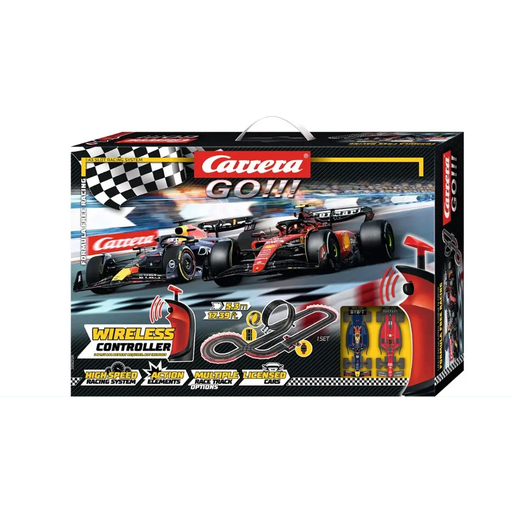
Why This Fits Their Persona: Ideal for primary school children and older fans who love real motorsport. With Formula 1 cars, a challenging track with a loop, and wireless controllers, this set offers an authentic racing experience.
It's challenging enough to avoid being underwhelming, thus sidestepping the trap of being too simple a toy. The Carrera GO!!! system is also widespread and extremely expandable, which rules out the incompatibility trap.
Wireless hand controllers for maximum freedom of movement. Challenging track design with a loop for a lasting challenge. Licensed Formula 1 vehicles.
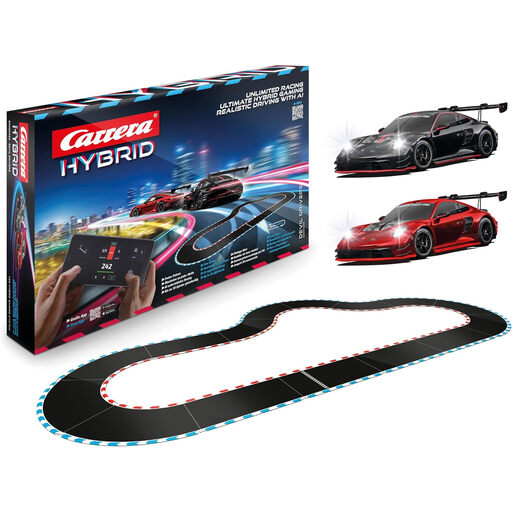
Why This Fits Their Persona: For teenagers and adults looking for a bridge between physical toys and digital technology. This set enables AI-assisted, free-roaming driving even off the track and is controlled via a smartphone app.
This is a premium hobby-grade system that completely bypasses the 'cheap toy' trap. It's a long-term investment in a state-of-the-art racing system that continuously gains appeal through app updates and virtual tuning options.
Innovative hybrid technology with AI support. Intuitive controls and virtual settings via app. Multiplayer function for up to 16 drivers for large-scale racing events.
We have compiled a complete, up-to-date list of products that fully meet these strict selection criteria and rigorous safety standards.
1. How much space does a car race track need? The space requirement depends heavily on the scale and the set. A Carrera First track for toddlers often only needs about 1 x 0.5 metres. A larger Carrera GO!!! or Digital 132 track can quickly take up an area of 2.5 x 1.5 metres or more, especially with long straights and many curves. Measure the available space before buying and check the assembled dimensions in the product description.
2. Are Carrera, Hot Wheels, and other systems compatible with each other? As a rule, no. Each manufacturer has its own track system and often different scales as well. Carrera GO!!! (1:43 scale) is not compatible with Carrera Digital 132/124 (1:32/1:24 scale). Hot Wheels tracks are also a standalone system. It is advisable to stick with one brand and product line to ensure compatibility and expandability.
3. What is the difference between an analogue and a digital race track? On an analogue track, each lane has its own electrical circuit. Only one car can run per lane. This is the classic, straightforward mode, ideal for beginners and direct head-to-head races. On a digital track, multiple cars (often up to 6) can race on the entire track simultaneously. Using special switches, drivers can change lanes at the push of a button to overtake. Digital systems are more expensive and complex, but they offer a more tactical and realistic racing experience.