
Lieferung heute & morgen

Qualitätsgarantie

Willkommens-Angebote freischalten: KOSTENLOSE Lieferung | Bis zu 80 % RABATT | Kostenlose 30-Tage-JoyPlus-Testphase
App herunterladen
A race track for children can bring together imaginative play, learning about vehicles and racing together. But products vary considerably, from simple ramps to electronic race tracks and portable transporter sets. For parents and family members, the number of toy cars isn’t the only thing that matters.
Three common buying mistakes can often lead to disappointment:
If you’re looking for a children’s race track for everyday play, consider how it works, how much space it needs, its materials, storage and safety all together.
For a race track for children aged 3 and over, the warning on the product page and packaging is what matters. Small vehicles, road signs, connectors and accessories can pose a choking risk to younger children. The label ‘not suitable for children under 3 years’ isn’t a judgement on quality; it’s an important safety warning.
For children aged 3 to 5, simple ramps, push-along vehicles and sturdy connecting pieces are usually easier to use. Older children, from around age 6, can often manage more complex track layouts, remote controls or slot-car systems. For electronic models, parents should also check the battery compartment, automatic shut-off and supervision requirements.
A race track often looks more compact in product photos than it does when fully assembled. So check:
A flexible race track or a foldable transporter is handy for smaller homes, travel and changing play areas. By contrast, a track that stays assembled with several bends needs a suitable space of its own.
Toy race tracks use different types of propulsion. Friction-powered toy cars move when pushed and don’t need batteries. This keeps running costs down and makes them easy to use. Electronic race tracks, on the other hand, can offer lights, music, sensors or motorised vehicles, but they need batteries and regular checks to make sure everything works.
Check the product details for the number of batteries required, what’s included and whether you’ll need spares. For example, the Carrera system requires two AAA batteries for the wireless controllers; according to the product details, these aren’t included. Other sets need AA batteries, which may also be sold separately.
The selection below groups different types of play by common everyday situations. The details are based on the respective product descriptions and don’t replace checking the latest safety information before you buy.
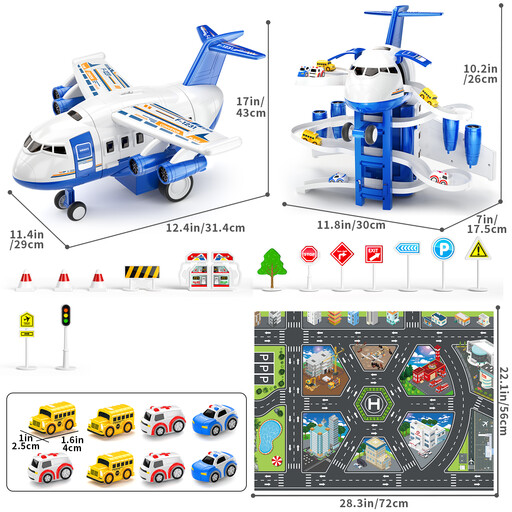
Why this product suits this type of buyer: This aeroplane play set combines storage, a city play mat and two-level slides. It’s a good choice for families looking for a versatile race track toy for younger children.
The eight vehicles can be stored inside the aeroplane. This keeps everything together after play, so you don’t have to search for accessories separately.
Includes eight small vehicles, a play mat and a convertible race track. According to the product description, the vehicles move when pushed.

Why this product suits this type of buyer: The track offers several layout features, two different vehicles and sensors that trigger sounds and melodies. It’s a good fit for families who prefer a structured electronic play system.
The product description lists 11 sensors, automatic shut-off and a secure battery compartment. Be sure to check the specific warnings before buying.
Includes a start-finish line, tunnel, S-bend and two vehicles. The product details state that four AA batteries are included.
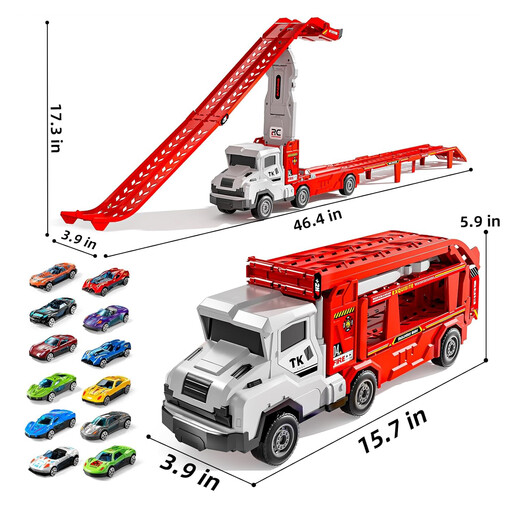
Why this product suits this type of buyer: The transporter doubles as a vehicle, storage and a two-lane race track. This makes it handy for regular set-up and pack-away, as well as playing together.
The foldable design helps solve the common problem of limited space. The two separate lanes allow two or four players to race, depending on the set-up.
Includes 12 vehicles and two fold-out race tracks. According to the product description, it works without batteries.
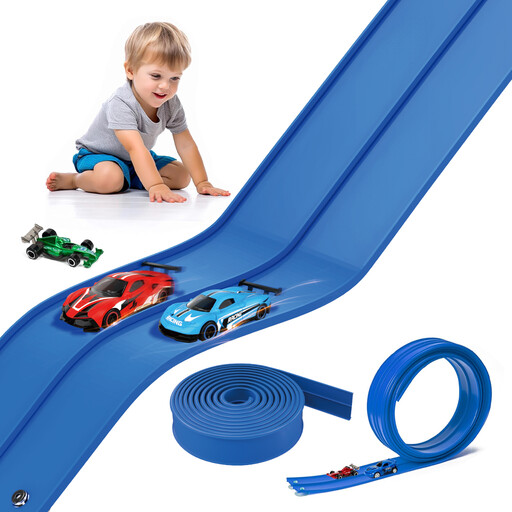
Why this product suits this type of buyer: The soft, roll-up double track can be used to create straight sections, bends and loops. It’s ideal for children who like changing their race track themselves.
According to the product details, the track extends to 4.5 metres and can then be rolled up again. This makes it easy to store when it’s not in use.
Includes four friction-powered vehicles, needs no batteries and, according to the description, can also be used with other small vehicles.
We’ve put together a complete, regularly updated list of products that meet these strict selection criteria and fully comply with the safety regulations in force in the EU.
Before the first play session, parents should check the track for loose parts, sharp edges and damaged connectors. A flat surface is best for a toy racing car set with ramps. Keep electronic sets away from water; insert batteries as instructed by the manufacturer and remove them if the toy won’t be used for a long time.
A product is likely to last longer with everyday use if children don’t force the vehicles into the tracks and the pieces are stored clean and dry after play. Avoid bending flexible tracks. With foldable transporters, check that the catches still click securely into place after repeated opening and closing.
It’s best to take a balanced view of the educational benefits: planning their own tracks can encourage spatial awareness and problem-solving. Racing together can help children practise following rules, taking turns and communicating. This makes a race track with toy cars a potential learning toy for children, without suggesting any therapeutic or medical benefits.
Look for manageable sets with a clear age recommendation, sturdy parts and vehicles that are easy to use. Small accessories should only be used under supervision. Read the warnings and assembly requirements before you buy.
It depends very much on the model. A permanent electronic track can take up considerably more space than a transporter with a race track or a flexible roll-up track. Dimensions for the assembled product are more useful than the size of the packaging.
Mechanical and friction-powered vehicles don’t normally need batteries. Electronic race tracks and models with lights and sounds may need AA or AAA batteries. Check whether batteries are included and how many are needed to operate the set.