For practising braking points while seated, your pedal set should be compatible with your PC or console, and stay stable along with your seat when you brake. A sensor-based set could be a good choice for desk use. If your pedals are securely mounted, consider a load-cell brake for practising repeated braking inputs. However, you’ll learn the racing line by studying the track and practising in-game, not from pedals alone.
Who are racing pedals for?
Desk racers with a movable chair
If you want to practise tracks and braking points while seated but can’t bolt your pedals down, pay particular attention to pedal grip and your seating position. Fanatec describes using its CSL Pedals on the floor or in a cockpit, while MOZA lists anti-slip pads and an optional wall support for the SRP2.
PC racers with a mixed setup
If you’re pairing separate pedals with a wheel you already own, check whether they connect directly via USB or through a compatible wheelbase. MOZA describes the SR-P as connecting directly to a PC via USB; depending on the version, Fanatec pedals may require an adapter or compatible wheelbase.
Rig racers practising their braking
With securely mounted pedals, you can fine-tune the braking feel and pedal position for repeated cornering drills. Thrustmaster and Logitech G describe adjustable or interchangeable components on their respective pedal models.
What should you look for when buying?
Travel or Hall sensor, without a load cell
A good fit if: you want to start practising at your desk and use a two-pedal set.
Keep in mind: the Fanatec CSL standard set doesn’t include a load-cell brake, and a travel-sensor set still needs a stable base.
Load-cell set
A good fit if: your pedals and seat are secure and you want to practise repeated braking inputs.
Keep in mind: compare mounting options, adjustable braking feel and connectivity. A manufacturer’s sensor-force specification doesn’t prove you’ll achieve better results.
Modular set for a rig
A good fit if: you use a fixed cockpit and want to adjust the pedal position or braking feel to suit your needs.
Keep in mind: check the exact version and what’s included, as optional modules aren’t automatically part of the set.
For seated practice, a stable setup and the right connection come first. Then you can match the braking feel and adjustment options to your training goals.
| Priority |
What to check before buying |
Who is this important for? |
| Pedal and seat stability |
Check grip on the floor, the option of wall support or bolting the pedals down, and how they’ll stay secure alongside your seat. |
If your pedals or chair move when you brake, your foot position will shift as you practise. Around 31% of consumers prioritise a stable setup. |
| Connection and platform |
Check the exact wheelbase, PC or console connection, and any adapters needed for the specific version. |
If you want to pair a separate pedal set with your existing system, the connection needs to be compatible. Around 25% of consumers put connection compatibility first. |
| Brake control |
Compare travel and force measurement, and check that the braking force is manageable with your setup. |
If you want to practise braking points repeatedly, it matters what input the pedal measures and how easily you can control it. Around 25% of consumers prioritise controllable braking. |
| Pedal position and adjustability |
Check the adjustment range and what’s included with the specific two- or three-pedal version. |
If you want to adjust your seating position or add modules later, the pedal spacing and version should suit your setup. Around 19% of consumers prioritise ergonomics and expandability. |
Common buying mistakes
-
Focusing only on the load cell’s kilogram rating
The stated sensor force doesn’t tell you whether the pedals and chair will stay stable in your seating position, or how easily you’ll be able to control the braking feel.
Check the mounting and adjustment options first. Don’t treat the manufacturer’s sensor-capacity figures as a promise of better training results.
-
Confusing PC USB compatibility with console use
The connection options for standalone PC use and console use differ on the Fanatec CSL Pedals.
Check the exact pedal version, wheelbase and target platform before buying. Depending on the connection, you may need an adapter or compatible wheelbase.
-
Assuming the pictured clutch or add-ons are included
The Fanatec CSL standard set, CSL Load Cell Bundle and modular SIMAGIC versions may come with different components.
Check the parts list for the exact version rather than assuming that everything in the product family name or pictured is included.
Brands and product ranges to consider
Fanatec
The CSL Pedals are a standard two-pedal set; the CSL Pedals LC is a separate bundle.
- Fanatec describes the standard pedals as adjustable and upgradeable.
- For standalone PC USB use with the standard set, you’ll need the specified adapter or Load Cell Kit. Console compatibility depends on having the right Fanatec combination.
Thrustmaster
The T-LCM is an adjustable three-pedal set with a load-cell brake.
- Thrustmaster lists interchangeable springs and adjustable pedal positions.
- Check the connection for your system. The stated sensor force isn’t independent evidence of improved driving performance.
MOZA Racing
The SR-P and SRP2 are different pedal models, offering different setup options.
- MOZA lists a direct USB connection to a PC for the SR-P, and anti-slip pads plus optional wall support for the SRP2.
- Don’t assume the SR-P and SRP2 have the same features or accessories; check the exact model.
Logitech G
The PRO Racing Pedals are a modular three-pedal set with a load-cell brake.
- Logitech G describes adjustable springs, brake elements and pedal positions.
- Claims about driving feel come from the manufacturer and aren’t independent proof of training results.
SIMAGIC
The P1000-F is a compact two-pedal option in the modular P1000 range.
- SIMAGIC describes other versions and optional hydraulic or haptic upgrades.
- Features vary by version, so check what’s included with the specific P1000-F set.
Racing pedals at Joybuy
This selection includes load-cell pedals for a fixed racing rig.
 No image available
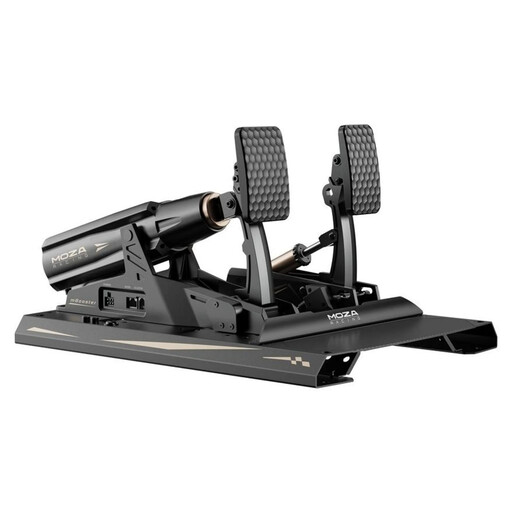
MOZA Racing RS082 Terrace Black Aluminum Pedalset
For repeated braking inputs on a fixed rig: the product specifications list a load-cell brake, adjustable pedal angle and pedal-face height, and an adjustable footrest.
The product specifications state that it can be calibrated via Pit House. The product name also lists 200 kg and 15 Bit.
According to the product description, the pedals must be securely mounted to a racing rig. Pedals alone won’t teach you the racing line; you’ll still need to study the track and practise in-game.
View at Joybuy
Frequently asked questions
Will better pedals automatically teach me the racing line?
No. Pedals register your throttle and braking inputs; learning the racing line and cornering technique also takes practice on the track. iRacing treats racing lines and braking technique as separate learning topics, and offers a colour-coded driving-line aid for braking and acceleration zones.
How should I set up my pedals before practising?
First, make sure your pedals and seat stay stable in your driving position. Then adjust the pedal position and, if needed, the braking feel, and calibrate the inputs according to the instructions for your model. With the MOZA SRP2, you can adjust calibration and curves via Pit House.
Do I need a clutch for virtual circuits?
Not necessarily. Check what’s included against the cars and inputs you want to use in your chosen game. Fanatec’s standard CSL set comes with two pedals; a third pedal is available in separate versions or as an add-on.
What are my rights when shopping online in Germany?
For a qualifying distance purchase from a business seller, you generally have a 14-day right to cancel, starting from delivery; exceptions and conditions apply. Your Europe states that faulty goods are covered by a legal guarantee of at least two years from receipt. This is separate from any voluntary manufacturer’s warranty.


