
Lieferung heute & morgen

Qualitätsgarantie

Willkommens-Angebote freischalten: KOSTENLOSE Lieferung | Bis zu 80 % RABATT | Kostenlose 30-Tage-JoyPlus-Testphase
App herunterladen
A racing track for children can keep them entertained for a long time – provided the age recommendation, space requirements and play style are right. Many disappointing purchases aren’t caused by one particular flaw, but by a combination that doesn’t suit the child, such as a complicated set-up, small parts or high ongoing costs.
A set with lots of features isn’t automatically suitable for younger children. Small components, loose accessories and battery compartments can pose a risk to children under three. Even a racing toy for ages 3+ may initially require adult help if it’s complicated to set up.
So be sure to check:
A Carrera racing track needs enough room to set up, use and store. A track with around 5.3 metres of track can take up considerably more floor space than the packaging dimensions suggest. Flexible play tracks are more compact to store, while fixed track systems tend to have a more structured layout.
Before buying, measure the available space and check whether the set can stay out permanently after playtime.
Batteries are often not included with battery-powered toy cars. With remote-controlled cars, you may also need to consider replacement batteries, charging times and extra batteries for the remote control. For a children’s racing track, check whether extension tracks, replacement cars or adapters are sold separately.
For younger children aged three and over, simple friction-powered vehicles, transporters or flexible tracks with large controls are good options. One example is a bendable double-lane track measuring 4.5 metres. It can be arranged as a straight, curve or ramp, and doesn’t need a power supply.
For children aged around nine or ten and over, detailed building sets such as LEGO Speed Champions are worth considering. The focus is on construction, model accuracy and imaginative play afterwards. Teens and adults may enjoy electronic systems with app control, multiple drivers and adjustable settings.
The materials should be suitable for the intended use. ABS plastic is commonly used for building sets, while die-cast metal is used for some model cars. The material isn’t the only thing that matters: check that moving parts, wheels and connectors are sturdy too.
When choosing a building set, it’s worth checking the number of pieces:
More pieces can offer more building possibilities, but they usually mean a longer build time too.
Before buying, check:
Only charge batteries in electronic products as directed by the manufacturer. Products with lithium batteries should be charged under adult supervision.
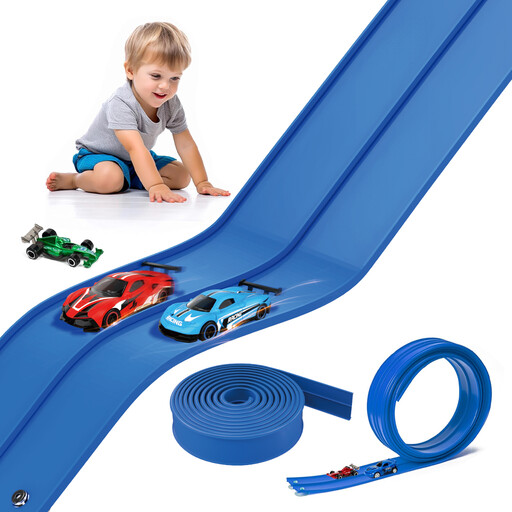
Why this product suits this profile: The flexible 4.5-metre double track is designed for children aged three and over, needs no batteries and can be rolled up to save space after playtime.
No ongoing battery costs and no fixed track layout. You can adapt the track to the space available.
Double track, suction cups for smooth surfaces, and compatible with small cars, buses and lorries.
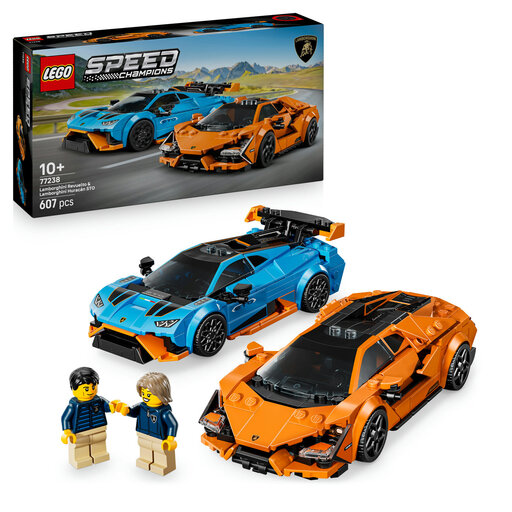
Why this product suits this profile: This set combines model building, play and display, making it a great choice for fans aged ten and over as well as adult collectors.
The age recommendation, piece count and model dimensions are clearly stated. This isn’t just a toy for short-term play; it can also be kept on display as a model.
607 pieces, two vehicles, two racing driver minifigures, and vehicles measuring 16 and 8 centimetres long respectively.
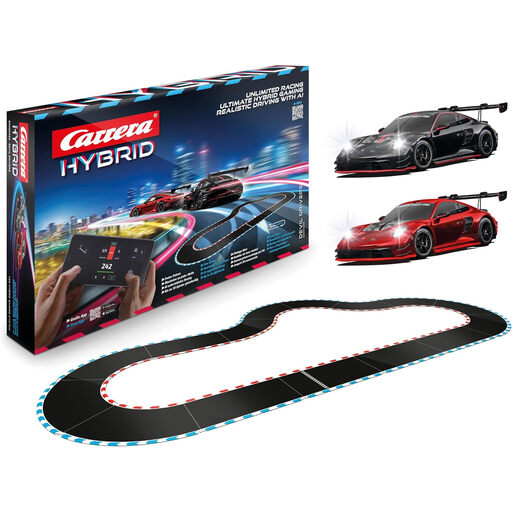
Why this product suits this profile: This set is aimed at users aged 12 and over who want app control, adjustable vehicle settings and multiplayer races.
The product details specify the age recommendation, battery, dimensions and controls. This makes it easier to assess the space needed and charging requirements before you buy.
Two Porsche 911 GT3 R models, smartphone or tablet control, and a multiplayer feature for up to 16 participants.
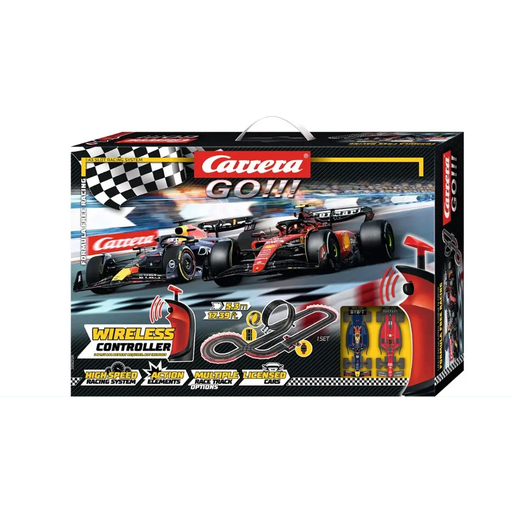
Why this product suits this profile: The wireless controllers and two licensed Formula cars are ideal for racing together, with up to two players.
The track length of around 5.3 metres and set-up area of approximately 180 × 75 centimetres are provided to help you plan.
Wireless controllers, a loop and an extendable track. According to the product details, the set is designed for children aged five and over, while the title says ages six and over.
We’ve put together a complete, regularly updated list of products that meet these strict selection criteria and the applicable EU safety regulations in full.
It depends on the model. Simple toy vehicles and flexible tracks are often designed for children aged three and over. Track systems with small parts are usually recommended for older children. Always follow the age recommendation and safety advice for the specific product.
It varies by set. For a system with around 5.3 metres of track, allow extra room beyond the track itself for controllers, vehicles and a safe area to move around. Before setting it up, choose a clear, dry and level surface.
A flexible track that doesn’t need a power supply has no initial battery costs. A Carrera racing track may need batteries for its wireless controllers. App-controlled systems generally need a charged battery; if you use the set frequently, a spare battery can be useful. LEGO building sets normally have no running costs after purchase, but you’ll need somewhere safe to store the small pieces.