Map and menu planners
If you want a clear view of route maps and control panels, compare the resolution, screen size and text legibility in the game you actually play.


A 27-inch QHD monitor is a useful benchmark for clearly visible maps and menus, provided you have enough desk space and a computer that can support it. If space is limited, start by looking at compact models around 24 inches. For late-night gaming, adjustable brightness and consideration for anyone trying to sleep matter more than an especially high advertised refresh rate. An ultrawide is only worth considering if you have enough room and your particular game makes good use of the wider format.
If you want a clear view of route maps and control panels, compare the resolution, screen size and text legibility in the game you actually play.
If you share a room and need to fit your monitor, stand, keyboard and mouse into a small area, the space it takes up matters more than having the largest possible screen.
If someone else wants to sleep in the same room, consider both screen brightness and sound. The CDC/NIOSH notes that screen light late in the evening can act as a signal to stay awake.
A good fit if: desk space is limited and you can comfortably read maps and menus at your usual viewing distance.
Trade-off: Full HD has fewer pixels than QHD, so check the text size in the game you play and the depth of the stand.
A good fit if: you want to compare more pixels for maps and control panels, and have enough space for a monitor around 61 cm wide.
Trade-off: A higher resolution doesn’t guarantee more comfortable text size; check the game interface and your computer’s performance too.
A good fit if: you have plenty of desk width and your particular game displays its map and interface well in a wider format.
Trade-off: The wider format takes up more space and doesn’t automatically mean more usable screen area for gaming.
| Priority | What to look for | Who it matters most to |
|---|---|---|
| Map and menu legibility | Check the game and its usual menus at your preferred resolution; consider resolution, screen size and viewing distance together. | If I want to see route maps and small labels clearly, how the game is displayed matters most to me. Around 36% of consumers put legibility first. |
| Desk space and positioning | Measure the available desk width and depth, including space for your peripherals; check the width of the monitor and the depth of the stand on the specific model. | If my monitor and stand need to fit alongside my keyboard and mouse, the space they take up is my top priority. Around 29% of consumers put space requirements first. |
| Evening gaming | Adjust the monitor’s brightness and plan a considerate way to manage sound; a colour mode won’t eliminate the light from the screen. | If someone wants to sleep in the room, I want to keep light and sound to a minimum. Around 21% of consumers prioritise consideration for sleepers. |
| Connections and running costs | Check your computer’s output and cable against the monitor’s connection requirements; compare the EU energy label for the specific model. | If the right connections and a clear picture of power consumption matter to me, I check both before buying. Around 14% of consumers put connections and running costs first. |
Samsung’s specifications for the Odyssey G5 LC34G55TWWPXEN list 3440 × 1440 and 21:9. That doesn’t tell you how a particular game arranges its menus on a widescreen display.
Check how your game is displayed and how much desk space you have before choosing 21:9 instead of 16:9.
For the MSI G274QPF E2, MSI lists up to 180 Hz over DisplayPort and up to 144 Hz over HDMI at QHD.
Compare the figures for the connection you’ll use with your computer’s output and cable. For this type of game, don’t prioritise the highest figure alone.
A switched-on screen is still a source of light. The CDC/NIOSH notes that computer screen light late in the evening can act as a signal to stay awake.
Keep brightness and sound down, and don’t point the screen towards the bed. If someone is asleep, check whether gaming in the same room is suitable at all.
In 2023, LG explained that leaving a still image on a display for a long time can leave marks. A voluntary manufacturer’s warranty is separate from your statutory rights against the seller.
For a particular OLED model, check the applicable terms for static game interfaces, and read the warranty conditions separately from your statutory rights.
The TUF Gaming VG249Q3A is a documented example of a compact 23.8-inch Full HD IPS monitor.
The UltraGear 27GS75QX-B is an example from Germany of a 27-inch QHD IPS monitor.
The G274QPF E2 is a 27-inch QHD IPS example with a height-adjustable stand.
The Odyssey G5 LC34G55TWWPXEN is a 34-inch ultrawide example with a VA panel.
The Joybuy options below are mainly 27-inch monitors with QHD resolution, suited to viewing maps and menus. There’s also a 4K model.
 No image available
If you’re comparing 27-inch QHD monitors for maps and control panels, these specifications are worth considering.
 No image available
If you’re comparing QHD models for maps and menus, also check the speaker specifications when planning how to manage sound in a shared room.
 No image available
If you’re looking for a QHD option with a 120 Hz refresh rate listed in the title, you can compare this model against it.
 No image available
If you’re comparing 4K as a resolution option, also check how your game is displayed and how well your computer can run it.
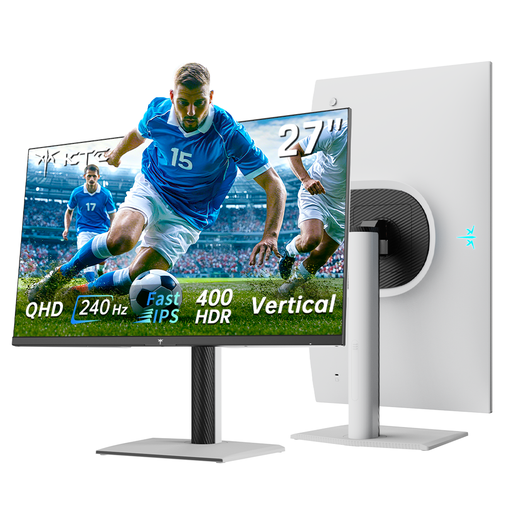 No image available
If you’re comparing a height-adjustable QHD model, consider whether the higher refresh rate is relevant to your game and computer.
With an external Windows monitor, the brightness slider may not appear in Windows. Microsoft recommends using the buttons on the monitor instead. Set the brightness so you can still read the game interface. If someone in the room has already gone to sleep, a dimmed display can’t guarantee an undisturbed night.
No, it depends on the model and connection. For the G274QPF E2 at 2560 × 1440, MSI lists up to 180 Hz over DisplayPort but up to 144 Hz over HDMI. Check your chosen model’s specifications, as well as your computer’s output and cable.
Compare the EU energy label for the specific monitor; it includes information about efficiency and figures for SDR and HDR, among other details. To work out your personal cost, you’ll also need your usage time and electricity tariff.
For a covered distance purchase, you generally have a 14-day cancellation period, subject to certain exceptions and details. Your statutory rights against the seller last for at least two years from the date you receive the monitor and are separate from any voluntary manufacturer’s warranty.