
Lieferung heute & morgen

Qualitätsgarantie

Willkommens-Angebote freischalten: KOSTENLOSE Lieferung | Bis zu 80 % RABATT | Kostenlose 30-Tage-JoyPlus-Testphase
App herunterladen
By a Joybuy Product Recommendation Officer, August 29, 2026
PLA filament with a rainbow gradient promises to turn 3D prints into unique, colourful works of art. But the reality is often different: instead of a smooth gradient, you get unsightly colour jumps, or the material repeatedly causes print failures. Many users invest in a spool only to find that their printed objects don't meet their expectations. Before you make a purchase, it's crucial to understand the common pitfalls to avoid disappointment and wasted material.
This guide focuses on the objective criteria that are crucial when selecting a multicolour filament, helping you find a product that suits your specific printing project.
The marketing for rainbow filaments often highlights only the vibrant colours on the spool, but conceals the practical challenges. Two problems are particularly common:
To avoid these problems, you should carefully check two technical parameters before buying. These largely determine the quality and appearance of your print results.
This is the most important, yet often overlooked, factor in a 3D printer filament colour gradient. The colour transition length indicates after how many metres of filament a complete colour change occurs.
The quality of a filament is evident not only in its colour but also in its physical properties.
Based on these objective criteria, we have identified some products from the CaiLab Filament range that are suitable for different user profiles and projects.
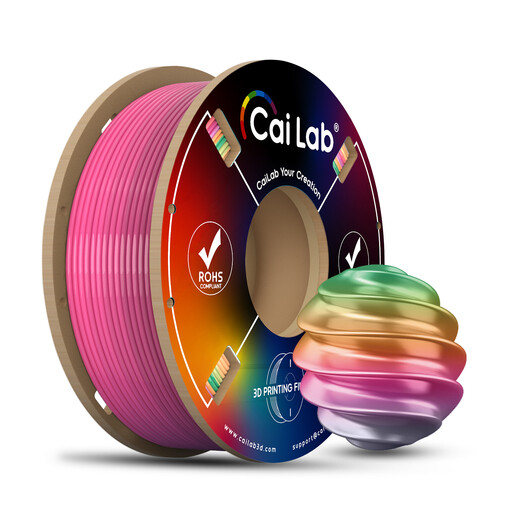
Why it's a match: Ideal for users printing small figurines, toys, or decorative items. The short colour changes ensure that a dynamic rainbow effect is visible even on small objects.
This filament solves the problem of invisible gradients on small prints by having a short colour transition length. The effect is immediately noticeable.
Combines rapid colour changes with a distinct silk sheen, resulting in visually stunning small objects.
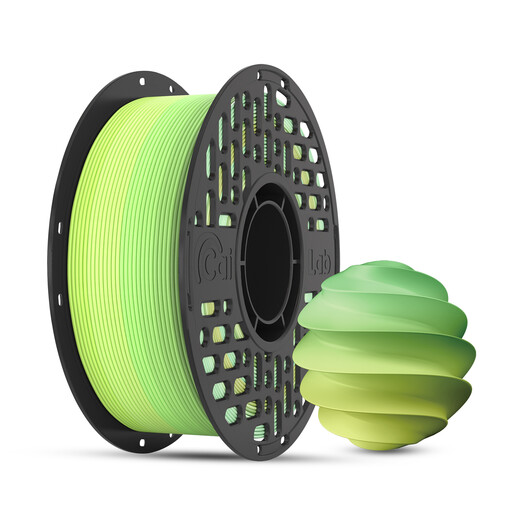
Why it's a match: Perfect for designers and artists printing large objects like vases, busts, or enclosures. The long, gentle colour gradient creates an elegant and professional finish.
It prevents the busy, "blotchy" look that rapid colour changes can create on large surfaces by offering a very gradual transition.
The long colour transition length ensures a harmonious and uniform appearance on prints that consume a lot of material.
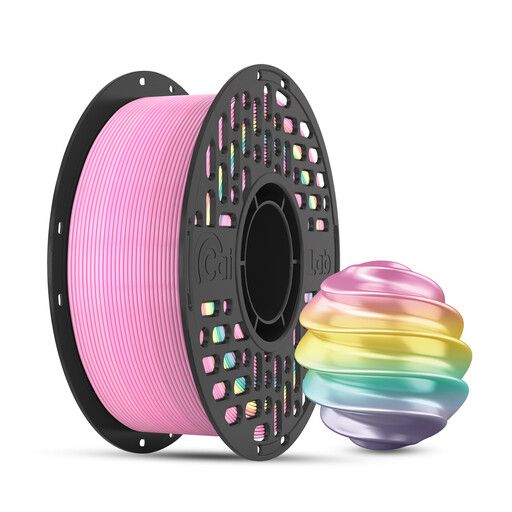
Why it's a match: For users who prioritise the metallic lustre of the silk finish. This filament is specially formulated to maximise this effect.
Addresses the typical brittleness and poor adhesion of silk filaments with an optimised material blend that improves print reliability.
Offers an intense silk sheen with good layer adhesion and a reduced tendency to clog compared to many other silk PLA filaments.
We have compiled a complete, up-to-date list of products that fully meet these strict selection criteria and comply with German safety regulations.
This depends directly on the colour transition length of the filament, which should be specified in the product description. For a filament with a 15-metre transition length, you will need a printed object that consumes at least 15 metres (approx. 45–50 grams) of material to display the entire cycle. With filaments that have long transitions (e.g., 50 metres), the full cycle is only visible on very large objects.
Generally, no. Most multicolour filaments, especially variants like Silk PLA, are designed for decorative purposes. The additives that provide colour and shine can reduce mechanical strength and impact resistance compared to standard PLA. For functional or mechanically stressed parts, materials like PETG or standard PLA are better suited.
A clogged nozzle can have several causes. First, check the manufacturer's recommended printing temperature—silk filaments often require a slightly higher temperature (e.g., 210–220 °C). Also, ensure the filament is stored dry, as moisture absorption can lead to irregular extrusion and clogging. Messy winding or significant fluctuations in filament diameter are also common causes.