
Lieferung heute & morgen

Qualitätsgarantie

Willkommens-Angebote freischalten: KOSTENLOSE Lieferung | Bis zu 80 % RABATT | Kostenlose 30-Tage-JoyPlus-Testphase
App herunterladen
A range hood should reliably remove cooking vapour, grease particles and odours from the immediate cooking area. In practice, however, the stated extraction rate alone does not determine whether a model is suitable for your kitchen. Installation type, operating mode, noise level, filter maintenance and hob width are equally important.
This buying guide from the Joybuy Product Recommendation Officer explains what households in Germany should consider in 2026 and which models are suitable for different usage scenarios.
The specification in cubic metres per hour, such as 400 m³/h, 611 m³/h or 650 m³/h, describes the extraction performance under certain conditions. In extraction mode, duct length, bends and a small duct diameter can affect the actual performance. In recirculation mode, the air passes through grease and activated carbon filters, making regular maintenance particularly important.
An extractor hood directs filtered air outside through a duct. This requires a suitable wall or masonry outlet. A recirculating hood returns the air to the room after filtration. It is suitable, among other things, for flats without an external connection, but requires a compatible activated carbon filter and regular filter replacement.
An energy efficiency class such as A++ or A+++ is an important comparison factor, but it does not replace a review of extraction performance and operating mode. A model with LED lighting, several power levels and an extraction rate suited to your needs may be a better fit for everyday use than one marketed solely on the basis of a high efficiency rating. Always check the specific figures on the product data sheet.
The range hood should be at least as wide as the hob. For a standard hob, a 60 cm range hood is often a suitable choice. A 90 cm range hood can cover a larger area when used with a wider hob or for more intensive cooking.
The most common designs differ considerably:
Before purchasing, compare the appliance width, depth, chimney height and available clearance above the hob. The manufacturer’s installation instructions take precedence. Gas hobs generally require different minimum clearances than electric hobs.
For occasional cooking, several lower power levels may be sufficient. Anyone who frequently fries food, cooks with several pots or uses a large hob should compare the extraction rate and distribution of the power levels more closely.
A quiet range hood cannot be identified solely by its design. The stated sound pressure or sound power level in decibels is the relevant factor. The models listed here, for example, specify 59 dB. Values should only be compared when they have been measured under comparable conditions.
Multi-layer aluminium grease filters can capture grease particles and, on some models, can be removed and are dishwasher-safe according to the product specifications. They still need to be cleaned regularly, as grease deposits can impair filtration performance and increase the risk of fire.
A compatible activated carbon filter is required in recirculation mode. It cannot bind odours indefinitely. Follow the replacement intervals recommended by the manufacturer. You can find an overview of suitable replacement filters in the Range Hood Filters category.
A range hood with LED lighting can illuminate the cooking area precisely. Also check whether replacement bulbs are available and whether the lighting can be switched on independently of the fan.
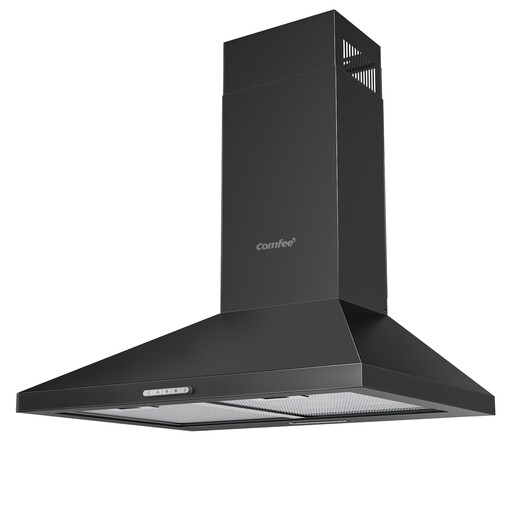
Why it is suitable: According to the product specifications, this 60 cm hood delivers 400 m³/h, offers three speed levels and supports both operating modes, making it suitable for typical kitchens in flats or smaller households.
The choice between extraction and recirculation is explicitly taken into account; according to the product specifications, an activated carbon filter is included.
60 cm width, LED lighting, three power levels and an adjustable chimney section.
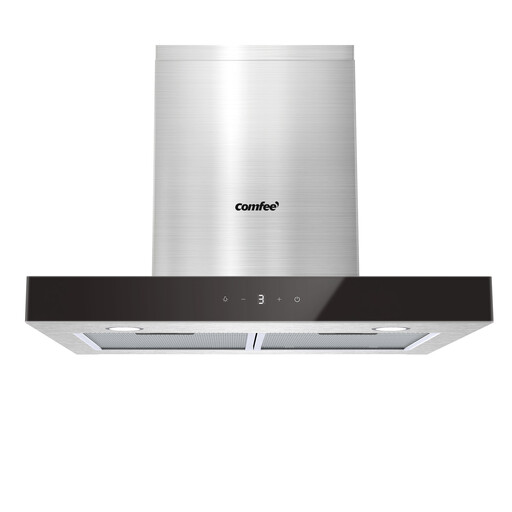
Why it is suitable: According to the product specifications, this T-shaped 60 cm model combines 650 m³/h, four power levels, touch and gesture controls, and a stainless-steel body.
In addition to the efficiency class, the specifications provide concrete details on noise level, filter type and operating modes. According to the product information, the aluminium filter is removable and dishwasher-safe.
650 m³/h, four power levels, LED lighting and two installation types according to the product data.
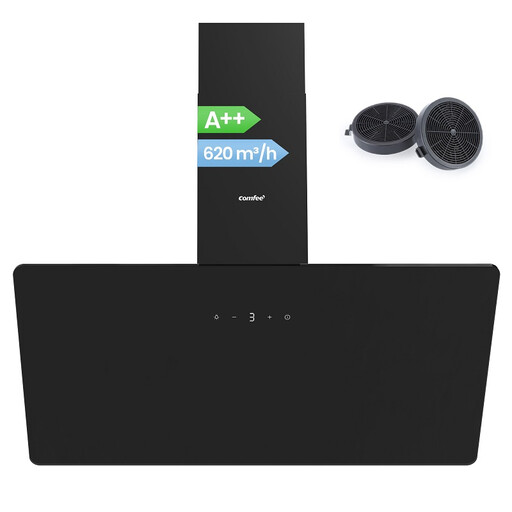
Why it is suitable: According to the product description, this 90 cm angled hood is designed for larger cooking areas and offers 620 m³/h, four power levels, and both extraction and recirculation modes.
The larger width is supported by specific performance and noise figures rather than being promoted solely on the basis of its design.
90 cm width, 620 m³/h, 59 dB according to the product specifications, touch controls and a five-layer aluminium filter.
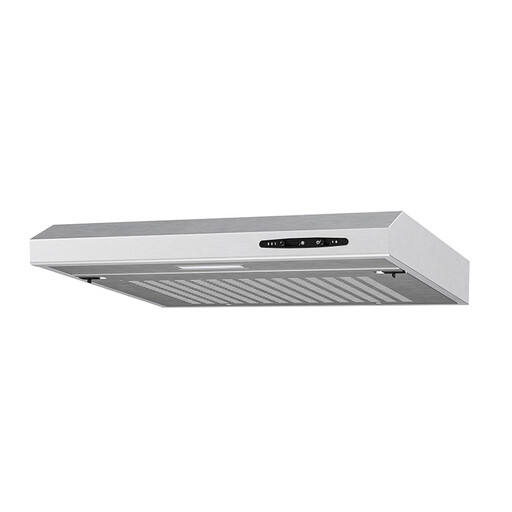
Why it is suitable: This 60 cm under-cabinet hood is designed for kitchens where there is limited space for a wall chimney. According to the product specifications, it delivers 212 m³/h and offers three power levels.
Rather than being marketed with an overstated extraction rate, its compact design is clearly positioned as a solution for straightforward installation situations.
Stainless-steel housing, LED lighting, three power levels and an activated carbon filter according to the product specifications.
Joybuy offers a continuously updated selection of range hood filters and suitable solutions for different kitchen layouts.
Before installation, check that the power connection, wall fixings, extraction outlet and chimney dimensions are compatible with the appliance. Some product specifications recommend installation by qualified professionals. Disconnect the power supply before cleaning or carrying out maintenance.
Grease filters should be cleaned regularly according to how frequently the hood is used. In recirculation mode, the cost of activated carbon filters must also be taken into account. When comparing an energy-efficient range hood, consider not only the efficiency class but also annual power consumption, service life and the required filter replacement intervals.
For a 60 cm hob, a 60 cm range hood is often a suitable choice. If the hob is used intensively or vapour is concentrated towards the sides, a larger hood may be beneficial, provided the kitchen offers sufficient space. Extraction rate, installation height and operating mode are also decisive factors.
This depends on the model, filter type and frequency of use. Some product specifications recommend replacement after approximately two to four months. The instructions provided by the respective manufacturer are authoritative. A grease filter can often be cleaned, whereas activated carbon filters usually need to be replaced.
Extraction mode generally does not incur recurring activated carbon filter costs, but it requires a suitable external connection. Recirculation is more flexible in terms of installation, but recurring filter replacements can result in higher running costs. To choose the right option, consider the structural conditions, cooking habits and energy consumption together.