
Lieferung heute & morgen

Qualitätsgarantie

Willkommens-Angebote freischalten: KOSTENLOSE Lieferung | Bis zu 80 % RABATT | Kostenlose 30-Tage-JoyPlus-Testphase
App herunterladen
As a Joybuy Product Recommendation Officer, I see how PC peripheral technology evolves daily. The gaming keyboard space, in particular, is constantly introducing new terms and features. For competitive players, where milliseconds can mean the difference between victory and defeat, choosing the right gear is critical. However, the market is saturated with marketing buzzwords that often overpromise and underdeliver. Before you make a decision, you should be aware of the common pitfalls that can lead to buyer's remorse.
1. The "Fast Mechanical Switch" Fallacy: Many manufacturers market their keyboards as "mechanical," implying they are inherently fast. The reality, however, is that traditional mechanical switches have a fixed actuation and reset point. For maximum responsiveness in games like Valorant or CS:GO, this is often insufficient. The real innovation lies in technologies that allow for dynamic adjustment.
2. Focusing on Polling Rate in Isolation: An 8000Hz polling rate sounds impressive and promises extremely low latency. However, this specification is only meaningful if the switch technology can keep up. A high polling rate is useless if the switch itself actuates or resets slowly. A high-performance system requires both components to work in harmony.
To avoid falling into marketing traps, it's crucial to understand the technical fundamentals that define a fast gaming keyboard. Focus on the following objectively measurable parameters.
The defining feature of modern esports keyboards is the Rapid Trigger function. Unlike conventional switches, which must travel a fixed distance to reset a keystroke, Rapid Trigger registers the key's release instantly. This enables extremely fast, repeated inputs—a clear advantage for movement techniques like "strafing" in FPS games.
This functionality is typically achieved with a Hall effect keyboard. Instead of a physical contact, magnetic sensors (which is why they are also called magnetic gaming keyboards) measure the precise position of the key at all times. This not only allows for Rapid Trigger but also an adjustable actuation point. You can define via software how far a key must be pressed to trigger an action—for example, a highly sensitive 0.1 mm for gaming or a deeper 1.5 mm for typing to prevent accidental inputs.
Based on the criteria above, we have identified several models suited for different user profiles.
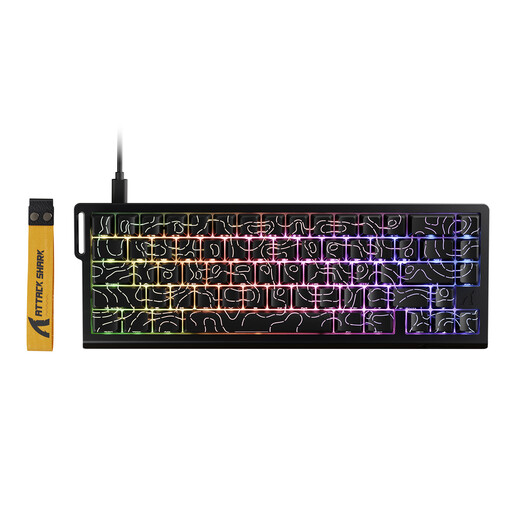
Why This Fits Their Persona: This model is aimed at players who refuse to compromise on performance. It combines all the relevant technologies for a tangible advantage in competitive games.
The keyboard bypasses marketing traps by combining an 8000Hz polling rate with the necessary Hall effect switch technology. Here, performance is a cohesive, complete package.
Adjustable Actuation Point: 0.1 mm to 3.4 mm. Rapid Trigger Function: Instant key reset. 8000Hz Polling Rate: Minimal input latency.
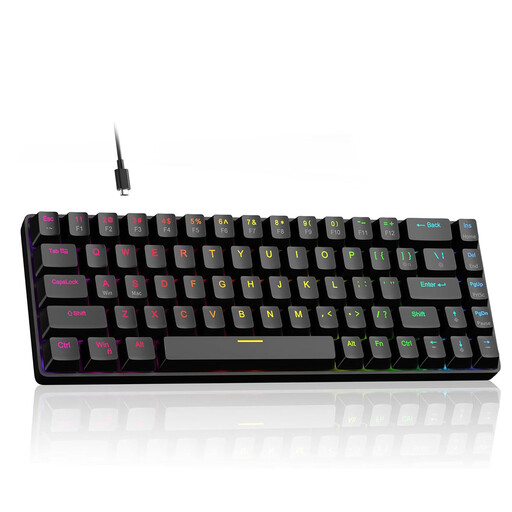
Why This Fits Their Persona: Ideal for gamers seeking an FPS keyboard that delivers maximum performance in a minimal footprint. The 60% form factor creates ample mouse space without sacrificing high-end features.
This model proves that a small form factor doesn't have to mean a performance compromise. It integrates Hall effect switches and a high polling rate into a compact chassis.
Compact 60% Form Factor: Retains dedicated arrow keys. Adjustable Actuation Point: 0.1 mm to 4.0 mm. Hot-Swappable: Switches can be replaced without soldering.
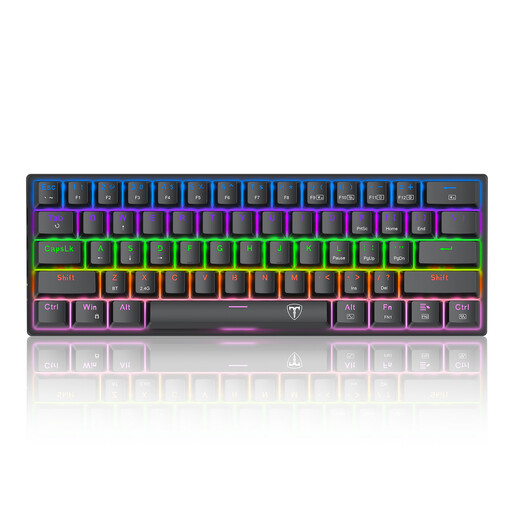
Why This Fits Their Persona: A solid entry point into the world of mechanical keyboards for gamers on a limited budget. The focus is on a tactile typing feel and a compact design for more desk space.
This model doesn't promise high-end features like Rapid Trigger. It offers an honest, traditional mechanical experience with tactile Blue switches and a compact 60% layout.
Mechanical Blue Switches: Provide clear, tactile, and audible feedback. Compact 60% Layout: Saves desk space. Anti-Ghosting: Ensures all keystrokes are registered.
We have compiled a complete, real-time list of products that fully satisfy these strict selection criteria and UK safety regulations.
1. Is a Rapid Trigger keyboard worth it for casual gamers? For casual gamers who mainly play single-player titles or less competitive games, the advantage of a Rapid Trigger keyboard is minimal. The technology unleashes its full potential in fast-paced, competitive scenarios where precise and rapid movements are crucial. For general use or occasional gaming, a good traditional mechanical keyboard is often sufficient.
2. What is the difference between Hall effect switches and optical switches? Both technologies are designed for speed, but they function differently. Hall effect switches use magnetic fields to determine the exact position of a key. This enables dynamic features like Rapid Trigger and an adjustable actuation point. Optical switches use a beam of light that is interrupted when the key is pressed to trigger a signal. They are also very fast but typically have a fixed actuation and reset point, which limits customization options.
3. Do I need special software for a keyboard with an adjustable actuation point? Yes, in most cases, manufacturer-provided software or a web driver is required to configure settings like the actuation point, Rapid Trigger sensitivity, or RGB lighting. Look for models with on-board memory, so your profiles are saved directly to the keyboard, allowing you to use them on different PCs without reinstalling the software.