
Lieferung heute & morgen

Qualitätsgarantie

Willkommens-Angebote freischalten: KOSTENLOSE Lieferung | Bis zu 80 % RABATT | Kostenlose 30-Tage-JoyPlus-Testphase
App herunterladen
A ratchet and socket set should loosen and tighten bolts reliably, work in confined spaces and be easy to store neatly after use. In practice, though, no single set is right for every job. A small socket set may be enough for furniture and bikes, while working on a vehicle may call for several drive sizes and a defined torque range.
A high piece count may look appealing at first. What matters, though, is whether the included sockets fit the fasteners you actually need to work on. A set with lots of bits but few metric sockets will only be of limited use for car repairs. So check:
A 72- or 90-tooth ratchet needs only a small return angle. This is useful for a ratchet for confined spaces, but it doesn’t mean the tool can withstand greater loads. Fine teeth make it easier to work between pipes, panels or pieces of furniture. Even so, don’t extend the ratchet with an extra pipe to loosen very tight bolts unless the manufacturer specifically allows it.
A torque wrench is designed to tighten fasteners to a controlled, preset value. A standard ratchet and socket set isn’t automatically suitable for this. For products where they apply, ratings such as ±2% or ±3% refer to the stated measurement range and the accuracy described by the supplier. Follow the instructions, stay within the permitted range and observe the storage guidance.
The three common sizes have different uses:
A socket set with several drive sizes gives you more flexibility. Check, though, whether the sockets fit each drive directly or can only be used with adapters.
The products listed include descriptions such as chrome vanadium steel, chrome alloys and Cr-Mo components. These material details offer an objective point of comparison, but on their own they don’t tell you how long a tool will last under every type of load.
Features worth considering include:
A mechanical torque wrench typically uses a scale and a release mechanism. A digital torque wrench displays the measurement electronically and, depending on the model, may also provide audible, visual or tactile signals.
Before you buy, check:
For safety-critical vehicle components, always follow the torque settings specified by the vehicle manufacturer.
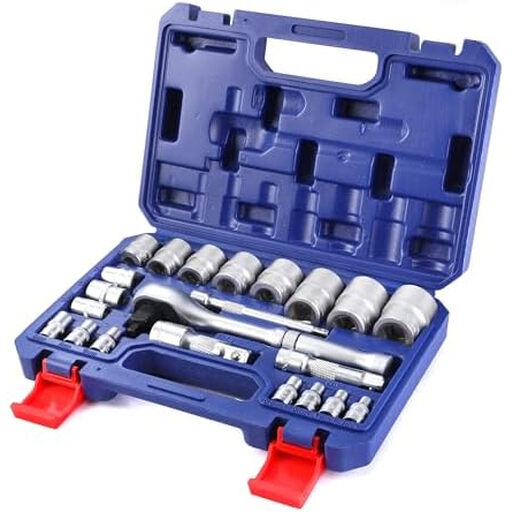
Why this product suits this profile: This set combines 1/4, 3/8 and 1/2-inch drives with metric sockets from 4 to 24 mm. It’s suitable for DIY jobs, bikes, household appliances and smaller car repairs.
The three drive sizes and clearly marked sockets reduce the risk of buying a set with the wrong drive or sizes that are difficult to find.
72-tooth ratchet, 18 metric sockets, three extensions and a storage case.
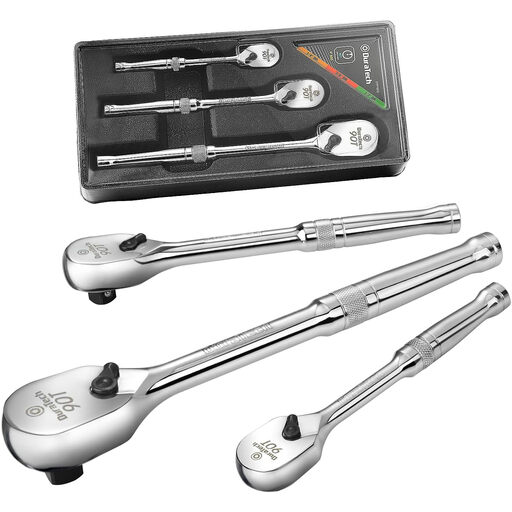
Why this product suits this profile: If you already own sockets and specifically need several ratchets, this case gives you three sizes: 1/4, 3/8 and 1/2 inch.
The separate drive sizes help prevent a small ratchet being used for larger bolted joints.
90-tooth mechanism, stated working angle of 4 degrees, enclosed heads and storage case.
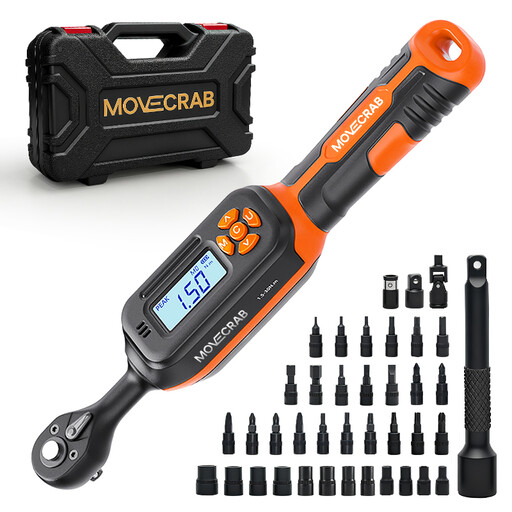
Why this product suits this profile: This set is aimed at bike and motorbike owners, as well as anyone who needs defined torque settings within a low range. The stated range is 1.5 to 30 Nm.
The clearly stated measurement range helps you avoid using the tool outside its intended application.
40 pieces, LED display, four selectable units, 72-tooth ratchet, plus track and peak modes according to the product description.
We’ve put together a complete, regularly updated list of products that meet these strict selection criteria and fully comply with the safety regulations in force in the EU.
Always use a socket that fits the fastener snugly, without any play. When using an automotive tool set, position the socket straight on the fastener. For bolts that are stuck, start by using penetrating oil or a suitable loosening method. A ratchet isn’t a striking tool.
After use, follow these steps:
A 3/8 inch ratchet is versatile enough for many general jobs on a car. Larger bolts may require a 1/2 inch ratchet. Small components and hard-to-reach areas can often be tackled with a 1/4-inch drive. The sizes you need will depend on the vehicle and the repair in question.
Its lifespan depends on the material, load, care and correct use. Don’t overload a reversible ratchet with an extension pipe or use it as a hammer. Keeping it clean and storing it properly, as well as observing the stated load limits, can help reduce wear.
A mechanical torque wrench doesn’t need a battery and works using a scale or release mechanism. A digital torque wrench can display readings and, depending on the model, provide alerts through a beep, vibration or LED. The key factors are the measurement range, drive size, ease of use and the accuracy your repair requires.