
Lieferung heute & morgen

Qualitätsgarantie

Willkommens-Angebote freischalten: KOSTENLOSE Lieferung | Bis zu 80 % RABATT | Kostenlose 30-Tage-JoyPlus-Testphase
App herunterladen
A ratchet set can save you a lot of time when assembling, maintaining and repairing things. However, not every set is suited to every job. Gaps in the range of sizes, an unsuitable drive or poor storage can quickly lead to a disappointing purchase. Marketing claims such as ‘professional’ or ‘extra durable’ also tell you little about what a tool is actually suitable for.
This guide explains what DIY enthusiasts, vehicle technicians, bike owners and tradespeople should look for before buying.
A large ratchet set may include plenty of bits, adapters and sockets, yet still be missing important sizes. For typical vehicle maintenance, metric sizes such as 10, 13, 17 or 19 mm are often useful. Bikes, on the other hand, often require smaller hex and Torx bits.
So don’t just check the number of pieces: look at the sizes and accessories actually included.
A ratchet with more teeth usually needs a smaller swing arc, making it easier to work in confined spaces. However, the load it can handle also depends on its material, design, drive size and construction. A small 1/4-inch drive is not designed to withstand the same forces as a 1/2-inch drive.
Fine gearing mainly makes a ratchet easier to use in tight spaces; it doesn’t replace choosing the right drive size.
Tool rolls and plastic cases help keep tools organised and make them easier to carry. What matters is whether each tool is held securely and clearly labelled. Loose sockets can easily go missing in a vehicle toolbox. When choosing a tool case, you should also consider its dimensions, weight and compartment layout.
With a socket set, the drive sizes are usually a key consideration:
A ratchet set with several drive sizes offers greater flexibility, but takes up more space. For occasional repairs, a compact 1/4-inch or 3/8-inch set may be enough.
The number of teeth describes the design of the ratchet mechanism. For example, according to the product specifications, a 72-tooth model needs a working angle of around 5 degrees. The WORKPRO set with 72-tooth ratchets is therefore designed for confined spaces. The 8-piece ratchet spanner set with 144 teeth is listed as having a 2.5-degree swing arc.
These figures are particularly relevant when working in an engine bay, with furniture fittings or in hard-to-reach parts of machinery. In open spaces, a larger swing arc is often less of an issue.
Many of the tools listed are made from chrome vanadium steel (Cr-V). When choosing a set, you should also check the following:
With a torque wrench set, the stated measurement range is also important. The WORKPRO 1/4-inch model is listed with a range of 2 to 26 Nm and a stated accuracy of up to ±3%. These specifications shouldn’t be confused with those of a standard ratchet. For safety-critical fasteners, always follow the relevant manufacturer’s instructions.
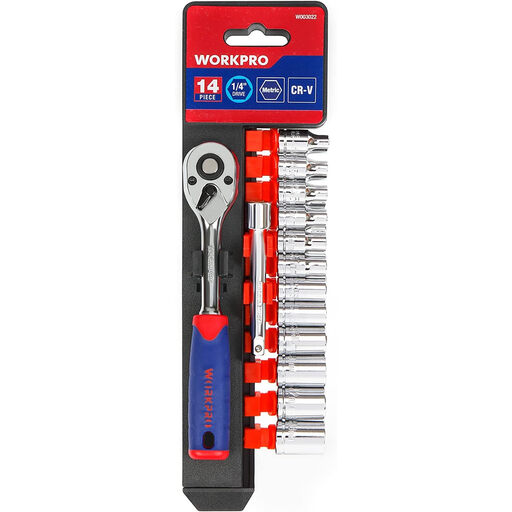
Why it suits this user: This compact 1/4-inch set covers metric sizes from 4 to 13 mm and is suitable for general repairs, furniture assembly and smaller mechanical jobs.
The sizes and contents are clearly specified. A 76 mm extension and socket holder make the set easier to check and store.
Cr-V steel, 72-tooth ratchet, quick-release button and compact dimensions.
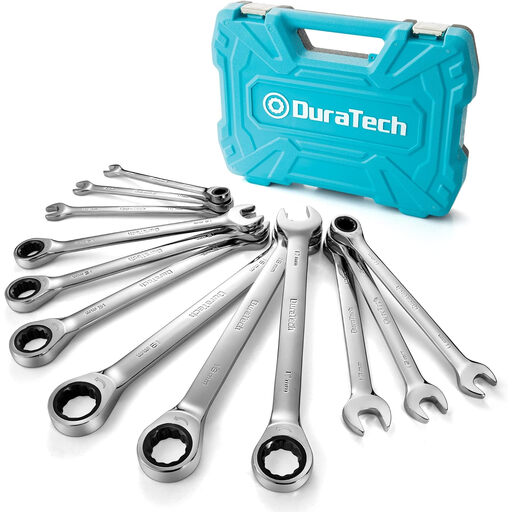
Why it suits this user: Combining ratcheting combination spanners with a flexible head, this set is designed for regular work on vehicles, machinery and installations.
All 12 sizes, from 8 to 19 mm, are listed individually. The 180-degree flex head and 72-tooth ratchet are designed for confined working spaces.
Cr-V steel, size markings on both sides and a tool roll with labelled pockets.
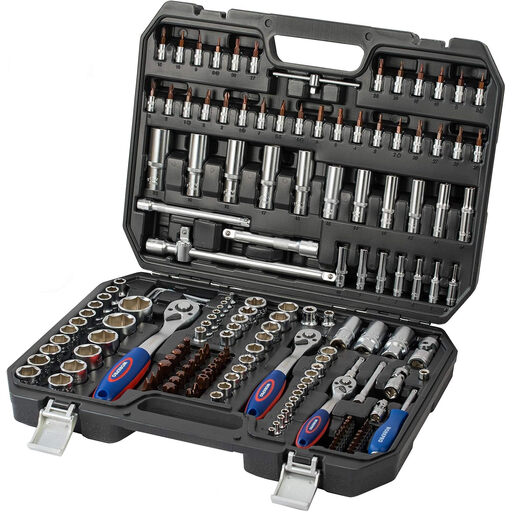
Why it suits this user: This comprehensive tool set combines 1/4-, 3/8- and 1/2-inch ratchets with sockets, Torx sockets, bits, extensions and spark plug sockets.
The contents are listed in detail by drive size, socket type and size. This makes it easier to check before buying whether any accessories would be duplicates or genuinely useful.
Three 72-tooth ratchets, S2 bits, a selection of deep sockets and a labelled plastic case.
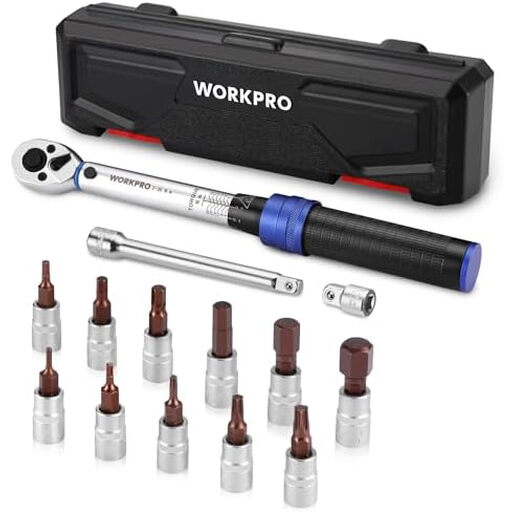
Why it suits this user: Its stated range of 2 to 26 Nm is designed for smaller fasteners, such as those found on bikes and motorcycles and in more delicate assembly work.
The torque range and stated accuracy of up to ±3% are clearly specified. This makes it easier to check the tool’s suitability against the manufacturer’s instructions before buying.
72-tooth ratchet, 14 accessories, extension bar and 1/4-to-3/8-inch adapter.
We’ve put together a complete, regularly updated list of products that meet these strict selection criteria and fully comply with the safety regulations in force in the EU.
To keep your ratchet set and socket set in good working order for longer, you should:
A vehicle repair tool with a 1/2-inch drive isn’t automatically suitable for every vehicle fastener. For safety-critical components, always follow the vehicle manufacturer’s torque and fitting instructions.
A set with a 1/2-inch drive is useful for many general car maintenance jobs. A supplementary 1/4- or 3/8-inch drive may be handy for smaller fasteners and confined spaces. The key considerations are the sizes you need and how much room you have to work.
How long it lasts depends on the material, the load it handles, how well it is maintained and whether it is used correctly. Cr-V steel, a clean mechanism and dry storage can help keep a set in good working order. Overloading, impacts and using the tools as levers can damage the ratchet and sockets.
A torque wrench is useful for fasteners that need to be tightened to a specified torque. A standard ratchet can loosen and tighten fasteners, but it doesn’t measure torque. Before buying, check the required measurement range and compare it with the set’s specifications.