
Lieferung heute & morgen

Qualitätsgarantie

Willkommens-Angebote freischalten: KOSTENLOSE Lieferung | Bis zu 80 % RABATT | Kostenlose 30-Tage-JoyPlus-Testphase
App herunterladen
A ratchet set can make repairs to your car, motorbike, bicycle or household items much easier. However, sets vary considerably in drive sizes, tooth count, materials and storage. A high piece count alone says little about how useful a set will be in practice.
Before buying, DIYers, mechanics and workshop owners should check that the set suits the fasteners they have, the space available and the jobs they plan to tackle.
A large socket set may look versatile at first glance. But if it contains lots of rarely used bits while leaving out common metric sockets, its practical value is limited. For repairs in Germany, metric sizes such as 8, 10, 13, 17 and 19 mm are often useful. Vehicles may also require deep sockets, spark plug sockets or E-Torx profiles.
A ratchet with more teeth usually needs a smaller return angle. This is useful in confined spaces, but tooth count alone does not tell you how much load the tool can handle. Don’t exceed the tool’s limits when working on very tight or corroded fasteners. For particularly high tightening torques, you’ll need a torque wrench designed for the job.
Loose sockets can easily get lost in the workshop, garage or boot of your car. A case or roll-up pouch with a dedicated place for each tool makes it easier to check that everything is there. Clear size markings also cut down on searching and help you pick the right socket straight away.
The most common drive sizes are:
A ratchet spanner set with ring ratchets works directly on the fastener, so it doesn’t need separate sockets. A socket set, on the other hand, usually offers a wider range of profiles and can be used with extensions, universal joints or adaptors.
A 72-tooth ratchet typically needs a swing arc of around 5 degrees, depending on its design. Models with 90 or 144 teeth may offer an even smaller angle. The 8PCS 144P Ratchet Wrench with Roll Bag is listed in the product description as having 144 teeth and a working arc of 2.5 degrees. This can be handy in tight spaces.
However, the head design, direction switch and secure connection between the ratchet and socket are just as important. A quick-release head makes changing sockets easier, while a textured surface helps with grip.
Many ratchet tools are made from chrome vanadium steel (Cr-V). The material name isn’t the only thing to consider: workmanship, heat treatment, surface finish and socket fit all matter too. A chrome-plated or otherwise coated surface can make cleaning easier and help protect against corrosion.
The following accessories can be useful in a car tool set or versatile workshop case:
Don’t continue using damaged sockets. Safety glasses and suitable gloves are advisable, depending on the job. Never use tools on live electrical equipment.
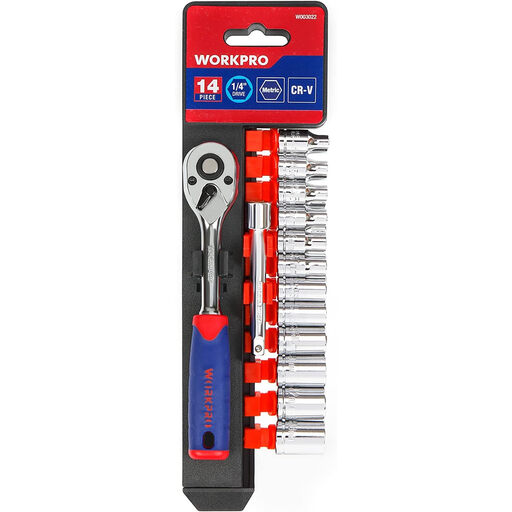
Why this product suits you: This compact metric tool set covers sizes from 4 to 13 mm, making it suitable for general repairs around the home, on bicycles or on smaller machines.
The included sizes and 72-tooth ratchet are clearly specified, so you can check in advance whether the selection suits your needs.
14 pieces, 1/4-inch drive, 76-mm extension and sizes from 4 to 13 mm, all in a compact storage case.
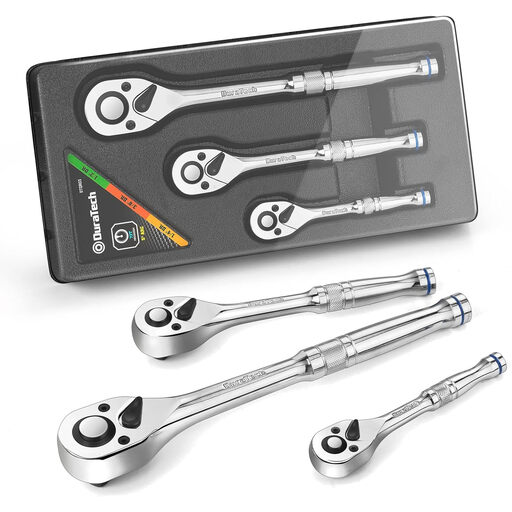
Why this product suits you: If you tackle a range of jobs, this set gives you three drive sizes—1/4, 3/8 and 1/2 inch—and neatly organised storage.
The three sizes are clearly differentiated, and the manufacturer specifies 72 teeth and a 5-degree working angle. This makes it easier to assess the technical details.
Three reversible ratchets, quick-release buttons, a fully polished chrome finish and a plastic storage case.
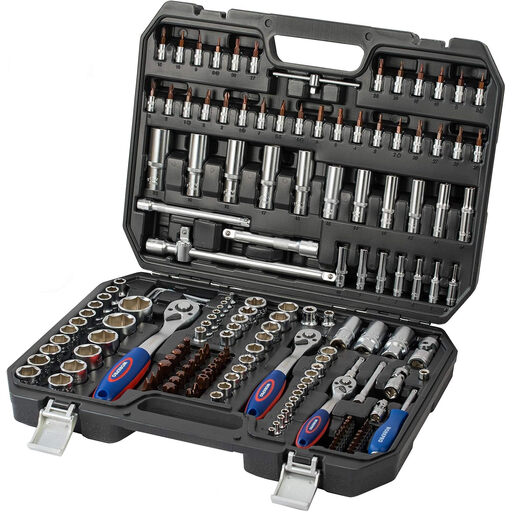
Why this product suits you: The set combines 1/4-, 3/8- and 1/2-inch ratchets with metric sockets, bits, Torx sockets, extensions and joints for jobs that vary from one day to the next.
The product description lists the included sizes, profiles and three drive sizes in detail. This lets you check the actual coverage before buying.
172 pieces, three 72-tooth ratchets, E-Torx and spark plug sockets, plus a moulded case with a dedicated place for each tool.
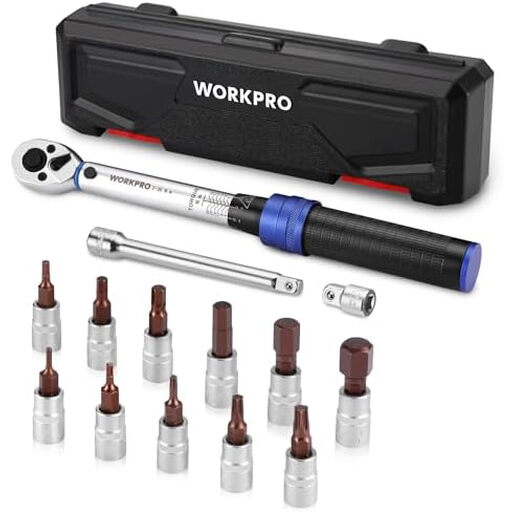
Why this product suits you: For fasteners that need to be tightened to a specific torque, this torque wrench set offers a range of 2 to 26 Nm and accessories for smaller jobs.
The stated measurement range helps prevent the tool from being used indiscriminately for every fastener. The manufacturer specifies accuracy of up to ±3 per cent.
72-tooth ratchet, 14 accessories, 102-mm extension and 1/4-to-3/8-inch adaptor.
We’ve put together a complete, regularly updated list of products that meet these strict selection criteria and fully comply with the safety regulations in force in the EU.
To keep your ratchet set in good working order for longer, clean oil, dust and moisture off the tools after use. You can occasionally apply a little oil to the ratchet mechanism, as directed by the manufacturer. Make sure sockets sit fully on the fastener. Extensions aren’t designed to let you increase the tool’s permitted force without limit.
For tight fasteners, a suitable longer lever or purpose-designed tool may be a better choice than a small fine-tooth ratchet. After use, reset a torque wrench to its lowest setting, if the instruction manual recommends this.
For a versatile car tool set, a combination of 1/4, 3/8 and 1/2 inch is a practical choice. A 1/4-inch drive covers smaller jobs, 3/8 inch suits many maintenance tasks, and 1/2 inch gives you extra capacity for larger fasteners.
For working in tight spaces, 72 teeth or more can be useful because they may reduce the return angle needed. When choosing a ratchet, also consider the head size, direction switch, handle, material and intended load range.
A ratchet set usually uses interchangeable sockets on a ratchet. A ring ratchet spanner set consists of fixed or combination ring ratchet spanners. Socket sets offer more ways to combine tools, while ring ratchets can be quicker to use on certain fasteners in confined spaces.