
Lieferung heute & morgen

Qualitätsgarantie

Willkommens-Angebote freischalten: KOSTENLOSE Lieferung | Bis zu 80 % RABATT | Kostenlose 30-Tage-JoyPlus-Testphase
App herunterladen
A ratchet set should make jobs around the house, on your bike or on your car easier. In practice, though, it soon becomes clear that the number of pieces isn’t the only thing that matters. A large tool case may contain sockets that aren’t right for your needs, while a compact set may cover most jobs but lack certain socket sizes.
The claim “more than 100 pieces” may sound impressive at first. However, the set could contain lots of bits, adapters or duplicate sizes. For vehicle maintenance, the most important items are the right metric sockets, extensions and a choice of drive sizes. A metric and SAE socket set is also useful if your vehicle or older equipment uses both millimetre and inch measurements.
According to the product description for the model in question, a 90-tooth ratchet often needs only a small return angle. That’s handy when space is limited. A 72-tooth ratchet also offers a relatively small swing angle. However, tooth count alone tells you nothing about the permitted torque, material quality or suitability for loosening seized bolts.
A standard ratchet is often not the right tool for very tight wheel nuts. A long breaker bar or a torque tool may be more suitable. Do not exceed the maximum torque specified for the product.
Loose sockets can easily disappear in a tool drawer or car boot. A tool case with a ratchet and clearly marked slots makes it easier to check that everything is there. Before you buy, check whether the case closes securely and whether the tools stay in their holders during transport and movement.
The terms 1/4, 3/8 and 1/2 inch ratchet refer to the square drive, not the size of the bolt.
A 3-in-1 ratchet handle can save space, but it won’t always replace three ratchets with different drive sizes. If you work in a workshop regularly, separate handles are often easier to organise and more clearly suited to the load involved.
Ratchets and sockets are often made from chrome vanadium or chrome molybdenum steel. The specific design, heat treatment and workmanship are what matter. A polished, chrome-plated finish can make cleaning easier and reduce the risk of corrosion. It’s no substitute for dry storage and regular care, though.
Also look for:
A small return angle is useful in tight spaces under the bonnet or inside furniture. The product details provided describe a 90-tooth ratchet as having a 4-degree swing angle. For the 72-tooth system, the stated angle is 5 degrees. These figures refer to the movement required to engage the next tooth and shouldn’t be taken as an indication of maximum load capacity.
For controlled tightening, you’ll need a torque ratchet or torque wrench. A standard ratchet is mainly for tightening and loosening, not for accurately setting a specified torque.
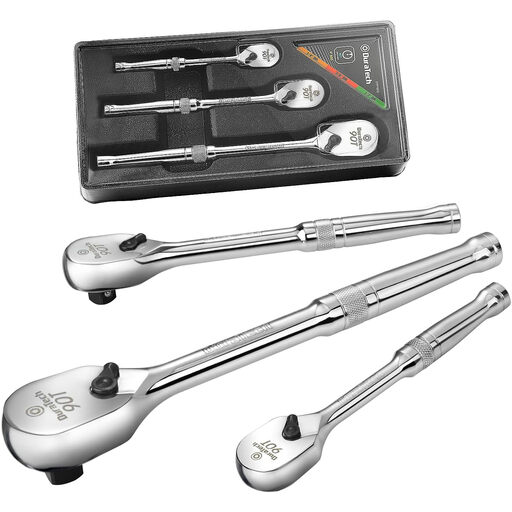
Why this product suits you: Three drive sizes cover a range of jobs around the house, in the garage and on your vehicle, without the need for a large all-in-one tool case.
The product description specifies a 90-tooth mechanism, a fully enclosed ratchet head and a storage case. This makes it easier to assess the return angle, protection from dirt and storage options.
1/4, 3/8 and 1/2-inch ratchets; polished chrome alloy; organised storage in a case.
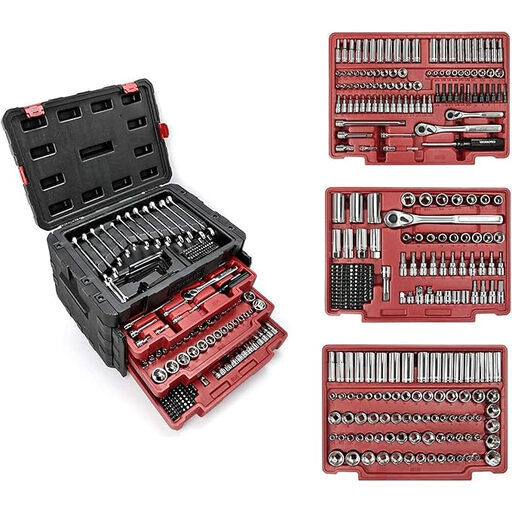
Why this product suits you: This set is for anyone who wants a wide range of tools and both metric and SAE sockets to hand for car and household repairs.
The product is described as a 450-piece set supplied in four case trays. This layout makes it easier to check the sizes and accessories against your needs before buying.
1/4, 3/8 and 1/2-inch drives; metric and SAE sockets; chrome vanadium steel according to the product description; lockable case.
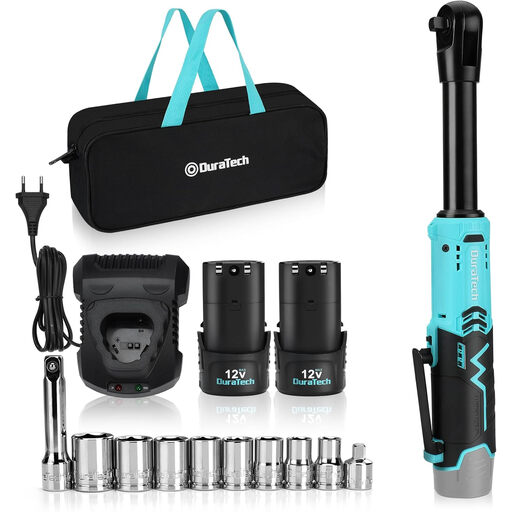
Why this product suits you: For repeated assembly jobs, a cordless ratchet wrench can save time and effort, provided its battery life, torque and size suit the task.
The product details specify 12 V, a maximum of 60 Nm, two 2.0 Ah batteries, a charger, an LED light and sockets. These details make it easier to check whether it’s right for the job you have in mind.
Cordless operation; 3/8-inch drive; LED light; forward and reverse; two batteries included.
For occasional repairs around the house, a compact socket set with 1/4 and 3/8-inch drives is often enough. If you own a car, also check whether it includes the sizes you need for the battery, brakes, interior and wheels. A 1/2-inch ratchet or a suitable breaker bar is useful for wheel nuts.
If you work regularly, you can add individual components: a flexible 1/4-inch ratchet for tight spaces, extensions for recessed bolts or a torque ratchet for specified tightening values. A cordless ratchet wrench is best suited to repeated assembly and disassembly, not necessarily to every seized fastener.
Before you buy, also compare the product description, what’s included, the sizes and the guidance on maximum torque. This helps you avoid paying for accessories you already have in your toolkit.
We’ve put together a complete, regularly updated list of products that meet these strict selection criteria and fully comply with the safety regulations in force in the EU.
A 3/8-inch ratchet is a versatile choice for many general repairs. A 1/2-inch ratchet is often used for larger bolts and wheel nuts. Small trim and interior bolts can often be handled with a 1/4-inch ratchet. The right socket size and permitted torque remain key.
Both can be useful in tight spaces. According to the product details provided, a 90-tooth ratchet has a 4-degree return angle, while a 72-tooth ratchet has a 5-degree return angle. You should also consider the material, head design, handle, socket retention and torque rating when choosing.
Its lifespan depends on the load, care, storage and correct use. Don’t use a ratchet as a hammer or extension, and don’t exceed the specified torque. After use, remove grease and dirt, then store the tools dry in their case.