
Lieferung heute & morgen

Qualitätsgarantie

Willkommens-Angebote freischalten: KOSTENLOSE Lieferung | Bis zu 80 % RABATT | Kostenlose 30-Tage-JoyPlus-Testphase
App herunterladen
A ratchet and socket set can replace many individual tools when repairing vehicles, assembling furniture, maintaining bicycles and carrying out household jobs. In practice, however, a set’s usefulness depends on more than the number of pieces alone. Incompatible drives, incomplete size ranges or inadequate storage can mean that a supposedly comprehensive tool case is barely usable.
This buying guide explains which technical specifications matter before you buy, which marketing claims deserve closer scrutiny and which socket set is best suited to different types of use.
A ratchet set with a large number of individual pieces may contain numerous bits, adapters and duplicate sizes. What matters is whether it includes the metric sockets you are most likely to need. For work on vehicles and household appliances, for example, 4 to 13 mm is useful for smaller fasteners, while 15 to 24 mm covers larger ones. Always check the included size list rather than relying on the total piece count alone.
A 72- or 90-tooth ratchet requires a smaller swing angle than mechanisms with fewer teeth. This is useful in confined spaces. However, the permissible load also depends on the design, material, drive and the manufacturer’s specifications. A small 1/4-inch ratchet is not designed to handle the same force as a 1/2-inch ratchet. The tooth count should therefore always be considered alongside the drive size and specified torque.
‘Steel’ is a very general description. With a Cr-V steel tool, or a tool made from chrome vanadium steel, buyers should look for details about heat treatment, surface coating and corrosion protection. A polished or chrome-plated surface makes cleaning easier, but it does not replace proper storage. After use, tools should be cleaned and dried, while moving parts should be lightly oiled when necessary.
The drive size determines which sockets can be used:
A set with multiple drive sizes is more flexible, but may require more storage space. A torque wrench extension must not be used without checking the manufacturer’s approval, as extensions can affect force transmission and the measured value.
The swing angle describes how far the handle must be moved back before the next tooth engages. According to the product specifications, several DURATECH models with 90 teeth require a swing angle of approximately 4 degrees. Models with 72 teeth are specified as requiring around 5 degrees, depending on the model. A 144-tooth ratchet with a 2.5-degree swing angle, as specified for the 8-piece ratchet set, is particularly suited to tight gaps.
Important: a small swing angle makes working in restricted spaces easier, but says nothing by itself about the maximum permissible load. Never exceed the specified torque.
Look for:
A tool case with labelled compartments makes it easier to check that everything is present. For a car boot, a compact tool roll may be more practical. A ring spanner ratchet set, meanwhile, is a sensible choice if you mainly work on hexagonal nuts without changing sockets.
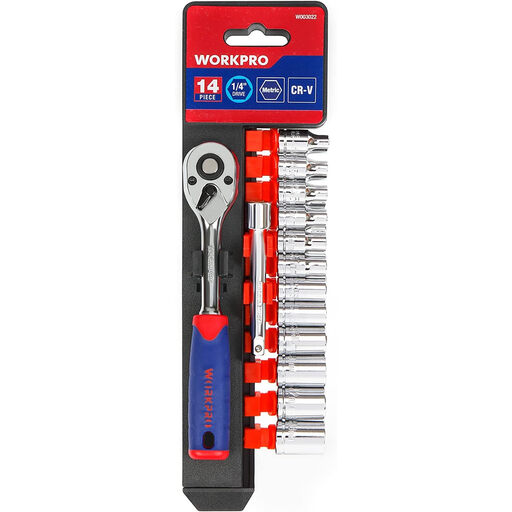
Why this product suits this profile: According to the product specifications, this compact 1/4-inch socket set covers metric sizes from 4 to 13 mm, making it suitable for DIY, household and light repair work.
The specific size list prevents the set from being marketed on piece count alone. The 72-tooth ratchet and quick-release mechanism are clearly specified.
Cr-V steel, 1/4-inch drive, 76 mm extension and a specified torque rating of 150 Nm.
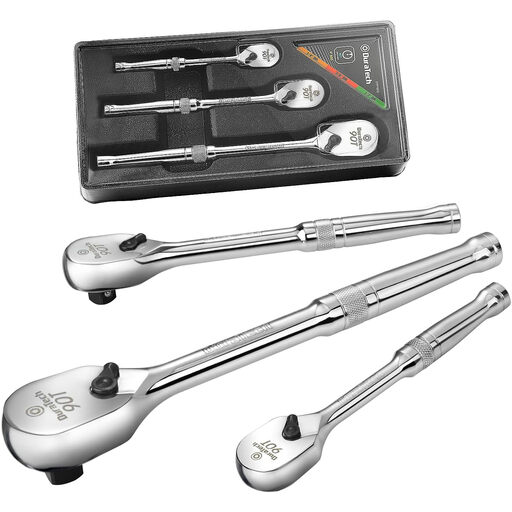
Why this product suits this profile: Three separate drives — 1/4, 3/8 and 1/2 inch — let you choose the appropriate drive and socket size for different assembly tasks.
The drive sizes are not hidden behind an unclear adapter arrangement. The product description specifies 90 teeth, a 4-degree swing angle and a fully enclosed ratchet head.
Heat-treated chrome-alloy steel, reversing lever, quick-release button and storage case.
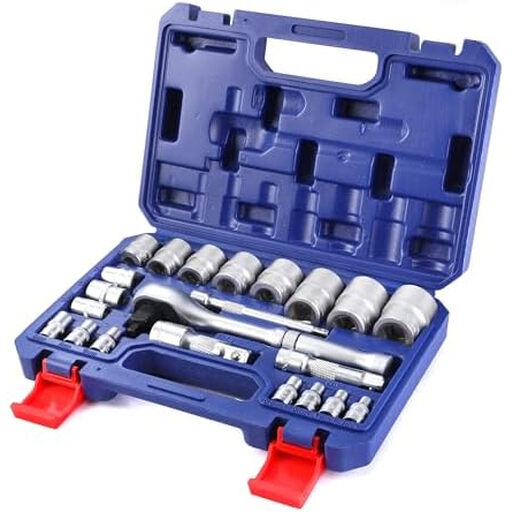
Why this product suits this profile: This set combines a 3-in-1 ratcheting handle with metric sockets from 4 to 24 mm, making it suitable for vehicle, bicycle, appliance and general maintenance work.
The drive and size breakdown is listed individually in the product description. Three extensions support work in hard-to-reach areas.
72-tooth ratchet, 18 metric sockets, three extensions and a shock-resistant storage case.
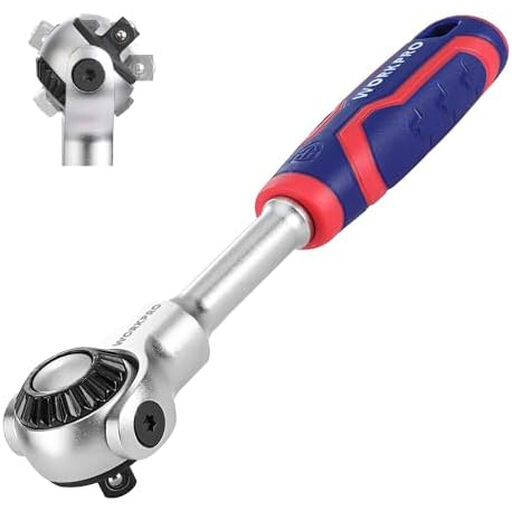
Why this product suits this profile: According to the product specifications, the swivelling head offers 270 degrees of movement, making it suitable for confined areas in vehicles, around the home or during assembly work.
The range of use is not described merely as ‘flexible’; it is specified through the 1/4-inch drive, 72 teeth, quick-release mechanism and stated swivel range.
Low product weight of 140 g according to the specifications, 150 mm length, ergonomic handle and reversible direction of rotation.
We have put together a complete, regularly updated list of products that fully meet these strict selection criteria and the safety regulations applicable in the EU.
For regular work on a car, a set with 1/4-, 3/8- and 1/2-inch drives is highly versatile. Also check whether it includes important metric sizes, extensions, universal joints and, where necessary, spark-plug sockets. For wheel nuts and safety-critical fasteners, follow the vehicle manufacturer’s torque specifications; a suitable torque wrench is required.
Its service life depends on the load, material, care and storage conditions. Heat-treated chrome vanadium steel and a corrosion-resistant coating are objectively relevant specifications. Avoid extending the ratchet handle, striking tools with a hammer unless they are designed for it, and exceeding the specified torque. After use, tools should be stored clean, dry and neatly organised.
A large case is worthwhile if you regularly carry out a range of vehicle, assembly and household tasks and genuinely need the included sizes. For occasional repairs, a compact socket set containing the most common metric sizes may be more economical and easier to store. Choose according to how you plan to use it, not simply by the number of pieces.