
Lieferung heute & morgen

Qualitätsgarantie

Willkommens-Angebote freischalten: KOSTENLOSE Lieferung | Bis zu 80 % RABATT | Kostenlose 30-Tage-JoyPlus-Testphase
App herunterladen
A ratchet tool set should cover a wide range of jobs, from assembling furniture and maintaining your bike to carrying out minor car repairs and household tasks. In practice, though, it soon becomes clear whether a set has been put together sensibly. Missing sizes, poorly fitting bits or a cluttered toolbox can significantly reduce the advantages of a supposedly comprehensive set.
This guide explains which technical features to consider before buying, which common marketing traps to watch out for, and which set might suit your needs.
A set with lots of pieces may sound versatile at first. What matters, though, is how many of them actually cover different sizes and shapes. Duplicate or rarely needed options can inflate the piece count without significantly expanding the range of jobs the set can handle.
Before buying, check:
A magnetic bit holder can make changing bits easier and help position them during assembly. However, magnetic force cannot make up for an ill-fitting connection. The bit may not stay in place under heavy pressure or sideways force, or if it is worn.
For furniture, electronics and household appliances, it’s also important that the bits fit the screw heads precisely. A bit that is too small or worn can damage the screw head.
A ratchet screwdriver set with a 1/4-inch drive is well suited to smaller fixings and tight spaces. For stubborn screws on a car or larger nuts, a more comprehensive socket set with a 3/8- or 1/2-inch drive is often a better choice.
Check the load limit specified by the supplier. Don’t use additional extension bars unless the manufacturer explicitly says you can.
A 1/4-inch ratchet is compact and suitable for smaller screws, bits and sockets for household, bike and electronics jobs. A 3/8-inch drive often covers medium-duty work, while a 1/2-inch drive is more commonly used for larger fixings.
The swing arc matters when you’re working in confined spaces. According to the product description, a ratchet with 72 teeth and a 5° swing arc needs only a short movement before the next tooth engages. This can be useful when working between components. However, how suitable it is will still depend on access, screw size and the torque required.
Bits are often described as being made from S2 tool steel or other steel alloys. Chrome vanadium steel is commonly used for sockets and ratchets. These specifications tell you what materials are used, but they don’t, on their own, guarantee a particular service life.
Other things to look for include:
A well-organised toolbox saves time and reduces the risk of losing individual pieces. Size markings on sockets and dedicated slots in the case are useful for regular maintenance work. If you’re choosing a portable DIY tool set, also consider its weight, case size and fastener.
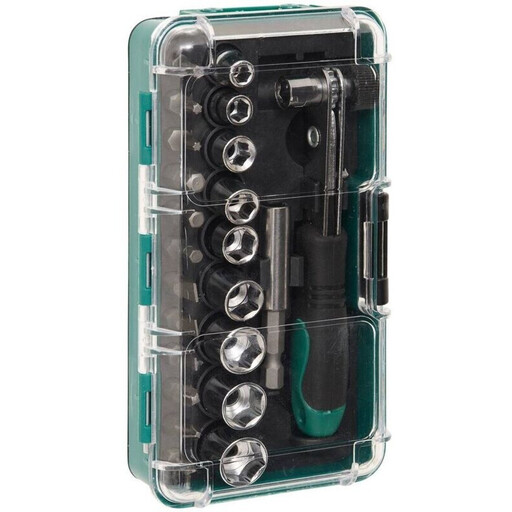
Why this product suits this user: This compact set is aimed at people who occasionally assemble furniture, secure household items or carry out minor repairs.
The contents are clearly specified: 11 bits, 9 sockets from 4 to 12 mm, and a magnetic adapter. This makes it easy to check the actual range before you buy.
1/4-inch ratchet, a net weight of 375 g according to the product information, and a compact case measuring 8,5 × 3,5 × 15,5 cm.
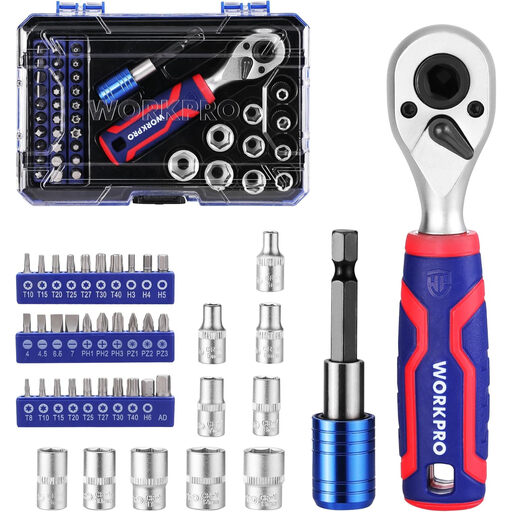
Why this product suits this user: For regular DIY jobs, bike maintenance and minor car repairs, this set offers a clearly specified 1/4-inch selection in a carry case.
The product description lists 10 metric sockets, 30 bits and a magnetic quick-change holder. Its 72-tooth mechanism is specified as having a 5° swing arc.
According to the product description, the bits and sockets are made from chrome vanadium steel. The sizes are suited to common assembly and maintenance jobs.
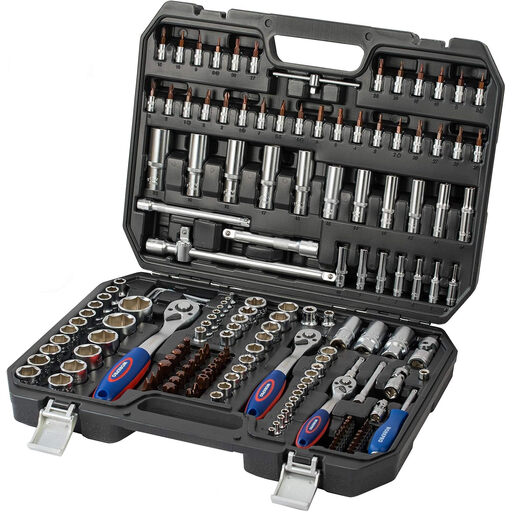
Why this product suits this user: This set is designed for people who regularly work on cars, motorbikes, bikes, machinery or household projects, and need more than one drive size.
Rather than simply offering lots of bits, the case includes 1/4-, 3/8- and 1/2-inch ratchets, extensions, universal joints, adapters and metric sockets.
According to the product description, the set includes three 72-tooth ratchets, deep sockets and a moulded case with size markings.
We’ve put together a complete, regularly updated list of products that meet these strict selection criteria and fully comply with the safety regulations in force in the EU.
A repair tool should always be matched to the screw and the load it’s intended to handle. Don’t use damaged bits, and replace sockets with visible cracks. When working on cars, take extra steps to prevent them from rolling. Don’t use metal tools on electrical cables or equipment connected to a power supply.
For electronics, a precision repair kit may be more useful than a large car tool set. When working with delicate screws, use light pressure, choose the correct bit size and keep the tool straight.
For many furniture and bike jobs, a 1/4-inch ratchet with metric sockets and commonly used bits is enough. In hard-to-reach places, a short head, a small swing arc and, where needed, extension bits can help.
Its lifespan depends on the materials, how heavily it’s used, how it’s stored and how well it’s maintained. Excessive torque, rust, using the tool at an angle and fitting the wrong bits can all speed up wear. Store the set somewhere dry, and regularly check the ratchet mechanism, bit tips and socket profiles.
A large set is worth considering if you genuinely need different drive sizes, deep sockets and a wide range of bit profiles. For occasional household jobs, a compact ratchet screwdriver set with a carefully chosen selection of accessories may be lighter, cheaper and quicker to use.