
Lieferung heute & morgen

Qualitätsgarantie

Willkommens-Angebote freischalten: KOSTENLOSE Lieferung | Bis zu 80 % RABATT | Kostenlose 30-Tage-JoyPlus-Testphase
App herunterladen
A high-quality ratchet wrench set is the cornerstone of any well-equipped workshop. However, the market is flooded with options that over-promise and under-deliver. If you don't pay attention to the crucial details during selection, you often end up investing in tools that quickly rust, break, or are simply useless in tight spaces. As your Joybuy Product Recommendation Officer, I'll help you navigate the common pitfalls and make an informed decision.
The most common problems with budget-friendly sets are easy to spot:
To avoid a bad purchase, you should check three core technical aspects. These features separate durable, efficient tools from short-lived substitutes.
The quality of the material is the most important criterion for the longevity of your tools. Look for the Chrome Vanadium Steel (Cr-V) specification. This alloy offers high strength and toughness, meaning the wrenches won't break or deform even under high torque. The chrome plating also provides effective protection against rust and makes cleaning easier. Tools without this specification are often unsuitable for long-term use, especially in professional or ambitious DIY settings.
The number of teeth in the ratchet head determines how finely and precisely you can work. A ratchet described as fine-toothed with 72 teeth requires only a minimal 5-degree swing arc to engage the next tooth. In contrast, an older 48-tooth mechanism requires 7.5 degrees. This 2.5-degree difference is critical when working on hard-to-reach fasteners, which is commonplace with an automotive tool kit. A smaller arc means you can effectively tighten or loosen the fastener even with minimal room to move.
Different designs are suited for different applications:
Based on the quality criteria mentioned, we have identified a few products that are particularly well-suited for specific user profiles.
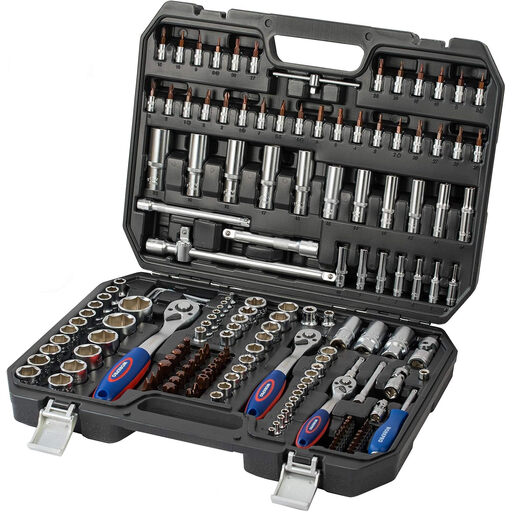
Why It's a Match: Ideal for users who want a single, comprehensive set for all jobs on cars, motorcycles, bicycles, and around the house. It offers enormous versatility without the need to constantly buy more tools.
This set avoids the "impractical composition" trap by offering a well-thought-out selection of sockets, bits, and three ratchet sizes (1/4", 3/8", 1/2"). The material is specified as Chrome Vanadium Steel, and the ratchets feature a 72-tooth mechanism.
The huge range of 172 pieces in an organized case makes it a complete workshop solution for almost any mechanical problem.
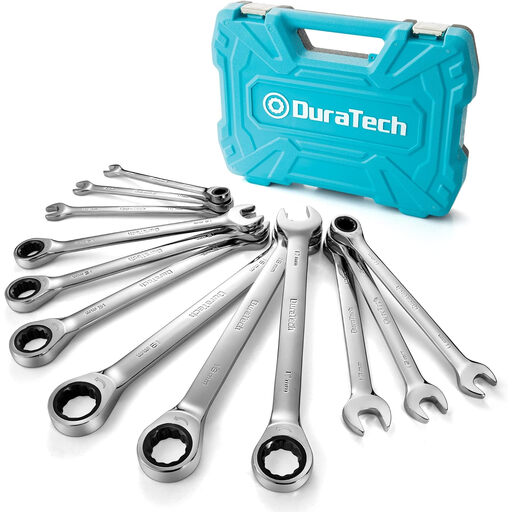
Why It's a Match: Perfect for mechanics and hobbyists who regularly work in tight engine bays or on obstructed machine parts where every millimeter of clearance counts.
This set solves the problem of "coarse ratchet mechanisms" and poor accessibility. The 180° flex-head combined with the 72-tooth ratchet (5° swing arc) allows you to work on fasteners that are unreachable with rigid wrenches.
The extreme flexibility of the flex-head saves time and frustration during complex repairs and maintenance tasks.
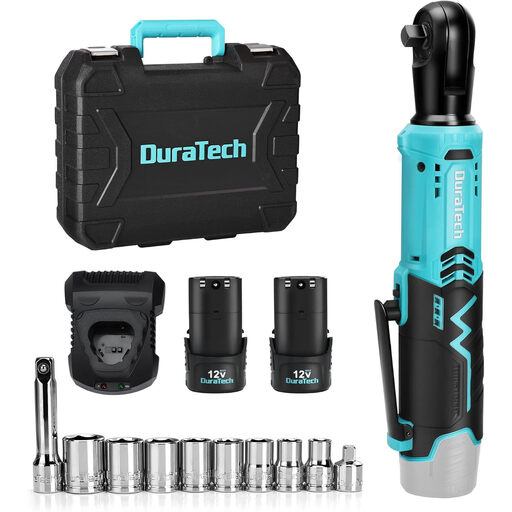
Why It's a Match: For professionals and enthusiasts who demand maximum efficiency for repetitive fastening tasks. Ideal for disassembly and assembly jobs involving many long-threaded bolts.
This tool eliminates the physical strain and time consumption of manual ratcheting. Instead of relying on pure mechanics, it offers a motorized solution for rapid work. The inclusion of two batteries and a fast charger ensures continuous operation.
The battery-powered drive with up to 65 Nm of torque enables significantly faster and less fatiguing work compared to any manual ratchet wrench.
We have compiled a complete, up-to-date list of products that fully meet these strict selection criteria and UK safety regulations.
A ratcheting wrench set consists of individual combination wrenches where the box end has a ratchet function. They are slim and designed for direct access to nuts and bolts. A socket set (also called a ratchet set) includes a central ratchet handle and a selection of interchangeable sockets. By using extensions and universal joints, it is more flexible and can also reach deep-set fasteners.
For professional demands and comfortable work, a ratchet with 72 teeth is now considered the standard. The resulting small swing arc of just 5 degrees is a major advantage, especially when working in confined spaces, as is often the case with an automotive tool kit. Models with fewer teeth (e.g., 48 or 60) require more room to operate and can be unusable in tight situations.
A flex-head ratchet wrench is a smart investment if you regularly work in hard-to-reach places. Typical examples include fasteners deep in an engine bay, behind fixed panels, or on angled components. The pivoting head allows you to work around obstacles. For easily accessible, straight-on fasteners, a rigid wrench is often sufficient and potentially more robust due to its simpler construction.