
Lieferung heute & morgen

Qualitätsgarantie

Willkommens-Angebote freischalten: KOSTENLOSE Lieferung | Bis zu 80 % RABATT | Kostenlose 30-Tage-JoyPlus-Testphase
App herunterladen
A ratchet wrench set can save you a great deal of time during repairs. The ratchet function allows you to keep turning without repositioning the wrench after every short stroke. This is particularly useful for vehicles, machinery and hard-to-reach fasteners.
However, several common pitfalls can lead to unnecessary expense when buying:
The tooth count indicates how many positions the ratchet mechanism is divided into. A higher tooth count can allow for a smaller working angle. This is useful when there is very little space between the fastener and adjacent components.
For example, according to the product details, the 8PCS 144P Ratchet Wrench with Roll Bag features a 144-tooth ratchet mechanism with a working angle of 2.5 degrees. The set includes the metric sizes 8, 10, 11, 12, 13, 14, 15 and 17 mm. With a traditional ratcheting ring spanner set, you should also check whether the switch for clockwise and anti-clockwise operation is clearly designed.
For hand tools, details such as chrome vanadium steel, carbon steel, heat treatment and a corrosion-resistant coating are relevant points of comparison. However, these details alone do not indicate whether a tool is suitable for every type of load.
Look for:
When working on seized fasteners, do not extend the tool with an additional pipe unless the manufacturer expressly permits this. A ratchet wrench is not a substitute for a torque wrench or a breaker bar.
A combination spanner set generally combines an open-ended section with a closed ring. A ratchet wrench set, by contrast, features a ratchet mechanism, while a socket set works with different sockets and drives.
The following points are decisive when choosing:
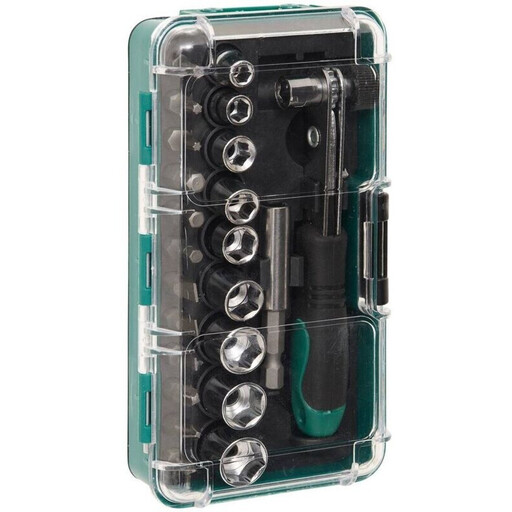
Why this product suits the profile: This compact set is suitable for occasional assembly work, furniture, minor repairs and use around the home. It contains 11 bits and 9 sockets from 4 to 12 mm in a handy case.
The sizes and components are clearly specified. This reduces the risk of choosing a set based solely on its advertised piece count.
1/4-inch ratchet drive, magnetic adapter, compact hard-shell case and a net weight of 375 g according to the product description.
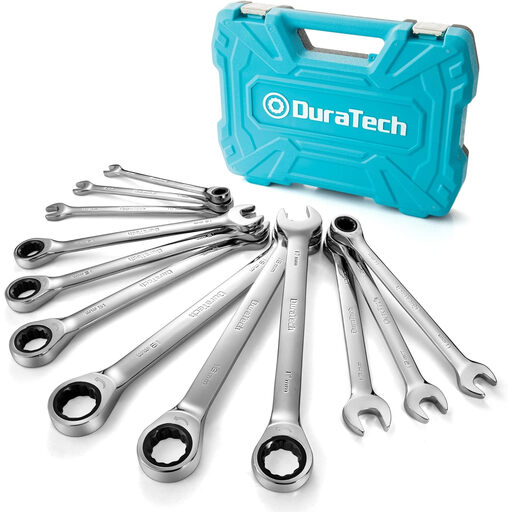
Why this product suits the profile: The complete metric range from 8 to 19 mm is clearly arranged for regular work on vehicles, machinery and installations.
The product details specify the material, sizes, tooth count and working angle. This makes it possible to compare advertising claims with concrete features.
Cr-V steel, 72-tooth ratchet mechanism, 5-degree working angle and labelled storage case according to the product description.
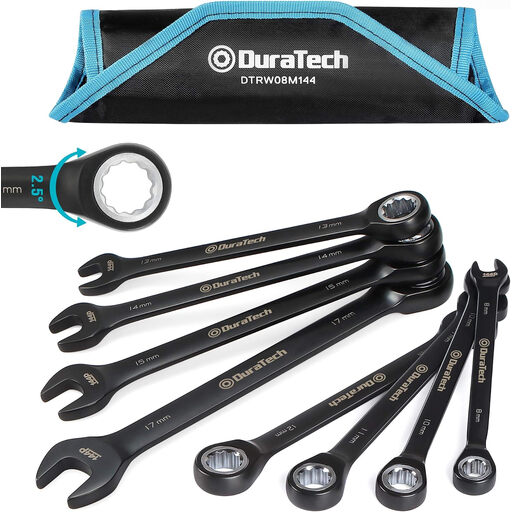
Why this product suits the profile: For car repairs, maintenance work and confined installation spaces, this set provides eight metric ratchet wrenches in a space-saving roll-up pouch.
The roll-up pouch keeps each size in its designated place. The specific size list prevents important measurements from being overlooked in favour of a high tooth count.
144 teeth, 2.5-degree working angle, Cr-V steel and black chrome finish according to the product description.
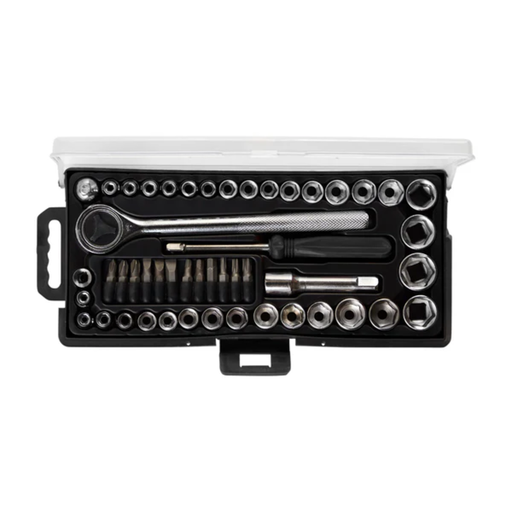
Why this product suits the profile: This set is aimed at users who want to combine bits, metric sockets and SAE sockets in one toolbox.
The 49 components are listed individually. This allows buyers to check whether 1/4- and 3/8-inch drives, an extension and the required measurement systems are actually included.
16 metric sockets from 4 to 15 mm, 16 SAE sockets, 12 bits and a 75-mm extension according to the product details.
We have put together a complete, regularly updated list of products that fully meet these strict selection criteria and the safety regulations applicable in the EU.
To find the right tool set, start by noting down the fastener sizes you use most often. For car-related work, the tool’s shape and accessibility are also crucial. An offset double ring spanner set can be advantageous for recessed nuts, while a straight ratcheting ring spanner works more quickly on easily accessible fasteners.
Keep the following points in mind every time you use your tools:
For general assembly work, a metric range of around 8 to 19 mm is often practical. Vehicles, bicycles or specific machines may also require smaller or larger wrench sizes. Before buying, check the fastener sizes used in your most common applications.
Both designs have different applications. An open-ended spanner set can be fitted quickly to a nut that is accessible from the side. A ratchet wrench saves time during repeated turning movements and is practical in confined spaces. For maintenance work, combining both types of tool can be a sensible choice.
Its service life depends on the material, construction, load, cleaning and storage. Only use the wrench for suitable fastened connections and do not exceed the intended load limits. After use, remove grease and dirt, then store the tools dry in the case or roll-up pouch.