
Lieferung heute & morgen

Qualitätsgarantie

Willkommens-Angebote freischalten: KOSTENLOSE Lieferung | Bis zu 80 % RABATT | Kostenlose 30-Tage-JoyPlus-Testphase
App herunterladen
A ratchet wrench set can make repairs, assembly work and maintenance tasks significantly easier. However, sets differ considerably in drive sizes, sockets, material, mechanism and accessories. A high piece count alone therefore says little about practical suitability.
Typical buying mistakes arise from three points:
With a socket set, 1/4, 3/8 and 1/2 inch determine which sockets and load ranges are sensibly covered. A 1/4-inch ratchet is compact and suitable for smaller screws and tight spaces. 3/8 inch is versatile for household, bicycle, motorcycle and many vehicle jobs. 1/2 inch is often used for larger fastenings.
Also pay attention to the actual sizes included. A socket wrench set with metric sockets from 4 to 15 mm covers different tasks than a set with sizes up to 24 mm. SAE sockets can be useful for certain imported vehicles or machines, but do not automatically replace a complete metric selection.
The tooth count affects the required return angle. A 72-tooth ratchet, for example, requires a working angle of around 5 degrees according to product specifications. This is practical in confined spaces, such as in the engine bay or on furniture fittings. With the described 8-piece ratchet wrench set featuring 144 teeth, a working angle of 2.5 degrees is specified.
A swivel head can provide additional freedom of movement. What remains important is that the head is guided stably and the switch for clockwise and anticlockwise rotation is easily accessible. For very tight spots, an extension may be more practical than a particularly long ratchet.
For sockets and ratchets, chrome vanadium steel (Cr-V), chrome molybdenum steel (Cr-Mo) or carbon steel are often specified. These material details help with classification but are not a sole indicator of quality. Also check:
A torque wrench serves a different purpose from a standard ratchet wrench. For precise assembly work, a digital torque wrench with display and signalling can be useful. The setting must always be based on the technical specifications of the respective component. A stated accuracy should be understood as a manufacturer's specification and does not replace proper application.
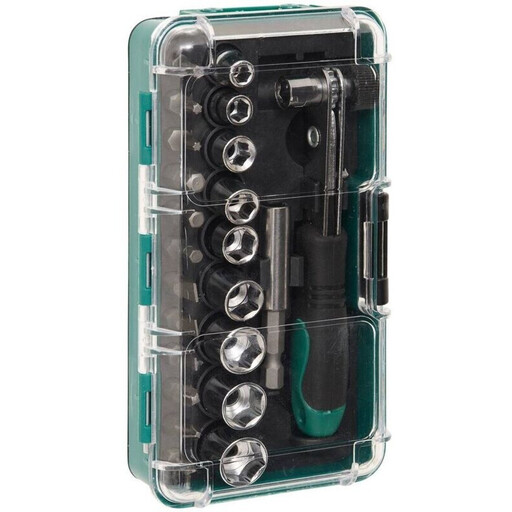
Why this product suits the profile: This compact 1/4-inch set is aimed at users who want bits and sockets ready to hand for smaller repairs, furniture assembly and maintenance tasks.
The equipment is clearly specified: 11 bits, 9 sockets from 4 to 12 mm, magnetic adapter and compact case.
Low net weight of 0.375 kg, ergonomic handle and storage in an 8.5 × 3.5 × 15.5 cm case.
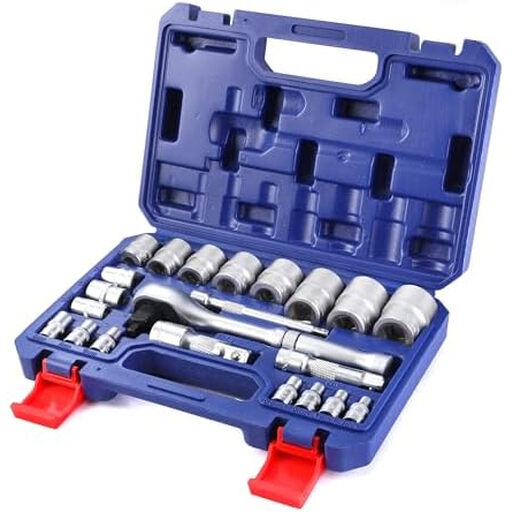
Why this product suits the profile: This ratchet tool set combines 1/4, 3/8 and 1/2-inch drives in one ratchet handle and is aimed at users with varying tasks.
The sizes are not just described by piece count: 18 metric 6-point sockets range from 4 to 24 mm, supplemented by three extensions.
72-tooth ratchet, Cr-V steel and a shockproof plastic case with individual slots.
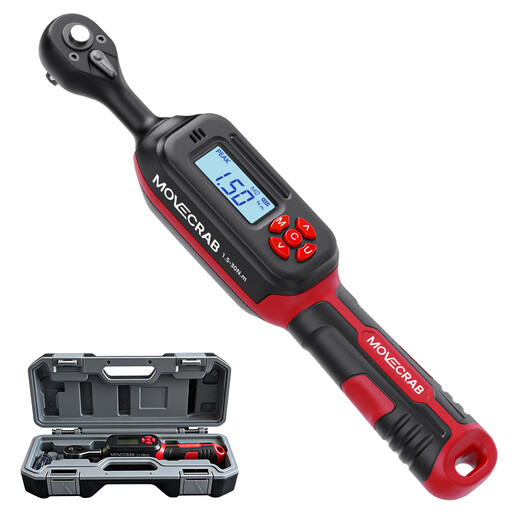
Why this product suits the profile: For cyclists and motorcyclists as well as finer assembly work, a defined range of 0.6 to 12 Nm is relevant.
The torque range is clearly stated. Additionally, users should check whether the target value of the component actually falls within this range.
According to the product specification, ±2 % accuracy, two measuring modes, ten memory slots and vibration, tone and LED signal.
We have compiled a complete, regularly updated list of products that fully meet these strict selection criteria and the safety regulations applicable in the EU.
A ratchet set or socket set with a case makes it easier to keep track of the parts and reduces the risk of losing individual sockets. For a car tool set, at least the commonly needed metric sizes, suitable extensions and a robust reversing mechanism should be included.
A combination spanner set complements the socket set where a ratchet cannot gain sufficient access. For wheel changes or heavily seized fastenings, a long breaker bar or flex handle can be useful. An electric impact wrench, on the other hand, is a powered tool and should not be confused with a standard ratchet wrench.
Before each use, remember:
For many household, bicycle and furniture jobs, a 1/4-inch or 3/8-inch ratchet is sufficient. For larger fastenings on a car, a set with a 1/2-inch drive is often more practical. A combined set offers more choice but requires more storage space.
The lifespan depends on material, load, cleaning and proper use. Overloading, extension pipes or striking the ratchet can damage the mechanism. Damaged sockets and ratchets should not be used further.
If the manufacturer of a component specifies a concrete tightening torque, a suitable torque wrench is advisable. A standard ratchet wrench is mainly used for loosening and tightening and does not reliably indicate when a specific torque value has been reached.