
Lieferung heute & morgen

Qualitätsgarantie

Willkommens-Angebote freischalten: KOSTENLOSE Lieferung | Bis zu 80 % RABATT | Kostenlose 30-Tage-JoyPlus-Testphase
App herunterladen
A remote-controlled car is often more than just a toy; it's a gateway into the world of technology and a guarantee of hours of entertainment. But the market is flooded with models whose advertised features don't always deliver on their promises. Before you make a decision that leads to short-lived fun and disappointment, it's important to know the most common pitfalls and which technical features really matter. This guide will help you sort the good from the bad.
Many buyers looking for a gift for boys or girls focus on flashy designs and promises of stunts. In doing so, they often overlook fundamental flaws that can quickly put an end to the fun.
To avoid these problems, you should focus on a few objective technical specifications. These provide a more reliable indication of a model's quality and performance than any marketing description.
The type of control significantly defines the driving experience. Alongside traditional lever-style remotes, innovative concepts are gaining traction.
The drivetrain determines where the car can be used.
The power source and material quality are the foundation for a long lifespan.
Based on these objective criteria, we have identified a few models suitable for different user groups and requirements.
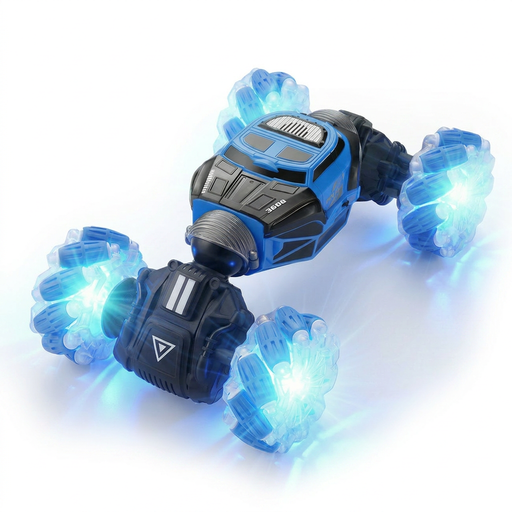
Why it's a great fit: This model combines almost all the most sought-after features: it's a gesture-controlled car, an off-road RC car with all-wheel drive, and an RC stunt car with 360-degree rotation. Ideal for kids and teens looking for maximum action and cool tech features.
The 1200 mAh battery provides a runtime of over 30 minutes, according to the manufacturer. The 2.4 GHz remote ensures a stable connection, and the all-wheel drive offers the necessary durability for off-road driving.
Dual control options (classic remote and gesture-watch) and an integrated RC car with lights and sound for visual effects.
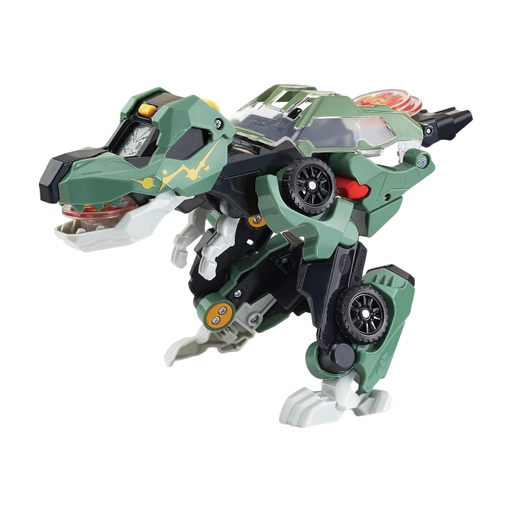
Why it's a great fit: For younger children, a full-featured RC car is often too complex. This 2-in-1 toy transforms from a dinosaur into a vehicle, combining role-playing with simple tech features like light and sound effects.
It bypasses the typical RC problems by relying on manual transformation and interactive buttons instead of a remote control. Its durability is designed for the 3-to-8-year-old target audience, and the batteries are included.
Promotes fine motor skills with its transformation feature. The LCD screen, which displays animated eyes, and the launching function offer additional play value.
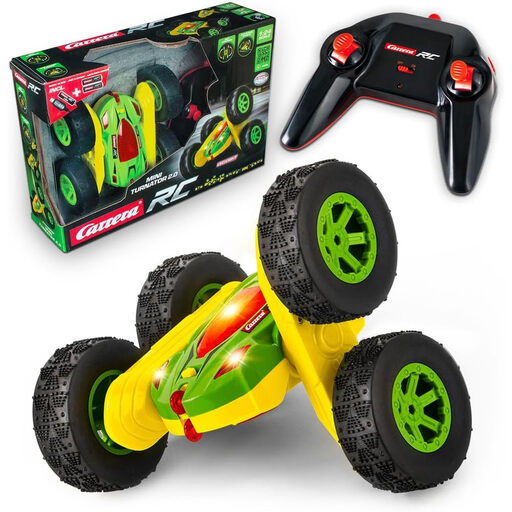
Why it's a great fit: For anyone looking for a straightforward yet powerful RC stunt car. Carrera is an established brand in the slot car racing world. This model focuses on the essentials: driving and spectacular 360-degree flips.
The model is designed as "Ready to Run," including the battery, charging cable, and controller. The 2.4 GHz technology allows for multi-player operation. Its robust construction is built to handle the typical stresses of performing stunts.
Focus on the core feature (360° flips) without unnecessary complexity. The LED lighting also allows for driving at dusk.
We have compiled a complete, up-to-date list of products that fully meet these strict selection criteria and rigorous safety standards.
1. What does 2.4 GHz technology mean for a remote-controlled car? The 2.4 GHz technology is a modern radio standard. Unlike older frequencies (like 27 or 40 MHz), the transmitter automatically finds a free channel. The result is a significantly more stable and interference-free connection. It also allows many RC vehicles to operate at the same time without interfering with each other.
2. On average, how long does the battery of an RC stunt car last? Battery life heavily depends on the capacity (mAh) and the intensity of use. Basic models often have a runtime of only 10–15 minutes. According to manufacturers, models with batteries of 1200 mAh or more can often last for 30 minutes or longer. Continuous stunts and full-speed driving consume more power than steady driving.
3. Is a gesture-controlled car suitable for a 6-year-old child? Yes, many gesture-controlled models are designed for children aged 6 and up. Controlling the car with hand movements is often more intuitive and easier to learn than coordinating two joysticks on a classic remote. However, it is recommended that use, especially in the beginning, takes place under adult supervision to ensure safe handling.