
Lieferung heute & morgen

Qualitätsgarantie

Willkommens-Angebote freischalten: KOSTENLOSE Lieferung | Bis zu 80 % RABATT | Kostenlose 30-Tage-JoyPlus-Testphase
App herunterladen
A remote control car that effortlessly transitions from the lawn to the water is a highlight for many children and tech-savvy families. However, the market is flooded with models whose promises quickly sink in practice. Before you make a decision, it's crucial to understand the common pitfalls that often lead to disappointment. As your Joybuy Product Recommendation Officer, I'll help you identify the decisive features.
Many buyers only realise after unboxing that their new toy doesn't meet expectations. Pay close attention to these three weaknesses to avoid a poor investment.
To ensure the vehicle lives up to its promises, you should carefully examine three technical aspects.
The heart of any amphibious vehicle is its drive system. A 4WD system (all-wheel drive) is almost essential for the dual demands of land and water. It provides the necessary traction on loose ground and sufficient thrust in the water. Pay attention to the wheels: special propeller or paddle wheels are a good sign. They are designed to act as grippy tyres on land and as propulsion paddles in the water.
A true amphibious vehicle for kids must be more than just superficially sealed. Look for mentions of a double-sealed or fully encapsulated electronics compartment in the product description. The body itself should be made of robust, impact-resistant ABS plastic. This material is resistant to the bumps and tumbles that are inevitable during off-road driving or stunts.
Modern RC vehicles use a 2.4 GHz radio frequency. This technology is crucial as it ensures a stable and interference-free connection between the transmitter and the vehicle. This is especially important when multiple vehicles are running at the same time, as the signals won't interfere with each other. If the model offers gesture control, check if a traditional button remote is also included. This gives the user a choice between intuitive fun and precise control, which is particularly useful for demanding manoeuvres like those of a 360-degree stunt car.
Based on the criteria above, we have identified some models that are suitable for different user profiles and play styles.
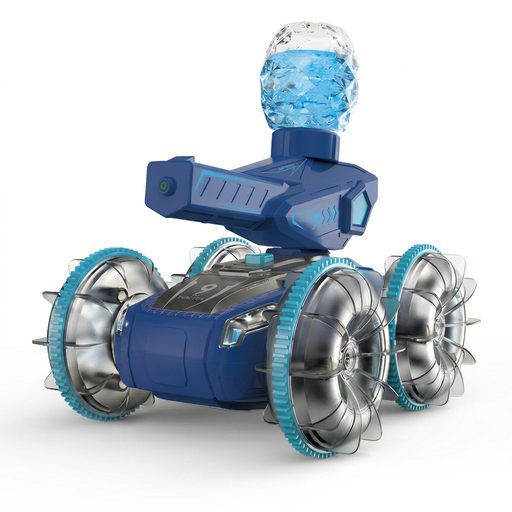
Why This Fits Their Persona: Ideal for kids who love interactive competitions. The integrated RC tank water cannon enables exciting water battles in the pool or at the beach, elevating the play experience beyond just driving. A perfect gift for boys who seek action.
The vehicle features a tight seal specifically designed for use in shallow water, thus bypassing the "false waterproofing" pitfall. The dual control system offers a precise alternative to pure gesture control.
The water spray function works both on land (with a tank) and in water (by suction). The 2.4 GHz technology allows for interference-free races with multiple vehicles.
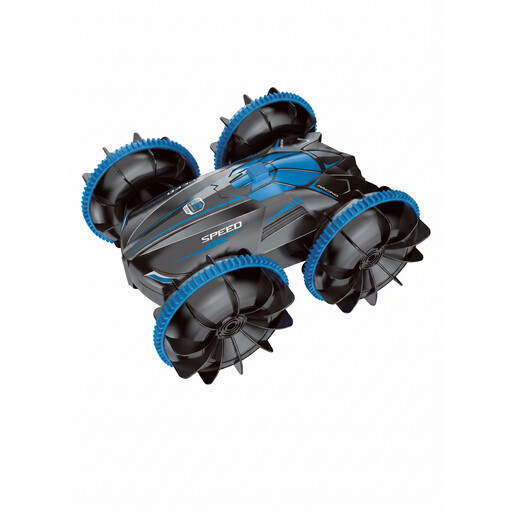
Why This Fits Their Persona: Perfect for kids fascinated by cool manoeuvres. This stunt car can rotate 360 degrees and drive on both sides, so it won't get stuck after flipping over. The gesture control watch is an added technical incentive.
The powerful 4WD drive delivers enough power for demanding stunts on land and in water, avoiding the "weak motor" pitfall. The double-sided driving design solves the problem of flipping over.
Offers an automatic stunt demonstration mode for beginners. The combination of a wrist remote and a classic remote provides flexibility and long-lasting fun.
We have compiled a complete, up-to-date list of products that fully meet these strict selection criteria and German safety regulations.
Battery life varies depending on the model and intensity of use. Most vehicles in this category offer a runtime of about 15 to 25 minutes per charge. Charging time is typically between 2 and 3 hours. Some sets include a second battery to extend the fun.
Models explicitly advertised as "amphibious" or "waterproof" for pool use are designed with sealed compartments for the battery and electronics. However, it is important to read the manufacturer's specifications carefully. Vehicles declared only as "splash-proof" should not be fully submerged.
The age recommendation depends on the complexity of the model. Simpler vehicles are often suitable for children as young as 3 or 4. Models with advanced features like RC car gesture control or a water cannon are generally recommended for children aged 6 and up, as they require more coordination to operate. Always observe the manufacturer's safety instructions.