
Lieferung heute & morgen

Qualitätsgarantie

Willkommens-Angebote freischalten: KOSTENLOSE Lieferung | Bis zu 80 % RABATT | Kostenlose 30-Tage-JoyPlus-Testphase
App herunterladen
An RC car for children can be a simple remote-controlled toy car for beginners or a more technically advanced vehicle for drifting, off-road driving and stunts. The choice may seem straightforward at first glance, but descriptions such as ‘high speed’, ‘robust’ or ‘suitable for all terrains’ do not always provide enough information to assess how practical a model is for everyday use.
Parents, grandparents and other relatives should therefore check three common pitfalls before buying:
A 4WD RC car transfers the motor’s power to all four wheels. This can offer advantages over a model with a simpler drivetrain when driving on grass, carpets, sand or uneven paths. Special Mecanum wheels are often used for sideways drifting and spinning. A classic RC drift car, on the other hand, is generally better suited to smooth, level surfaces such as tiles, parquet flooring or concrete.
This overview can help with your decision:
The term ‘waterproof’ should not automatically be taken to mean completely unaffected by water. Always follow the manufacturer’s instructions before using the vehicle on damp surfaces. Electronic components should not be submerged.
With a rechargeable RC car, voltage and capacity are important points of comparison. A 7.4-volt battery with 1,500 mAh offers different performance from a 3.7-volt battery with 500 mAh. Actual driving time also depends on the motor, surface, speed and driving style.
Look out for the following details:
When charging lithium batteries, follow the safety instructions, monitor the charging process and do not leave the battery connected to the power supply permanently once charging is complete.
A 2.4 GHz remote control generally provides a stable connection and is practical when several vehicles are being used in the same area. Simple two-lever or button controls are often suitable for younger children. Gesture controls, drift modes and several driving programmes are more likely to appeal to older children and teenagers.
The manufacturer’s age recommendation must always be followed. With models recommended from age 5, adults should supervise the first driving attempts. Vehicles recommended from age 8 may have more powerful motors, faster responses or additional stunt functions. The vehicle should be used in an open area away from traffic, stairs, delicate furniture and small parts that can be easily reached.
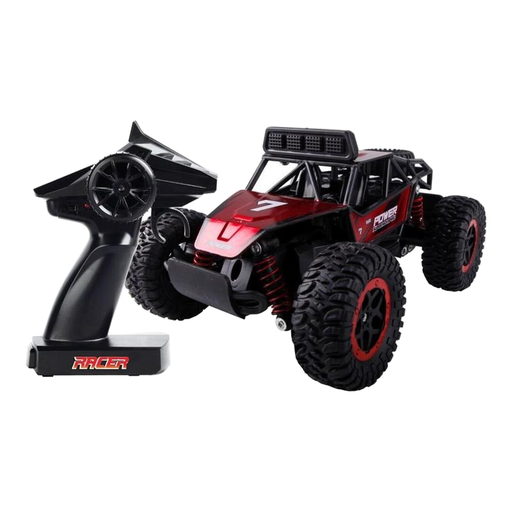
Why this product suits the profile: The buggy is designed for children aged 5 and over and offers a manageable set of features for first driving experiences indoors and outdoors.
The product details state a range of up to 30 metres, a speed of up to 18 km/h, and that the battery and remote-control batteries are included.
2.4 GHz control, all-direction steering, lights and a stated driving time of up to 20 minutes.
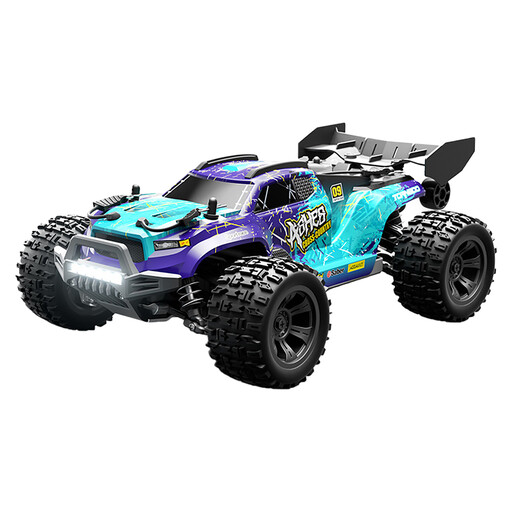
Why this product suits the profile: This model is aimed at users looking for a remote-controlled off-road vehicle with metal components, 4WD and a larger battery.
The specification sheet lists an aluminium metal chassis, differential, metal drive shafts, independent shock absorbers and wear-resistant tyres.
7.4 V battery with 1,500 mAh, 2.4 GHz remote control, LED headlights and 4WD chassis for uneven surfaces.
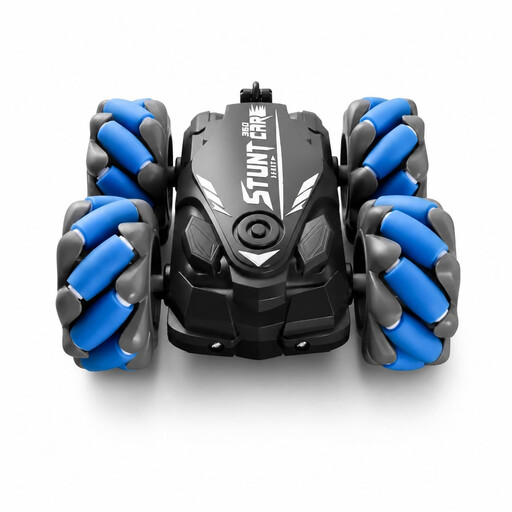
Why this product suits the profile: For children aged 8 and over who want to try more than simply driving forwards and backwards, including stunts, sideways drifting and gesture control.
The minimum age of 8, the need for supervision and the instructions for charging the lithium battery are all clearly stated.
4WD, Mecanum wheels, 360-degree spins, driving on both sides, lights and music, plus three control modes.
After every drive, check the tyres, body and visible connections for cracks or loose parts. Sand and dust can usually be removed with a dry or slightly damp cloth. Do not allow water to enter the motor, battery or electronic compartments.
With a remote-controlled car featuring lights, it is also important not to confuse the lighting with the driving function: it makes the vehicle more visible, but does not replace a safe play area. The models mentioned are not suitable for children under three because of small parts or their stated age recommendations.
We have put together a complete, regularly updated list of products that fully meet these strict selection criteria and the safety regulations applicable in the EU.
That depends on the controls, speed and construction. Some simple models are recommended from age 5 or 6. Stunt cars with gesture control, powerful 4WD or several driving modes are often intended for children aged 8 and over. The information on the product page and packaging should be treated as authoritative.
Driving time varies depending on battery capacity, motor power and surface. The Racer R/C Beach Buggy is stated to run for up to 20 minutes, while the 1:24 GTR 4WD RC Drift Car is said to have an approximate runtime of 20 to 40 minutes. These figures should be understood as manufacturer specifications under certain conditions.
An RC drift car works most reliably on smooth, level surfaces. For grass, sand or uneven paths, an off-road RC car with grippy tyre tread, shock absorbers and 4WD is more practical. Always check the product description to confirm whether the vehicle is suitable for the intended surface.