
Lieferung heute & morgen

Qualitätsgarantie

Willkommens-Angebote freischalten: KOSTENLOSE Lieferung | Bis zu 80 % RABATT | Kostenlose 30-Tage-JoyPlus-Testphase
App herunterladen
The search for the right RC drift car can quickly become overwhelming. The market is filled with models that promise spectacular drifts and high speeds. However, not every vehicle advertised as a drift car meets the technical requirements for precise and controlled manoeuvres. Many buyers invest in a model only to find it's unsuitable for this demanding hobby.
This guide serves as your roadmap. We'll highlight the most common pitfalls to avoid when buying and explain which technical features truly matter, so you can make an informed decision.
Before we dive into the important specifications, let's look at the typical issues that lead to disappointment. By understanding these, you can more easily spot unsuitable models.
To avoid the pitfalls mentioned above, you should carefully examine three technical aspects. These form the foundation of a high-performance hobby-grade RC race car that is optimised for drifting.
A 4WD remote control car (all-wheel drive) is a fundamental requirement for RC drifting. Power to all four wheels ensures even force distribution, allowing the driver to keep the vehicle stable and accelerate precisely even while drifting. Equally important is an independent suspension. It ensures that each wheel can react to bumps independently of the others. This improves grip and prevents the vehicle from losing control over small bumps.
The biggest difference between a toy and a hobby-grade vehicle lies in the controls. Always look for the term proportional controls. This means you can smoothly adjust both the steering angle and the speed—the further you move the stick on the transmitter, the stronger the car's reaction. This is the only way to achieve controlled, long drifts.
Another important feature is an RC car with a gyro. A gyroscope (gyroscopic stabiliser) detects unwanted rotation of the car's rear (oversteer) and automatically applies a slight counter-steer. This stabilises the vehicle during a drift and makes it much easier for beginners to hold a clean drift angle. On many models, the gyro's sensitivity is adjustable.
The 1:24 drift car scale has established itself as a popular sweet spot. These vehicles are compact enough for indoor use but also powerful enough for smooth outdoor surfaces like asphalt or concrete. Make sure the set includes at least two sets of tyres: one set of hard plastic drift tyres and one set of rubber tyres with more grip for regular racing. An RC car with LED lighting also adds appealing aesthetics, especially for driving at dusk.
To make the selection process easier, we have curated a few models based on different requirements and user profiles.
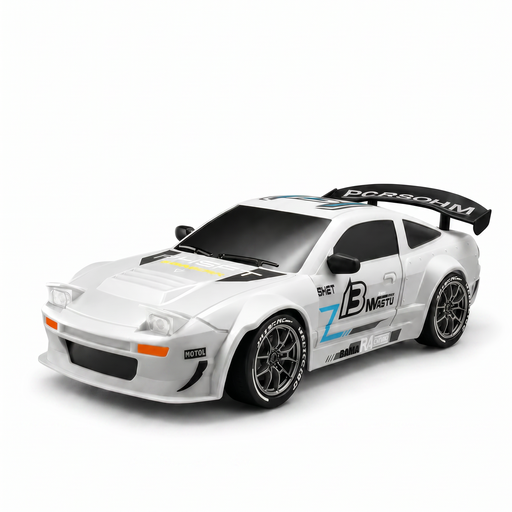
Why this model is a great fit: This set is ideal for anyone looking to get into the hobby with no prior experience. It includes all the necessary components, including a gyro that significantly eases the learning curve, and two sets of tyres for different driving styles.
The vehicle comes with dedicated drift tyres and a gyro stabiliser, making it truly "Ready-to-Drift" and bypassing the first pitfall.
Complete package with 4WD, a gyro, and interchangeable tyres. Ideal for a hassle-free start.
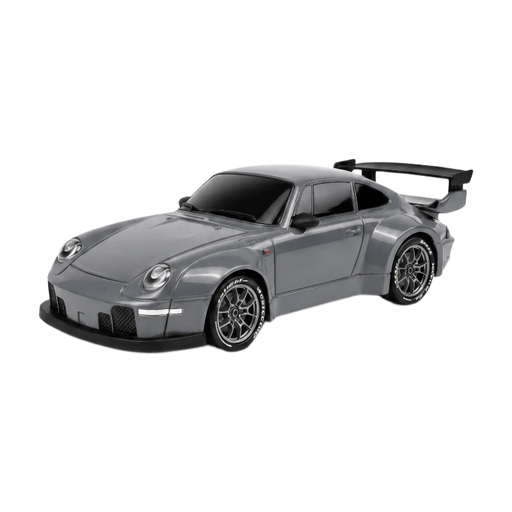
Why this model is a great fit: For drivers looking for more than just an entry-level model. The combination of a proportional 2.4G remote and a professional steering servo allows for significantly more precise control, which is essential for advanced manoeuvres.
This model directly addresses the "inferior controls" pitfall by using a professional steering servo and a proportional remote control system.
The steering servo provides direct and responsive steering feel, which is indispensable for advanced drifting techniques.
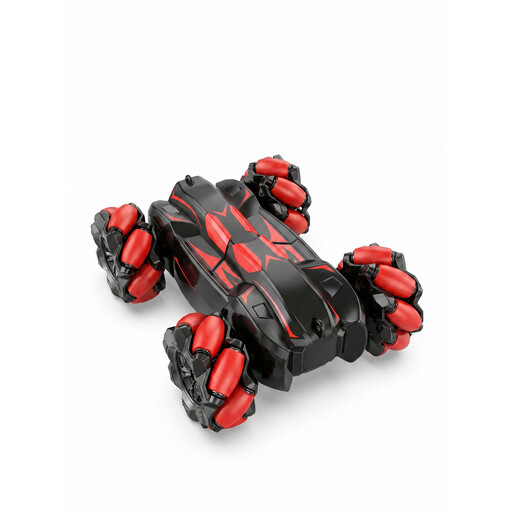
Why this model is a great fit: If the focus is on the fun factor and spectacular manoeuvres, this RC Stunt Car is the right choice. The special Mecanum wheels enable movement in all directions, including sideways and 360° spins on the spot.
This model is clearly positioned as a stunt vehicle and doesn't create the false impression of being a precision racing drift car. The focus is on durability and versatility.
The Mecanum wheels allow for unique driving manoeuvres that are impossible with normal wheels, offering high entertainment value.
We've compiled a complete, up-to-date list of products that meet these strict selection criteria.
The main difference lies in specialisation. An RC drift car typically features a 4WD drivetrain, proportional controls, hard plastic tyres with low grip, and often a gyro stabiliser. A normal RC car is usually designed for speed or off-road capability and uses high-grip rubber tyres, which prevents controlled drifting.
The battery run time depends heavily on the model, battery capacity (measured in mAh), and driving style. On average, you can expect a run time of 15 to 30 minutes per charge. For longer sessions, it's recommended to have one or more spare batteries on hand.
Yes. A gyroscope is a driving aid, not an autopilot. It makes it easier to hold the drift angle by making small, rapid corrections to the steering. The fundamental control of throttle, brake, and steering to initiate and maintain the drift must still be learned and mastered by the driver. It lowers the learning curve but doesn't replace practice.