
Lieferung heute & morgen

Qualitätsgarantie

Willkommens-Angebote freischalten: KOSTENLOSE Lieferung | Bis zu 80 % RABATT | Kostenlose 30-Tage-JoyPlus-Testphase
App herunterladen
The search for the right RC off-road car can quickly become overwhelming. The market is filled with models promising high speeds, extreme durability, and limitless driving fun. But not every remote-controlled car advertised as "off-road capable" lives up to that promise in practice. Many buyers invest in a vehicle that shows defects after a short time or fails to deliver the expected performance.
As a Joybuy Product Recommendation Officer, I see daily what features distinguish a good model from an unsuitable one. In this guide, I'll show you the most common pitfalls when buying and which technical details you should pay attention to in order to make an informed decision—whether for your own hobby or as a high-quality gift for kids and adults.
Marketing terms can be misleading. Before you make a decision, you should be aware of these three typical problems that often lead to disappointment:
To avoid these pitfalls, it's helpful to focus on the core components that determine an RC car's performance and longevity.
The drivetrain is the heart of a vehicle's off-road capability. While a rear-wheel drive (2WD) is sufficient for flat, solid surfaces, a four-wheel drive (4WD) is essential for challenging terrain.
An RC Truck 4WD distributes the motor's power to all four wheels. This provides significantly more traction on loose surfaces like sand, mud, or snow and improves control on inclines. Models with a powerful brushed motor (Carbon Brush Motor) offer a good balance of performance and reliability, making them a solid choice for beginners and advanced drivers.
The chassis is the vehicle's skeleton and is crucial for its durability. Budget models often use simple plastic tubs that can easily give way under stress.
Look for models with a reinforced metal chassis, for example, one made of aluminium. Such a construction offers much higher torsional rigidity and effectively protects internal components like the motor and gearbox from impacts. This is especially important for a fast RC car that is driven at high speeds off-road and will inevitably come into contact with obstacles.
A powerful battery is crucial for long-lasting fun. What's important here is not just the capacity, measured in milliampere-hours (mAh), but also the voltage, measured in volts (V). Higher voltage allows the motor to deliver more power.
Modern Lithium-Ion (Li-Ion) batteries with 7.4V and a capacity of 1500mAh or more provide a good foundation for run times of over 20 minutes, even with aggressive driving. Another advantage is choosing an RTR RC Car (Ready-to-Run). These complete sets already include a suitable battery and charger, so no additional components need to be purchased.
To make your choice easier, we have put together a few models tailored to different requirements and user profiles.
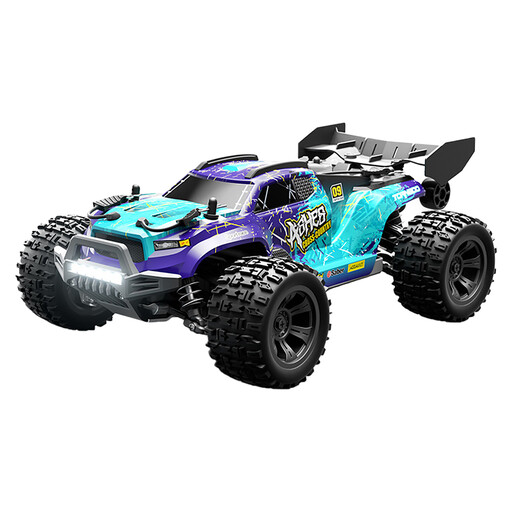
Why This Fits Their Persona: This model is designed for drivers who want more than just simple backyard bashing. It combines a powerful 4WD system with a robust construction, making it suitable for challenging terrain like sand, grass, and light inclines. An ideal vehicle for anyone who takes their hobby seriously.
The reinforced aluminium metal chassis offers real protection against breakages, avoiding the 'durability' trap. The 7.4V 1500mAh lithium battery ensures sustained and stable power delivery.
A complete RTR set with a professional 2.4 GHz remote control that allows for precise adjustments to speed and steering. The LED headlights enable driving at dusk.
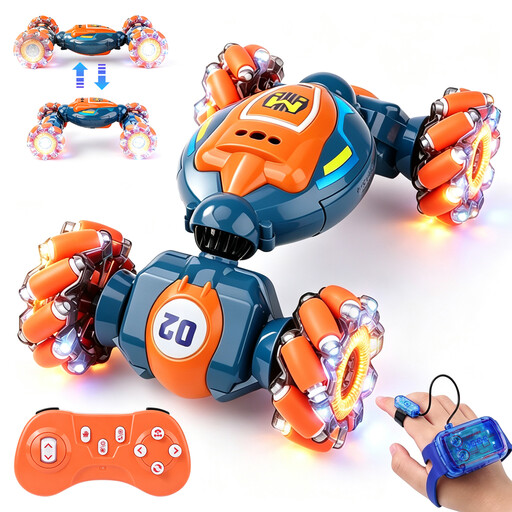
Why This Fits Their Persona: For tech-savvy adults and teens looking for an extraordinary driving experience. The combination of a classic remote and innovative gesture control via a wristband makes this vehicle a special piece of tech.
This model focuses on a unique feature set rather than exaggerated all-terrain promises. The Mecanum wheels are optimised for stunts and drifts on flatter surfaces, which clearly defines expectations.
Two control modes (handheld remote and gesture wristband) for varied fun. The omnidirectional wheels allow for cool sideways drifts and 360° rotations.
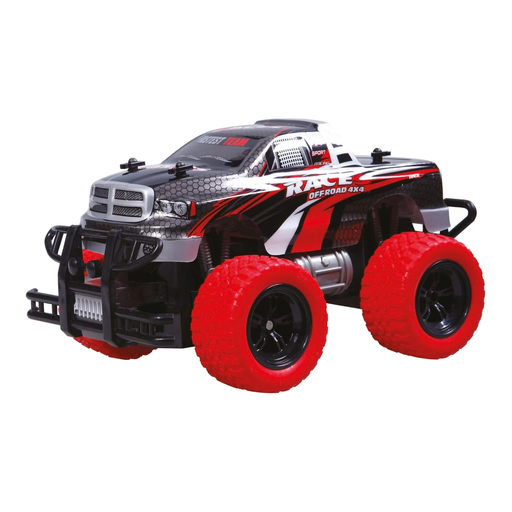
Why This Fits Their Persona: A straightforward and robust model that is an excellent first RC car for children aged 5 and up. The moderate speed of approx. 12 km/h is easy to control, and the operation is intuitive, which prevents frustration and puts the focus on fun.
This model sets realistic expectations. It's not advertised as an extreme high-performance vehicle, but as a solid monster truck for beginners. The durable plastic body is designed for typical play scenarios.
As a "Ready to Run" package, it comes with all the necessary batteries for both the vehicle and the remote. This makes it an ideal and hassle-free gift for boys and girls.
We have compiled a complete, real-time list of products that fully satisfy these strict selection criteria and UK safety regulations.
RTR stands for "Ready-to-Run". This means the vehicle is delivered fully assembled, and all components necessary for operation, such as the remote control, battery, and charger, are included. You usually just need to charge the battery and you can start driving immediately. This is especially convenient for beginners.
The run time heavily depends on the model, battery capacity (mAh), terrain, and driving style. On average, you can expect a run time of 15 to 30 minutes per battery charge for most hobby-grade models. For longer driving fun, it's recommended to have a second, compatible battery ready as a spare.
For true off-road driving on uneven or loose surfaces, an RC Truck 4WD (four-wheel drive) has a clear advantage. It offers significantly better traction and stability when climbing, in mud, or on sand. A 2WD model (rear-wheel drive) is often cheaper and can be fast on flat, solid paths, but it quickly reaches its limits in challenging terrain.