
Lieferung heute & morgen

Qualitätsgarantie

Willkommens-Angebote freischalten: KOSTENLOSE Lieferung | Bis zu 80 % RABATT | Kostenlose 30-Tage-JoyPlus-Testphase
App herunterladen
An RC off-road car 4WD needs to do more than just drive in a straight line on smooth ground. If you're looking for a remote-controlled car for grass, sand, mud, snow or climbing, it's worth checking the technical specifications more closely. Terms like "High Speed", "waterproof" or "Brushless Motor" sound impressive, but they don't always describe genuine everyday usability.
This buying guide from the Joybuy Product Recommendation Officer will help you interpret marketing claims and choose a 4WD RC car that suits your intended use.
High motor power alone doesn't tell you much about how the car will actually drive. For an RC car with all-wheel drive, the gearing, tyre tread, differentials, suspension and power supply are also crucial. A vehicle with a powerful motor can still lose traction quickly on uneven ground if the tyres or axle design aren't right.
So look out for specific details such as:
For the model mentioned, the product information lists a carbon-brush high-torque motor, while the feature description also mentions a brushless motor. This contradictory information should be considered before purchase: a definite brushless specification cannot be reliably determined from the information provided.
A waterproof RC car is not automatically suitable for deep puddles, heavy rain or full submersion. Often, the term only refers to a degree of splash protection for individual components. After driving through mud or damp grass, the vehicle, battery connector and drivetrain should be dried and cleaned of dirt.
Practical points to remember:
An RC car with a battery is often sold as a Ready-to-Run set. However, additional batteries for the remote control may still be required. The model described includes a 7.4-volt lithium-ion battery with 1,500 mAh and a USB charging cable. However, the pistol-grip remote control requires three AA batteries, which are not included in the package.
Before giving it as a gift or taking it out for its first drive, you should also check:
A 4WD RC car distributes driving power to all four wheels. This can offer advantages on loose ground and inclines. The selected 1:18 model features an aluminium metal chassis, metal bearings, differentials and drive shafts. Independent shock absorbers and nylon drivetrain components are designed to absorb the strain on uneven terrain.
Large anti-slip tyres with a wear-resistant rubber compound are particularly relevant for grass, sand and compacted gravel surfaces. However, for very deep mud or fine sand, ground clearance remains crucial. Without a specific measurement for wading depth or ground clearance, such terrain should be approached with caution.
A 7.4-volt battery typically corresponds to a 2S configuration. The capacity of 1,500 mAh describes how much electrical charge can be stored, not automatically the running time. This depends on factors including driving style, terrain, temperature and motor load.
A USB charging cable makes charging easier, but doesn't replace careful charging practice. The battery should only be charged with the designated cable and under suitable conditions. Lithium-ion batteries should be kept away from heat or naked flames. If you drive regularly, you should also factor in the long-term costs of a spare battery, tyres and drivetrain parts.
A 2.4 GHz remote control normally provides a reliable, interference-free connection and is more practical for using several vehicles in the same area than older, fixed-frequency systems. Details such as range or maximum speed should only be used as a deciding factor if they are specifically stated.
The model features bright LED headlights. A remote-controlled car with LED lights is therefore easier to spot in poor light conditions. However, the lighting does not replace a safe driving environment and should not be taken as permission to drive on public roads.
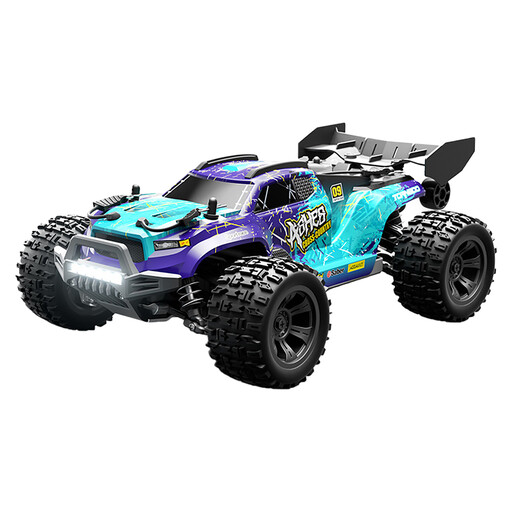
Why this product suits the profile: The set includes the vehicle, remote control, battery and USB charging cable. Only three AA batteries for the remote control need to be provided separately.
The included core components are clearly listed. The AA batteries that are not included are explicitly stated.
4WD drive, 7.4 V battery, LED headlights and 2.4 GHz remote control.
Why this product suits the profile: The aluminium chassis, metal bearings, differentials and drive shafts are aimed at users who pay attention to construction and maintainability.
The description names specific components rather than just making general statements about robustness. However, the motor designation remains contradictory and should be noted before purchase.
Aluminium metal chassis, differentials, independent shock absorbers and wear-resistant tyres.
Why this product suits the profile: For driving on grass, sand and slightly damp surfaces, the model offers 4WD, shock absorbers, LED headlights and grippy tyres.
The splash protection should not be equated with full waterproofing. This reduces the risk of incorrect usage expectations.
LED front headlights, all-wheel drive, shock absorbers and anti-slip tyres for changing surfaces.
We have put together a complete, regularly updated list of products that fully meet these strict selection criteria and the safety regulations in force in the EU.
According to the warning notice, the model described is not suitable for children under three years of age and should be used under the direct supervision of an adult. For younger children and beginners, the size, speed, remote control and any small parts should be assessed particularly carefully. Even a gift for a boy should be chosen age-appropriately and only used on suitable surfaces.
A fixed running time cannot be determined from the battery capacity alone. A 7.4 V battery with 1,500 mAh can be used for different lengths of time depending on motor load, terrain and driving style. Frequent driving in sand, mud or on inclines puts more strain on the drivetrain than driving on flat ground. A fully charged spare battery can be practical for heavy users, provided it is approved for the vehicle.
That depends on the protection of the electronics, the ground clearance and the care taken after driving. The selected model is described as waterproof and suitable for all-terrain use. However, this should not be taken as permission to drive through deep water or fully submerge it. After driving on wet or dirty surfaces, the battery, connectors, chassis and drivetrain should be cleaned and thoroughly dried.