
Lieferung heute & morgen

Qualitätsgarantie

Willkommens-Angebote freischalten: KOSTENLOSE Lieferung | Bis zu 80 % RABATT | Kostenlose 30-Tage-JoyPlus-Testphase
App herunterladen
An RC stunt car should be able to drift, flip over and drive on different surfaces. In practice, though, the differences often only become clear after you buy one. Some models can perform a 360-degree spin but have little grip. Others look robust but need disposable batteries or are only easy to control on smooth surfaces.
This buying guide helps parents and family members choose a remote control stunt car using clear, practical criteria. We focus on the drive system, tyres, power supply, age recommendation and where the car will be used.
A car with a flip or drift button is not automatically suitable for every terrain. Sideways movement requires special wheels, such as Mecanum wheels, and a suitable drive system. A basic 2WD model can drive forwards and backwards, but may not support controlled sideways drifting.
If you’re looking for a 4WD RC car, check that all four wheels are actually driven. The label “off-road” alone tells you little about the car’s technical features.
An RC car with LED lights can be fun to use in a dimly lit room. But for everyday use, the battery type, charging time, range, tyre tread and availability of spare parts matter more. Music features don’t automatically improve performance either, and can become annoying during longer play sessions.
A vehicle with a high top speed or moving wheels may not be suitable for every child. The recommended age should match the child’s stage of development. If the product has a lithium battery, make sure you follow the charging instructions too. An adult should be present while it’s charging, and damaged batteries or casings should not be used.
For indoor stunts on tiles, laminate or carpet, a nimble model with an easy-to-control remote is a good choice. An RC drift car with proportional steering gives you finer control than a simple forwards-and-backwards controller.
For flips and driving on both sides, a sturdy body and protected drive train are essential. The product description for a flip car should specifically state that it supports two-sided driving, 360-degree spins or flips.
Large, treaded wheels provide better grip on carpets, concrete or firm grass. Very small models, on the other hand, are more suited to flat indoor surfaces. A remote control off-road car needs enough ground clearance and, ideally, shock-absorbing features if it’s going to tackle small bumps outdoors.
Important: don’t assume that “waterproof” means the car can be used anywhere. Unless the manufacturer gives a specific protection rating or clear guidance, don’t use the vehicle in puddles, wet grass or mixtures of sand and water.
A rechargeable lithium battery reduces the need for disposable batteries. Check whether the battery and charging cable are included, and which batteries the remote control needs. If you have several vehicles at home, a 2,4-GHz remote control can be handy, as it may be designed for playing with multiple cars at the same time.
It’s a good idea to carry out a quick check before every drive:
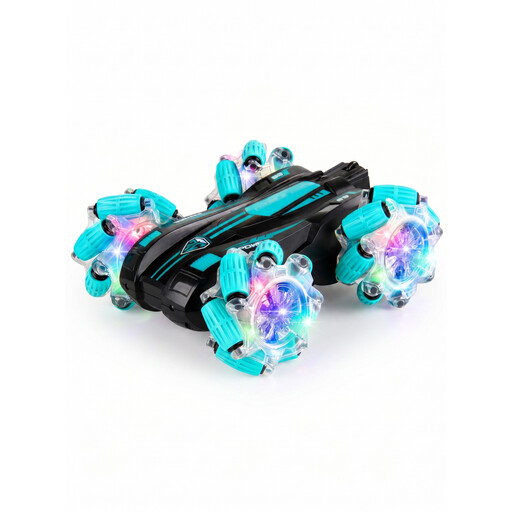
Why this product suits this profile: This model combines 4WD, two-sided driving and several stunt features in a compact vehicle. It’s a good fit for children looking for a versatile RC stunt car for the home, patio or a flat outdoor area.
The product description specifically mentions Mecanum all-wheel drive, sideways drifting, 360-degree spins and two-sided driving. Buyers don’t have to rely on vague terms such as “stunt” or “off-road”.
4WD, 9 cm wheels, LED lights and a rechargeable lithium battery, according to the product details.
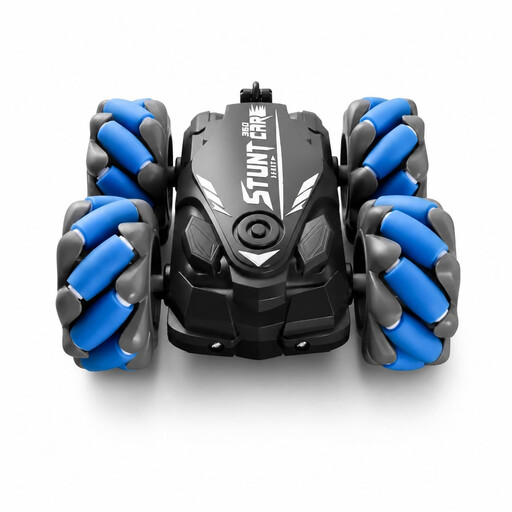
Why this product suits this profile: According to the product details, this model is intended for children aged 8 and over. As well as a 2,4-GHz remote control, it offers gesture control. It’s an interesting option for families who want to try different ways of controlling the car.
The safety and maintenance guidance specifies an age limit, adult supervision during charging, and checks for the casing, wheels and connections. This makes it easier to assess the product realistically before buying.
2,4-GHz control, gesture mode, 4WD, two-sided driving, LED lights and a USB charging cable, according to the product description.
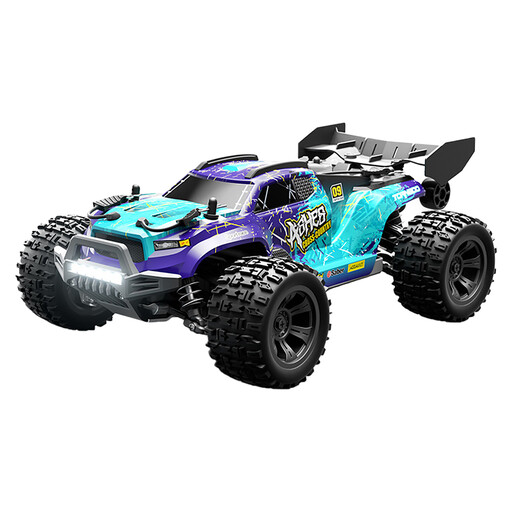
Why this product suits this profile: This remote control off-road car is designed to drive over sand, grass, mud, snow and uneven surfaces. It’s aimed more at teenagers and adults than younger beginners.
The product details list the motor, battery voltage, battery capacity, metal chassis and tyres. This makes it easier to assess key technical features than with products that rely on vague marketing claims.
7,4-V-1500-mAh lithium battery, 4WD metal chassis, shock absorbers and LED headlights, according to the product description.
We’ve put together a complete, regularly updated list of products that meet these strict selection criteria and fully comply with the safety regulations in force in the EU.
For children aged around 6 and over, simple models with clearly laid-out button controls may be suitable, provided the age recommendation for the specific product allows it. Don’t choose a remote control car for children based on speed alone. Easy-to-reach controls, a robust body and supervised use are all important.
Children aged 8 and over, as well as teenagers, can use proportional steering, gesture control or interchangeable tyres. When choosing an RC gift for boys and girls, their interests matter too: stunt features for indoor play, drift tyres for smooth surfaces or an off-road suspension for outdoor use.
Battery life depends on the battery, motor, surface and driving style. Product details for each model often provide an approximate run time. For longer play sessions, an additional compatible battery can be useful. Lithium batteries should only be charged using the recommended charging accessories.
Models with larger treaded wheels and 4WD are generally better suited to carpet, concrete and paved outdoor surfaces. Very smooth drift tyres, on the other hand, often work better on tiles or laminate. Before using the car outdoors, avoid rain, deep mud and very uneven terrain unless the product is clearly stated to be suitable for these conditions.
After driving, remove hair, dust and sand from the wheels. Store the vehicle somewhere dry and check it for cracks, loose parts and damaged cables before each use. Stop using it if you hear unusual noises, notice a swollen battery or find a broken casing.