
Lieferung heute & morgen

Qualitätsgarantie

Willkommens-Angebote freischalten: KOSTENLOSE Lieferung | Bis zu 80 % RABATT | Kostenlose 30-Tage-JoyPlus-Testphase
App herunterladen
An RC stunt car should do more than just drive in a straight line. Many models boast 4WD, 360° spins, LED lights, sound, watch control or the ability to drive on water. But not every feature is necessarily a practical benefit for parents and family members. What matters is where the car will actually be used, how easy it is to control, the battery specifications and whether it’s suitable for the child’s age.
A remote-controlled stunt car with large tyres may look ready for off-road driving. Even so, carpets, wet sand, long grass and larger steps can put a strain on the drive system. So always check claims such as “off-road” against the specific surfaces you plan to use it on. A model designed for tiles and flat paths won’t necessarily handle rough gravel.
The stated battery life depends on speed, surface, lighting and how often you use the stunt functions. A driving time of 20 to 40 minutes should therefore be treated as a product specification, not a guaranteed running time. It’s also important to check whether a battery is included, how it charges and whether the remote control needs additional AA or AAA batteries.
A fast RC drift car can be difficult for younger children to control. Small parts, lithium batteries and moving wheels also mean the car should be used according to the instructions, and an adult may need to supervise. Before buying, check the age recommendation for the specific product against the child’s stage of development.
A 4WD RC car sends power to all four wheels. This can be useful on grass, firm gravel paths or slightly uneven ground. Mecanum or specially designed stunt wheels are relevant for sideways movement and tight spins. A standard 4WD model won’t necessarily be able to drive sideways.
If you’re looking for a remote-controlled off-road car, also check the tyre tread, ground clearance, impact protection and suspension. According to its product description, the 1:18 4WD off-road model in our selection has an aluminium chassis, shock absorbers, non-slip tyres and LED headlights. The specifications also list a 7.4-volt, 1,500 mAh battery.
For an RC car with 360° rotation, check whether it spins on the spot or simply drives in large circles. A double-sided RC car can keep going on either side after a flip. This means less interruption to play, but it still needs plenty of clear space.
A traditional 2.4 GHz remote control lets you operate the car directly using buttons. An RC car with watch control, on the other hand, responds to the tilt of your hand. This can add variety, but it takes a little time to get used to. For precise turns or controlled drifts, a handheld remote is often the more straightforward option.
Before buying, check:
Switch the car off after every drive and remove any sand, dust and moisture. For lithium batteries, follow the manufacturer’s instructions on charging, storage and damage. Only use a water model as described in its specific product information.
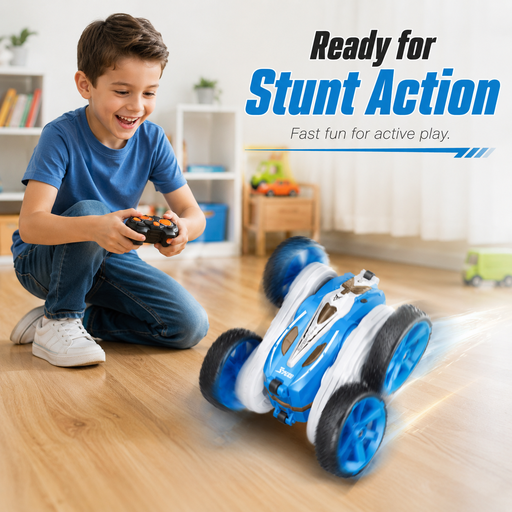
Why it suits this profile: This model focuses on basic flipping and driving functions, making it an easy introduction to the world of stunt cars.
The product description highlights a 2.4 GHz remote control and double-sided driving, rather than focusing solely on light effects.
Double-sided driving, simple controls and an ideal choice for imaginative play or as a gift.
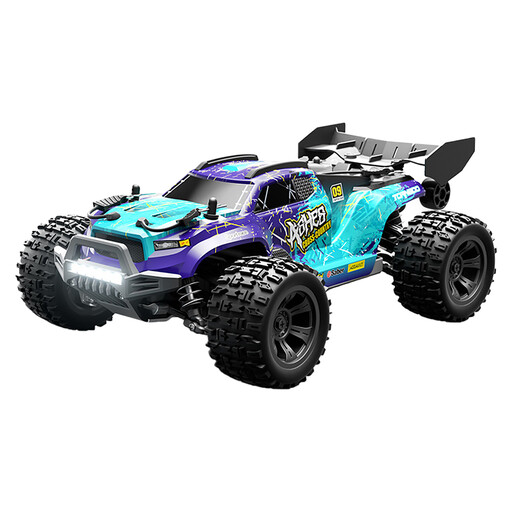
Why it suits this profile: This remote-controlled off-road car is for buyers who value the drive system, chassis, lighting and tyre specifications more than showy features alone.
The description lists specific technical details, including a 7.4-volt, 1,500 mAh battery, an aluminium chassis, shock absorbers and 2.4 GHz control.
4WD, LED headlights, non-slip tyres and Ready-to-Run equipment, according to the product specifications.
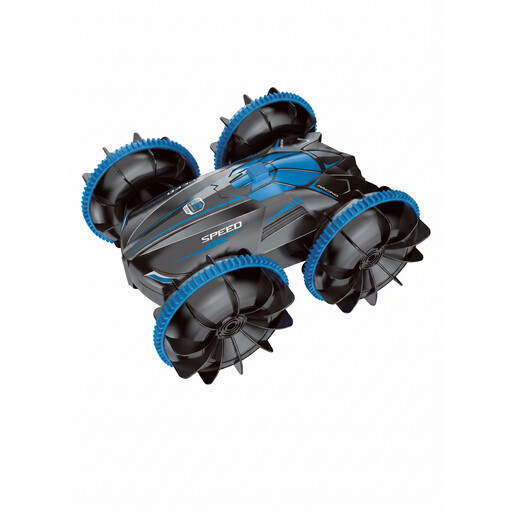
Why it suits this profile: The vehicle is designed for driving on land and in shallow water, according to the description, and offers both handheld and watch controls.
The product description specifically mentions a sealed design and lists several suitable surfaces. Even so, only use it on water as instructed and in a suitable shallow area.
4WD, 180° double-sided driving, 360° rotation and two control options, according to the product description.
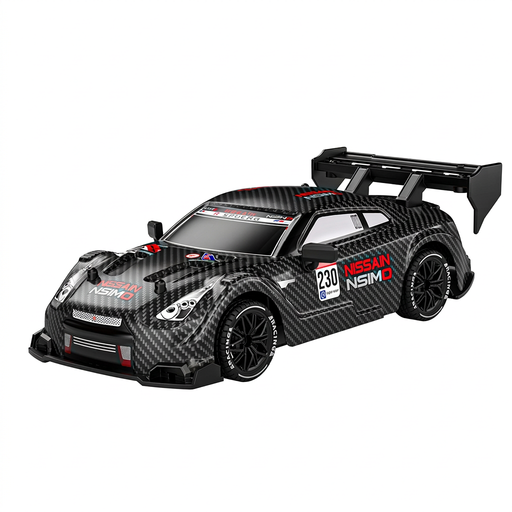
Why it suits this profile: This model is aimed at children and teenagers in the recommended age group who want to practise drifting on smooth surfaces.
The description distinguishes between drift and racing tyres, and lists flat indoor and outdoor surfaces as suitable places to use it.
4WD, two sets of tyres, LED lighting and a stated battery life of around 20 to 40 minutes.
We’ve put together a complete, regularly updated list of products that meet these strict selection criteria and the safety regulations in force in the EU.
Battery life depends on the model, battery, speed and surface. The product specifications in our selection, for example, state around 20 minutes or approximately 20 to 40 minutes. A second compatible battery can be useful if you want longer play sessions. Make sure the voltage, connector and shape match.
Many models are described as suitable for firm outdoor surfaces such as concrete, grass or gravel. However, a remote-controlled car for children shouldn’t be used on busy roads, near water unless approved for it, or in poor visibility. For a water-going vehicle, follow the stated details on sealing and permitted water depth.
When choosing an RC toy car as a gift, key things to consider include simple controls, an appropriate age recommendation, included charging accessories and robust driving features. A double-sided model with 360° rotation is easy to use on flat surfaces. Older children and teenagers may prefer an RC drift car with interchangeable tyres, proportional control or several speed settings.