
Lieferung heute & morgen

Qualitätsgarantie

Willkommens-Angebote freischalten: KOSTENLOSE Lieferung | Bis zu 80 % RABATT | Kostenlose 30-Tage-JoyPlus-Testphase
App herunterladen
An RC stunt car for children should withstand flips, drifts and off-road driving without becoming unusable after only a few outings. In practice, however, eye-catching LED effects, music and a long list of functions are not what lead to the right choice. Reliable information about the drive system, battery, age recommendation and intended use is far more important.
A 360° stunt car may perform impressive spins on smooth surfaces, but that does not automatically mean it will travel well across grass, gravel or sand. Small wheels, limited ground clearance or a basic two-wheel drive system restrict outdoor use. If you are looking for a remote-controlled off-road car, look for 4WD, treaded rubber tyres and a shock-resistant body.
RC vehicles may be described as splash-proof, waterproof or amphibious. These terms are not interchangeable. Check whether the manufacturer explicitly mentions a sealed construction and intended use in shallow water. After water play, the vehicle should be switched off, dried and maintained according to the instructions. A standard RC car with LED lights is not automatically suitable for use in a pool or pond.
A high battery capacity alone says little about the actual run time. Motor power, surface and stunt use all affect consumption. Important details include the battery type, voltage, charging accessories and, where applicable, charging time. Children should not charge lithium batteries without adult supervision. During charging, the rechargeable RC car should be placed on a dry, non-flammable surface and switched off after play.
An RC 4WD car powers all four wheels and can distribute its power more evenly across uneven surfaces than a vehicle with a basic rear-wheel drive system. For grass, fine gravel or sand, wide, grippy tyres and sufficient ground clearance are important. On certain models, Mecanum wheels also enable sideways gliding and diagonal movement. This is a specific technical function, but it does not mean that every type of terrain is equally suitable.
For carpets, tiles and paved paths, a more compact model will often be sufficient. If you are looking for an RC climbing car for outdoor use, you should also consider the axle suspension, impact protection and the surfaces specified by the seller. Small steps may be manageable, but larger obstacles can put strain on the motor, gearbox and axles.
A traditional 2.4 GHz remote control allows the speed, direction and stunt functions to be operated separately. Gesture control via a motion-sensor watch may be more intuitive for younger children, but it still requires a certain degree of coordination. When using several vehicles, a 2.4 GHz connection is practical because, according to the product information, several cars can be operated at the same time.
The age recommendation is a selection criterion, not a substitute for supervision. For children aged around 3 and over, the vehicle should not contain small parts that can be easily detached, and it should be slow and straightforward to control. Models with high speeds, lithium batteries or complex functions are generally more suitable for older children and teenagers. For example, the beach buggy mentioned is recommended for children aged 5 and over and has a stated top speed of 18 km/h. This may already be challenging for younger children.
Look out for:
LED lights, music, mist and spray functions add to the entertainment value, but they are additional features. With spray systems, only the water intended for that purpose should be used. Fragrances, cleaning products and other liquids must not be put into the tank.
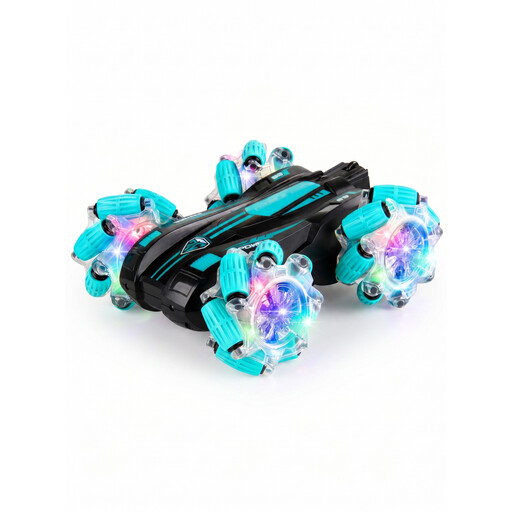
Why this product suits the profile: This compact model combines 4WD, double-sided driving and 360° spins. LED wheels and a rechargeable power supply complement the core functions for indoor and outdoor use on suitable surfaces.
The double-sided design reduces the need to turn the car over manually after a flip. The product information also mentions rounded edges and protected internal components.
4WD, double-sided driving, sideways drifting, LED lighting and a rechargeable battery.
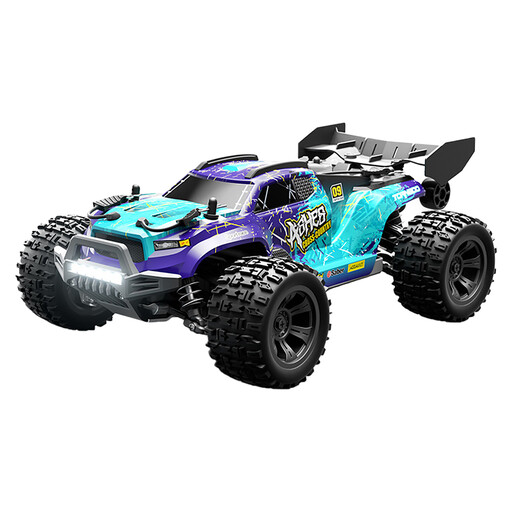
Why this product suits the profile: This remote-controlled off-road car is aimed at older children, teenagers and RC fans who value 4WD, LED headlights, large tyres and a ready-to-run set.
The specifications mention a 7.4 V/1500 mAh lithium battery pack, a reinforced aluminium metal chassis, shock absorbers and 2.4 GHz control.
Metal chassis, independent wheel suspension, LED headlights, four-wheel drive and large non-slip tyres.
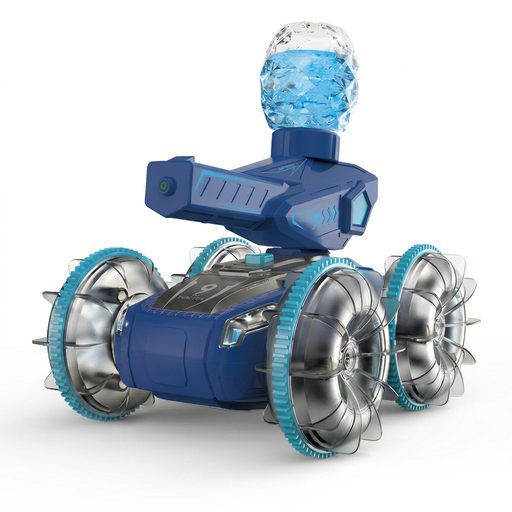
Why this product suits the profile: This amphibious vehicle is designed for play on land and in shallow water. Handheld remote control, gesture control, 360° rotation and a water-spraying function offer several ways to play.
The product description mentions a sealed body and propeller wheels for shallow water. Nevertheless, cleaning, drying and following the usage instructions are still essential.
4WD propeller wheels, land-and-water use, two control methods, LED lighting and 360° rotation.
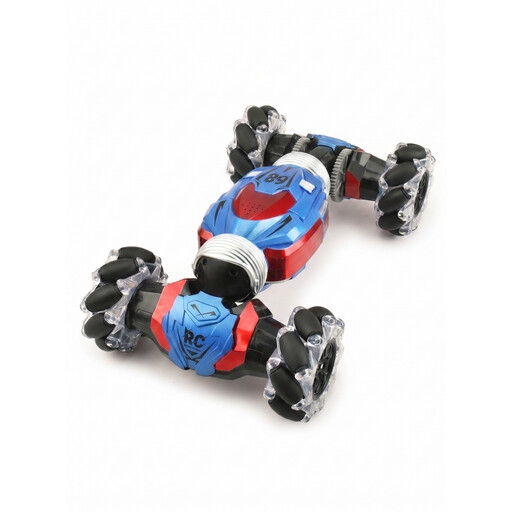
Why this product suits the profile: This gesture-controlled RC car combines a 2.4 GHz remote control with a motion-sensor watch. The deformable body and Mecanum wheels will appeal to children who want more than forward and reverse driving.
The product information lists two control methods, double-sided driving, motor overload protection and rounded edges.
Sideways drifting, two body designs, 4WD Mecanum wheels and multiplayer operation via 2.4 GHz.
We have put together a complete, regularly updated list of products that fully meet these strict selection criteria and the safety regulations applicable in the EU.
This depends on the speed, weight, controls and small parts. According to the product information, some models are intended for children aged 3 and over, while others are suitable from 5, 6 or 8 years. The age marking, user manual and child’s motor skills are the key considerations. Adult supervision is advisable for fast vehicles or models with lithium batteries.
Run time varies depending on the battery, motor, surface and how the vehicle is used. The product description for the Racer R/C Beach Buggy states up to 20 minutes with a 3.7 V/500 mAh battery. Another model specifies approximately 20 to 40 minutes. These figures are guidelines under specific conditions and may be shorter with frequent drifting or on inclines.
Only models with an explicitly described amphibious design and sealed construction should be used in shallow water. An ordinary drift car for children or an RC car with LED lights is not automatically suitable for this purpose. Before buying, check the permitted water environment, maximum depth, care instructions and the manufacturer’s specifications.