
Lieferung heute & morgen

Qualitätsgarantie

Willkommens-Angebote freischalten: KOSTENLOSE Lieferung | Bis zu 80 % RABATT | Kostenlose 30-Tage-JoyPlus-Testphase
App herunterladen
An RC stunt car for children should allow flips, drifts and 360° spins without becoming unusable after just a few drives. In practice, however, unclear age recommendations, missing accessories and exaggerated promises often lead to disappointing purchases. This guide explains which technical details really matter and which remote-controlled car for children is suitable for different situations.
The term RC off-road car alone tells you very little. A vehicle may work well on carpet and tiles but lose traction on gravel, sand or grass. The key factors are:
Large wheels do not automatically improve performance. With a 4WD RC car, the power transmission and manoeuvrability should also suit the intended environment.
A remote-controlled stunt car with 360° spins, flips and drifting sounds versatile. For younger children, however, complex controls can quickly become confusing. Practical features include:
Gesture-controlled RC car controls can make it easier to get started, but they do not replace control over speed and direction. When choosing and using the vehicle, consider the child’s age, reaction speed and the available space.
A rechargeable vehicle is more convenient in everyday use than a model with batteries that need constant replacing. Even so, check the following before buying:
Some product descriptions, for example, mention integrated 3.7-volt batteries and separate batteries for the remote control. Always check the specific details on the product page.
For stunts, 4WD individual-wheel drive and grippy tyres are useful because they transfer power to the surface more evenly. Depending on their design, Mecanum wheels can also enable sideways gliding and diagonal movement. This sets such a vehicle apart from a classic racing car.
For smooth floors, an RC drift car with specially designed tyres may be suitable. On lawns, gravel or sand, however, an RC off-road car with deep tread and greater ground clearance is the better choice. Driving through water is only appropriate if the manufacturer explicitly states that the construction is water-resistant. “Splash-proof” does not automatically mean that a vehicle may be fully submerged.
A vehicle that can drive on both sides can continue moving after a flip without a child having to turn it over by hand. With a flip car, a symmetrical body, sturdy wheels and a protected underside are therefore important.
Typical functions include:
More functions also mean more moving parts, however. For frequent use, it is worth looking for sturdy joints, protected electronics and clear care instructions.
The age recommendation is an important guide, but it is no substitute for adult supervision. A remote-controlled car for children aged 3 and over should only be used if the product page explicitly lists this age group. According to their descriptions, some models are intended only for children aged 8 and over.
For products with warnings about small parts, the following applies: Not suitable for children under 3 years of age and only to be used under direct supervision. For use in the home, also consider the noise level, vehicle size and available driving area. LED lighting is an attractive extra feature, but says nothing about range or durability.
The recommendations below group the models according to typical requirements. Product details such as age suitability, battery, controls and water resistance should be checked on the relevant product detail page before buying.
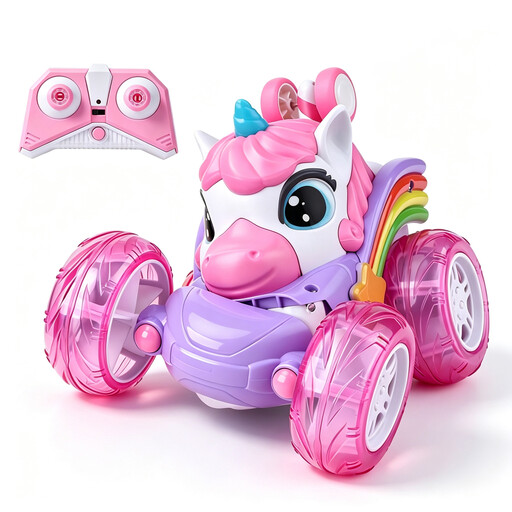
Why this product suits this profile: According to the product description, this compact model is intended for children aged 3 and over. It combines an eye-catching design with LED lighting and USB charging.
The included items list an integrated battery and a charging cable. However, the remote control requires two AA batteries, which need to be purchased separately.
USB charging, a 2.4 GHz remote control and LED lights. The stated control range is up to 40 metres.
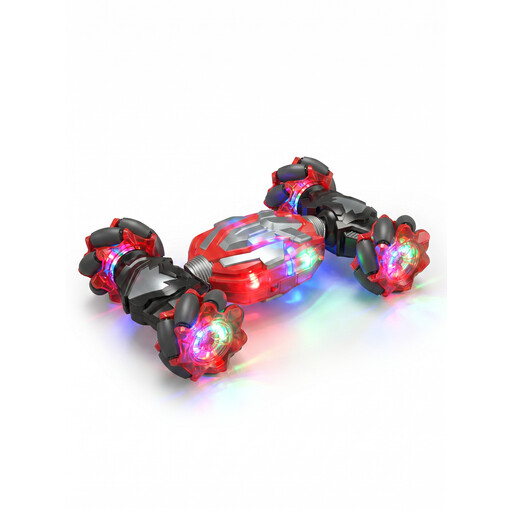
Why this product suits this profile: According to the description, this model is intended for children aged 8 and over. It features Mecanum wheels, two control methods and a transformable centre section.
The description mentions rounded edges, robust soft-rubber rings and integrated overload protection. These are clear design features, but they do not guarantee damage-free play.
4WD individual-wheel drive, sideways drifting, driving on both sides, and switching between a wide and narrow body shape.
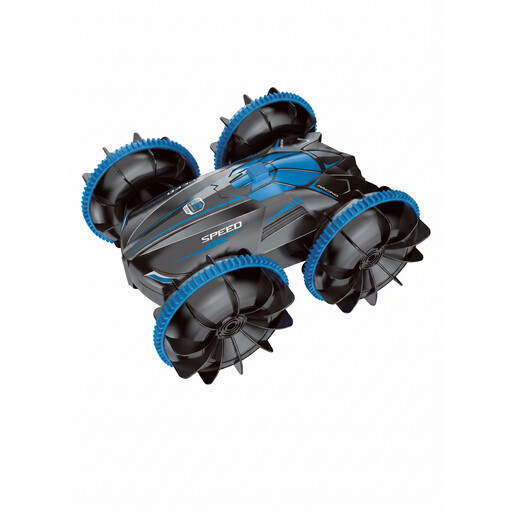
Why this product suits this profile: This vehicle is designed for driving on land and water. It features large propeller wheels as well as hand and gesture controls.
The product description mentions a sealed housing. Nevertheless, water should only be used in the explicitly stated shallow areas, and charging ports must be dry before charging.
Driving on both sides, 360° spins and use on grass, sand, gravel and shallow water according to the product details.
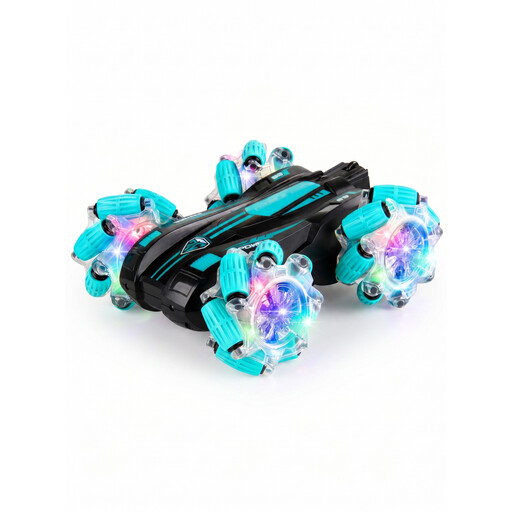
Why this product suits this profile: This compact 4WD model is described as suitable for indoor and outdoor use. It combines driving on both sides with LED wheels.
The stated 9 cm Mecanum wheels, impact-resistant housing and rechargeable lithium battery make the specification clear. Actual running time depends on the surface and driving style.
Sideways gliding, 360° spins on the spot, automatic stunt demonstration and LED lighting on the transparent wheels.
We have put together a complete, regularly updated list of products that fully meet these strict selection criteria and the safety regulations applicable in the EU.
A model is suitable only if the product page explicitly gives an age recommendation of 3 and over. Adults should also consider the vehicle’s speed and size, as well as any small parts. For younger children, simple button controls and an automatic stunt function are often easier to understand than several complex control modes.
Running time depends on battery capacity, surface, speed and the number of stunts performed. Manufacturer specifications such as a charging time of two hours and a play time of 60 minutes should be treated as guidelines. For longer afternoons of play, a replaceable spare battery may be more practical. With lithium batteries, use only the charging cable provided for that purpose.
Only models with an explicitly stated water or amphibious function are designed for this. Even then, restrictions apply, such as shallow water, dry charging ports and thorough drying after play. An ordinary remote-controlled toy car with LED lights or 4WD is not automatically suitable for driving through water.