
Lieferung heute & morgen

Qualitätsgarantie

Willkommens-Angebote freischalten: KOSTENLOSE Lieferung | Bis zu 80 % RABATT | Kostenlose 30-Tage-JoyPlus-Testphase
App herunterladen
A remote-controlled stunt car for kids should drift, perform flips and keep going after a crash. In practice, however, models vary considerably in terms of drivetrain, battery, controls and intended use. If you focus solely on large wheels, LED lights or spectacular product images, you may end up with a vehicle that barely moves on carpet, has a battery that runs out quickly or is unsuitable for the intended age group.
This buying guide from the Joybuy Product Recommendation Officer explains which details matter before purchasing a remote-controlled car for kids and which models suit different usage profiles.
A 4WD RC car is driven through all four wheels. This can be beneficial on grass, gravel or when tackling small obstacles. However, tyre tread, ground clearance, weight and motor torque are also crucial. Even an all-wheel-drive vehicle can lose traction on loose sand if its tyres are not designed for that surface.
An RC car with LED lights stands out in the dark and can make play more engaging. However, the lighting says nothing about range, battery life or impact resistance. These specifications should be assessed separately. For younger children, it is also important that light and sound functions can be switched off or, at the very least, are not persistently disruptive.
With an RC off-road car, it is important to distinguish between basic splash protection and a housing explicitly designed for driving through water. Even with a model described as water-compatible, the charging port, battery and remote control should remain dry. After outdoor use, check the vehicle for sand, moisture and dirt.
Several functions are particularly relevant for stunts:
A classic remote-controlled drift car is often particularly easy to control on smooth floors. For grass, gravel or paths, larger, heavily treaded tyres and a suitably engineered chassis are the better choice.
A 2.4 GHz remote control is used in many modern toy cars. It enables wireless operation and, according to the respective product descriptions, is designed to support parallel play with multiple vehicles. Nevertheless, range and surroundings should be taken into account: walls, vehicles and other radio sources can affect operation.
A gesture-control RC car supplements the traditional remote control with a motion-sensing watch. Tilting the hand controls the direction of travel. This option can appeal to children who prefer intuitive operation. For precise manoeuvres, however, a button-based remote control is generally easier to use.
A rechargeable RC car requires less effort than a model that regularly needs disposable batteries in the vehicle. Before buying, check the following points:
Lithium batteries should only be charged with the supplied cable and should not be left connected unattended for extended periods. If the housing, cables or wheels show visible damage, discontinue use of the vehicle.
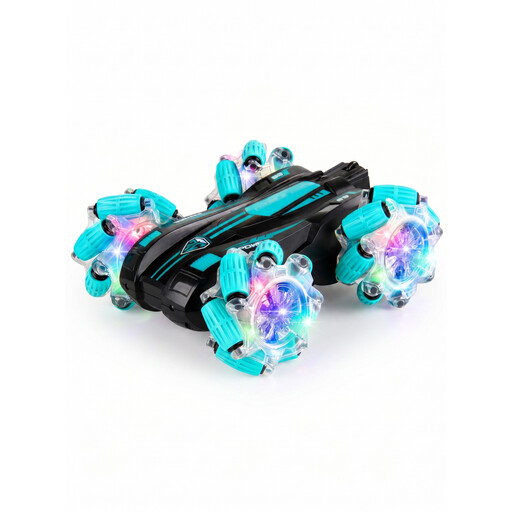
Why it is a good fit: This compact vehicle features 4WD, two-sided driving, sideways drifting, 360° spins and LED-lit wheels for indoor and outdoor use.
The product description lists specific driving functions and a rechargeable lithium battery instead of relying solely on generic stunt terminology.
According to the product specifications, it includes Mecanum wheels, LED lighting and an automatic stunt demonstration.
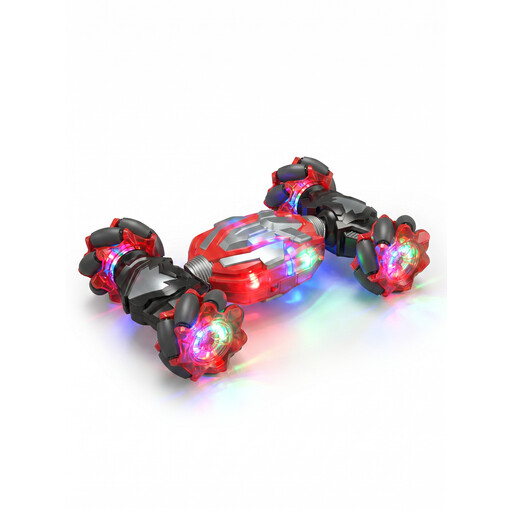
Why it is a good fit: Designed for children aged around 8 and over who want to try deformation, lateral movement and two different control methods.
The product data lists the handheld remote, gesture control, age recommendation and specific driving manoeuvres separately.
The listed functions include a bionic deformation structure, Mecanum all-wheel drive and two-sided driving.
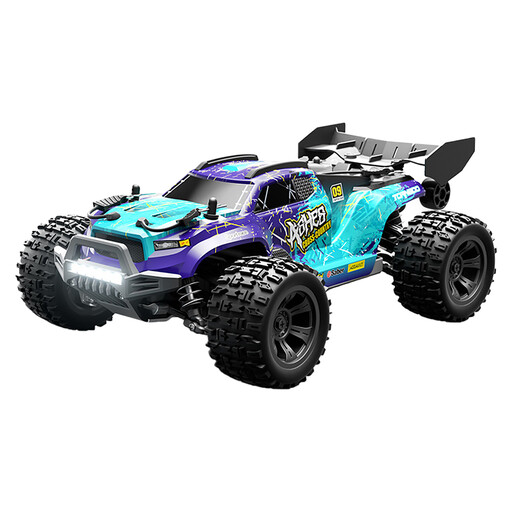
Why it is a good fit: This model is aimed at users looking for an RC off-road car for sand, grass, mud, snow or uneven paths.
The specifications clearly state an aluminium chassis, shock absorbers, treaded tyres and a 7.4 V battery.
According to the product description, the package includes LED headlights, 4WD, a USB charging cable and a 1,500 mAh lithium battery.
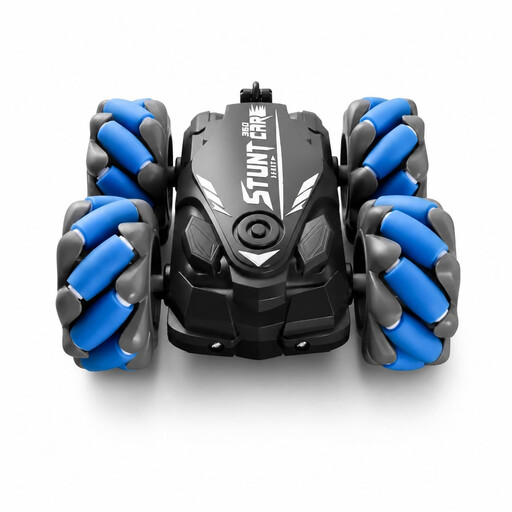
Why it is a good fit: This compact model is designed for children aged 8 and over and can be used on wood, tiles, carpet and level outdoor surfaces.
The guidance clearly states the limitations: do not submerge in water, supervise charging and check the wheels regularly.
The listed features include gesture control, a 2.4 GHz remote control, LED lighting, music and an integrated battery with USB cable.
Browse the complete selection to compare models by intended use, drivetrain, age recommendation, lighting and battery.
Before each drive, inspect the housing, wheels, axles and battery connections. Keep fingers away from rotating wheels while the vehicle is operating. For children aged around 8 and over, a brief introduction is advisable, particularly when using fast vehicles or driving in public areas.
A remote-controlled stunt car should only be used under direct supervision on roads, pavements with pedestrians or near water. The relevant age rating, safety warnings and manufacturer’s instructions take precedence. After driving on sand or gravel, clean the wheels and store the vehicle in a dry place.
This depends on the speed, control system and safety warnings. Some models in this selection are rated for children aged 8 and over. The information on the product page and packaging is always decisive. Small parts, rotating wheels and lithium batteries require particular care.
There is no universal playtime. It depends, among other things, on motor load, surface, stunt use and battery capacity. A higher-capacity battery may enable longer driving times, but it may also require more time to charge. Always follow the charging instructions for the specific model.
Only if the manufacturer explicitly describes the vehicle as suitable for driving through water. A splash-resistant model is not automatically suitable for use in a swimming pool. The battery, charging socket and remote control must remain dry unless the product specifications permit more extensive use.