
Lieferung heute & morgen

Qualitätsgarantie

Willkommens-Angebote freischalten: KOSTENLOSE Lieferung | Bis zu 80 % RABATT | Kostenlose 30-Tage-JoyPlus-Testphase
App herunterladen
An RC car for children can be used on tiles, carpet, asphalt or uneven surfaces, depending on the model. However, the differences are not limited to the design. The drive system, battery setup, remote control and age rating determine whether the remote-controlled car is genuinely suitable for the child and the intended environment.
Terms such as “off-road” or “all terrain” do not tell you very much on their own. A small remote-controlled toy car with narrow wheels may be suitable for carpets and smooth floors, but can struggle on damp grass or rough ground. Before buying, check whether the manufacturer specifies suitable surfaces such as concrete, grass, sand or tiles.
A rechargeable RC car often takes several hours to charge fully. Actual playtime depends on speed, the driving surface and how the car is driven. Claims such as “long battery life” are difficult to assess without specific battery information. Figures such as 7.4 volts, 1,500 mAh or a stated playtime of around 20 to 40 minutes are much more informative.
An RC car for children aged 3 and over is not automatically easy for every three-year-old to operate. Simple forward and reverse controls are very different from proportional steering, drift functions or gesture control. For vehicles with small parts, lithium batteries or rapidly rotating wheels, the safety instructions for the individual product are decisive.
A 4WD RC car transfers power to all four wheels. This can be helpful on uneven surfaces, slopes or when performing stunts. For ordinary driving around a child’s bedroom, however, a simpler drive system is often sufficient. On certain models, Mecanum wheels also enable sideways movement and special turning manoeuvres.
Look out for:
A remote-controlled off-road vehicle with large, non-slip tyres is generally more suitable for grass, sand or paved outdoor surfaces than a low-slung RC drift car.
With a rechargeable RC car, the rechargeable battery and charging cable are not always included in the same package. Therefore, check the following:
Lithium batteries should only be charged according to the instructions and must not be used unattended. Disconnect the cable after charging. Spare batteries are only worthwhile if the voltage, connector and design are explicitly compatible.
A 2.4 GHz remote control allows several vehicles to be operated at the same time in many cases, without the control channels typically interfering with one another. For younger children, large, clearly labelled buttons are often easier to understand. Teenagers and hobby beginners may prefer more precise steering or separate driving modes for racing and drifting.
LED lights can improve orientation in poor lighting conditions, but they are no substitute for a safe, well-lit play area. Music and sound effects are additional features, but they cannot replace suitable controls.
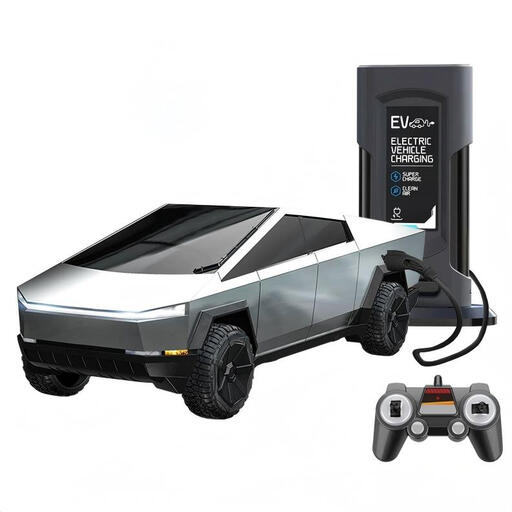
Why this product suits this profile: This pickup truck is aimed at families looking for a conventionally controlled vehicle with a 2.4 GHz remote control, charging port and LED lights. The stated recommended age starts at 3 years.
The product name specifies features such as 2.4 GHz control, LED lighting and a rechargeable battery, rather than making only general claims about driving performance.
Pickup design, LED lights, 2.4 GHz remote control and charging function; suitable for simple driving on appropriate surfaces.
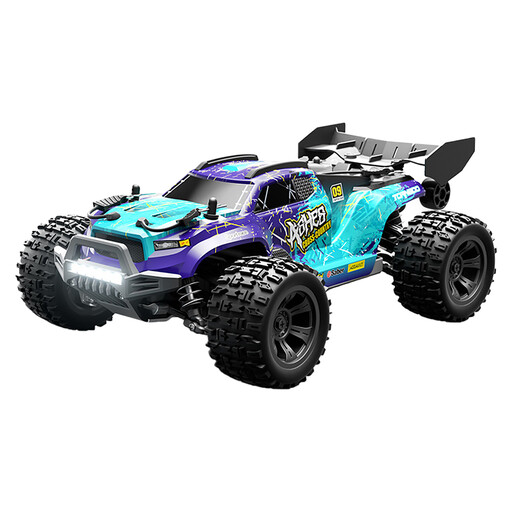
Why this product suits this profile: This model is intended for teenagers, adults and hobby beginners looking for a remote-controlled off-road car with 4WD, a metal chassis and larger tyres.
The battery voltage and capacity are specified as 7.4 volts and 1,500 mAh. The product description also clearly identifies the chassis, tyres and remote-control batteries.
4WD, aluminium metal chassis, shock absorbers, LED headlights and a 7.4 V battery; the remote control also requires 3 AA batteries.
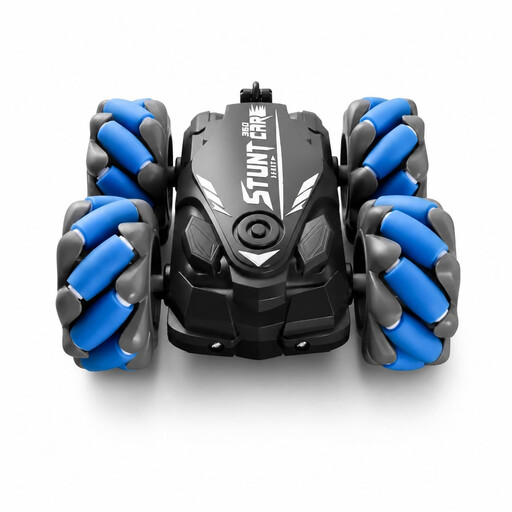
Why this product suits this profile: According to the product information, this RC stunt car is designed for children aged 8 and over and offers both remote control and gesture control. It is suitable for indoor surfaces and level outdoor areas.
The age limit, permanently installed battery system and guidance on small parts, charging and rotating wheels are all stated explicitly.
4WD, 360-degree turns, sideways drifting, driving on both sides, LED lights and three control modes.
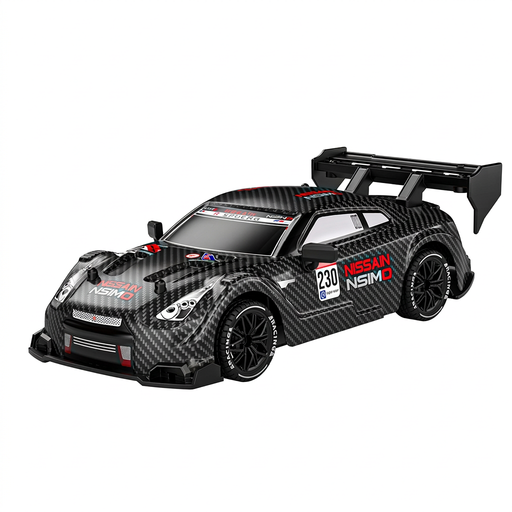
Why this product suits this profile: This compact RC drift car is specified for children and teenagers aged 8 and over. It can be used on level indoor surfaces and paved outdoor paths.
It is not presented as suitable for off-road use across the board. Instead, the description specifies tiles and level roads, as well as two interchangeable sets of tyres.
4WD, drift and racing tyres, LED lighting, shock absorption and a stated playtime of around 20 to 40 minutes per charge.
We have put together a complete, regularly updated list of products that fully meet these strict selection criteria and the safety regulations applicable in the EU.
Before giving the car as a present or using it for the first time, parents and other supervising adults should:
A gift for children aged 3 and over should be particularly easy to operate. Stunt vehicles with gesture control, Mecanum wheels or faster drive systems are more suitable for older children and teenagers. The phrase “for boys and girls” simply describes the target group; age, motor skills and intended use are what really matter.
This depends on the battery, motor power, surface and driving style. A model with a 7.4 V 1,500 mAh battery or a stated runtime of 20 to 40 minutes gives you a much clearer idea of what to expect than purely promotional claims. For longer play sessions, a compatible spare battery can be useful.
Choose a model with a clear age rating, straightforward controls and as few loose small parts as possible. A slow-moving vehicle for smooth surfaces is often easier for beginners than a 4WD RC car with drift or rollover functions. Adult supervision remains important for younger children.
Not every remote-controlled off-road vehicle is designed to cope with wet conditions. Only explicitly stated water resistance should be used as a guide. Even then, the battery, charging port and electronics should be protected and dried after use. If the manufacturer provides no relevant information, avoid using the vehicle in rain, snow or puddles.