
Lieferung heute & morgen

Qualitätsgarantie

Willkommens-Angebote freischalten: KOSTENLOSE Lieferung | Bis zu 80 % RABATT | Kostenlose 30-Tage-JoyPlus-Testphase
App herunterladen
A rearview mirror dash cam combines a digital interior mirror with a front and rear camera. This is particularly interesting for commuters, families, high-mileage drivers, and owners of SUVs, vans, motorhomes and lorries. However, before you buy, you should carefully check the technical specifications. A high resolution alone doesn't tell you much about how well it will perform in everyday use.
The phrase "4K dash cam front and rear" isn't always understood correctly. On many devices, only the front camera records in 4K, while the rear camera uses a lower resolution. That might be sufficient for reversing, but it delivers fewer details when it comes to vehicles further away.
So check each separately:
A mirror camera with a touchscreen shows the camera image on the display. This isn't automatically the same as a classic reflective interior mirror. Depending on installation, brightness and viewing angle, the display can look different.
What matters is a suitable screen size, easy-to-reach controls, and secure mounting over your existing rearview mirror. A 10- or 12-inch display can be practical in larger vehicles, but it must not obstruct your forward view.
Terms like lane change assist, ADAS, BSD or blind spot assist describe warning and indicator functions, depending on the model. They do not replace a shoulder check or the driver's attention. Buyers should also check which function is actually included in the specific product.
Even parking surveillance won't work without a suitable power supply. For monitoring when the vehicle is parked, an additional hardwire kit may be required. Check before installation whether this accessory is included in the box or available separately.
A front camera with 4K resolution can record number plates and traffic situations in more detail than a Full HD camera. However, the actual image quality also depends on the image sensor, optics, lighting and compression.
For driving in the dark, look for details on night vision or WDR. WDR stands for Wide Dynamic Range and helps process scenes with strong contrasts in brightness, for example when facing oncoming traffic or when entering and exiting tunnels. Such a feature does not guarantee a recognisable recording under all conditions.
Loop recording overwrites older, unprotected video files once the memory card is full. This means you don't have to manually clear the card after every journey. Pay attention to:
A G-sensor detects sudden movements or impacts and can protect the corresponding files from being overwritten. The sensitivity should suit your vehicle usage, otherwise potholes or hard kerbs could lock an unnecessary number of files.
A car camera with GPS can document location, route or speed in the recordings, according to the respective product specifications. With a dash cam with Wi-Fi, transfer usually happens via a smartphone app. This makes viewing and saving videos easier, but doesn't replace regular checks of the storage.
Before buying, check the installation:
In the UK, dash cam footage should not be permanently stored or published indiscriminately. Make sure you understand the rules on usage and data protection, especially for longer recordings and when sharing video files.
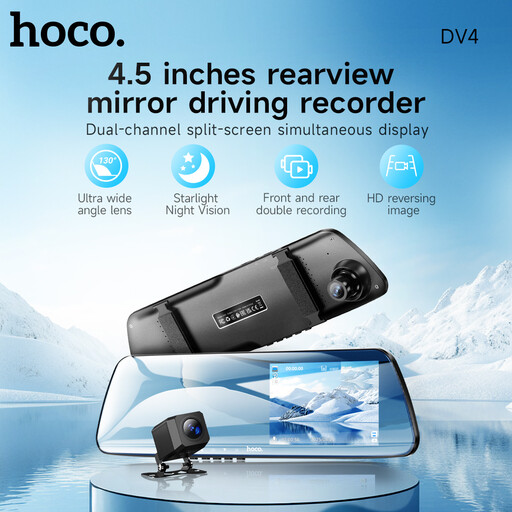
Why this product fits the profile: This compact rearview mirror camera for cars and lorries combines front and rear recording with a 4.5-inch IPS display, and is ideal for users who want straightforward features.
The resolutions are listed separately: 1080P front and 720P rear. This lets you assess performance more realistically than with a blanket marketing claim.
130-degree viewing angle, 30 frames per second and support for memory cards up to 128 GB. According to the manufacturer, 22 languages are available.
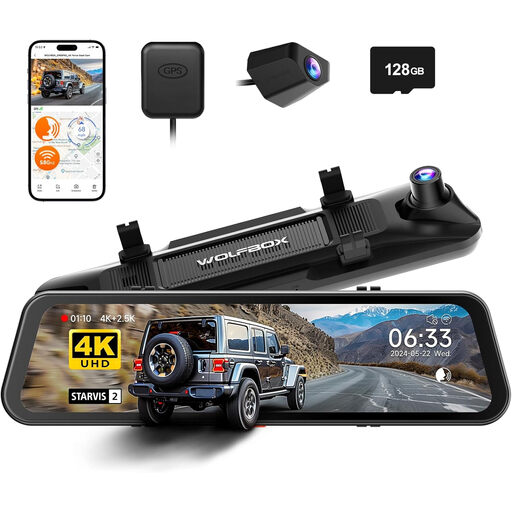
Why this product fits the profile: For high-mileage drivers and families who want front and rear recordings with a large display, GPS and app connectivity.
The front and rear resolutions are stated separately: 4K front and 2.5K rear. Loop recording and G-sensor are also explicitly mentioned.
12-inch mirror display, 128 GB memory card, 5.8 GHz Wi-Fi, voice control and GPS according to the manufacturer.
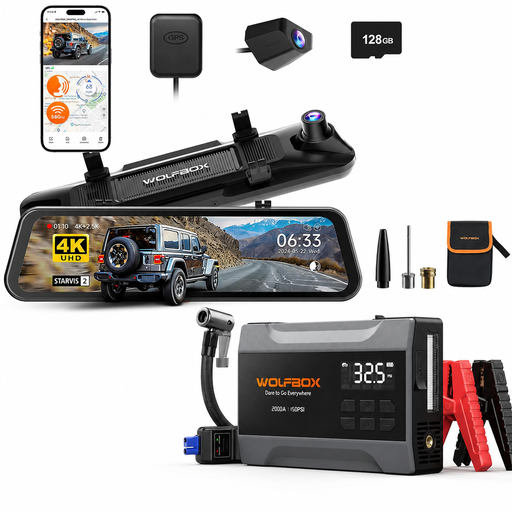
Why this product fits the profile: For long journeys, camping, motorhomes or vehicles where a portable jump starter with compressor is a useful addition to a rearview mirror dash cam.
The package contents explicitly list the 128 GB card, GPS, Wi-Fi, loop recording and G-sensor. The additional devices are therefore clearly separate from the camera system.
Front recording in 4K, rear recording in 2.5K, 5.8 GHz Wi-Fi and a 2000 A jump starter with 150 PSI air compressor according to the product specifications.
We've put together a complete, regularly updated list of products that fully meet these strict selection criteria and the safety regulations in force in the EU.
Many models are attached with straps over your existing interior mirror. Then the rear camera cable is routed along the interior trim to the back, and the power supply is connected to the 12-volt socket. Before you finalise the routing, check that the display doesn't cause glare and that the rear camera has a clear field of view.
That depends on the resolution, storage capacity and loop recording. A 128 GB card stores fewer hours at higher resolutions than at Full HD. Protected files from the G-sensor are usually not overwritten automatically and should be checked or transferred regularly.
In addition to the purchase price, costs can arise for a suitable microSD card, an optional parking surveillance cable or replacement parts. Wi-Fi normally doesn't incur its own mobile data charge if the connection is made directly between the dash cam and your smartphone. GPS is integrated into the models mentioned here, according to the product specifications.