
Lieferung heute & morgen

Qualitätsgarantie

Willkommens-Angebote freischalten: KOSTENLOSE Lieferung | Bis zu 80 % RABATT | Kostenlose 30-Tage-JoyPlus-Testphase
App herunterladen
Choosing the right lighting is crucial for the atmosphere and functionality of any room. LED recessed spotlights offer a modern, energy-efficient, and space-saving solution, but the market can be overwhelming. Many products advertise features that lead to problems in practice. As your Joybuy Product Recommendation Officer, I'll help you identify the typical pitfalls and make an informed decision that perfectly suits your project.
Before you invest, you should be aware of the three most common mistakes made when selecting recessed spotlights. These often lead to disappointment, additional costs, or even safety risks.
To avoid these mistakes, focus on the following technical specifications. These define the quality, safety, and suitability of an LED recessed spotlight for your project.
The IP (Ingress Protection) rating indicates how well a light is protected against the intrusion of foreign objects and water. Choosing the correct rating isn't a minor detail—it's a necessity.
The lighting ambiance has a huge impact on well-being. Modern LED technology offers flexible solutions for this.
The on-site technical conditions are decisive for a trouble-free installation.
Based on these criteria, we have identified some products that are particularly well-suited for typical user profiles.
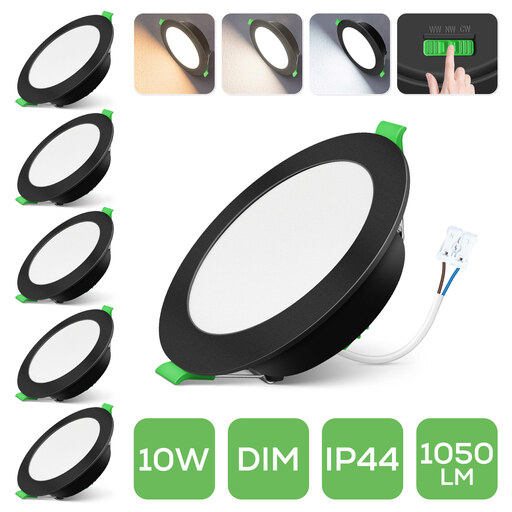
Why This Fits Their Persona: Ideal for renovators who want a uniform look in different rooms. The modern design as a recessed spotlight in black complements many interior styles, while its technical features allow for use from the kitchen to the bathroom.
Thanks to 3CCT colour temperature switching, the light colour doesn't have to be decided in advance. The IP44 rating prevents failures in damp rooms, and the low-profile design (34 mm) fits into almost any ceiling.
Maximum flexibility with dimmability, three selectable light colours, and suitability for damp areas. Direct 230V connection without a transformer.

Why This Fits Their Persona: Specifically designed for mobile use in motorhomes, vans, or boats. Its low power consumption conserves the battery, while the robust construction withstands the demands of being on the road.
This spotlight is designed for 12-24V DC, thus avoiding the fatal mistake of connecting a 230V spotlight to an on-board electrical system. The ultra-slim design (29 mm) is ideal for the limited space in vehicles.
Direct compatibility with 12V-24V systems. Flicker-free operation and 3CCT function for customisable light in your motorhome.
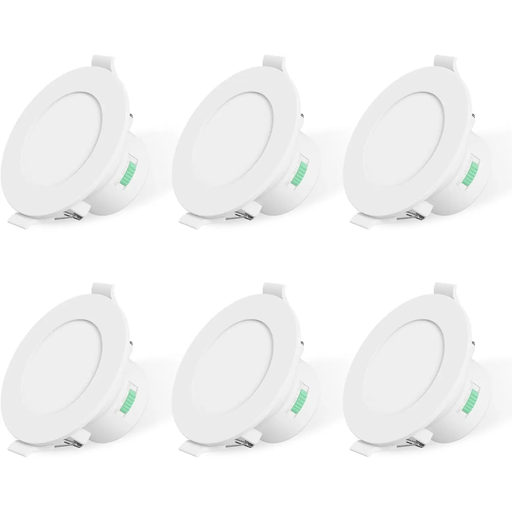
Why This Fits Their Persona: Perfect for families and anyone who values safety and orientation. Designed as a recessed wall light for stairs, it provides glare-free illumination of steps and hallways, especially at night.
Instead of unsuitable ceiling spotlights, this set offers a targeted solution. The adjustable power (0.5W/1.5W/2.5W) prevents excessive brightness and glare, which increases safety on stairs.
A specialised solution for stair lighting. Dimmable and with adjustable power and colour temperature for perfect adaptation to any time of day.
We have compiled a complete, up-to-date list of products that fully meet these strict selection criteria and UK safety regulations.
1. How many LED recessed spotlights do I need per square metre? A general rule of thumb for uniform ambient lighting is one spotlight per 1.5 to 2.5 square metres. However, this heavily depends on the ceiling height, the beam angle and luminous flux (lumens) of the spots, and the room's use. You will generally need higher illuminance in a kitchen or study than in a living room or bedroom.
2. Can I install LED recessed spotlights myself? In many countries, work on 230V electrical installations may only be carried out by a qualified electrician in accordance with local regulations. This is for your safety and ensures your insurance coverage remains valid. While experienced DIYers may be able to handle 12V systems, hiring a professional for 230V installations is mandatory.
3. What does 3CCT mean for LED spots? 3CCT stands for "3 Correlated Colour Temperatures." An LED spot with this feature has a small switch that allows you to choose between three preset light colours before or after installation—typically Warm White (approx. 3000K), Neutral White (approx. 4000K), and Cool White (approx. 6500K). This gives you the freedom to adjust the lighting atmosphere of a room at any time without having to replace the fixture.