
Lieferung heute & morgen

Qualitätsgarantie

Willkommens-Angebote freischalten: KOSTENLOSE Lieferung | Bis zu 80 % RABATT | Kostenlose 30-Tage-JoyPlus-Testphase
App herunterladen
Dark cabinets, cluttered kitchen countertops, or poorly lit hallways are everyday annoyances. A rechargeable motion sensor cabinet light promises a simple and fast solution—completely wireless and drill-free. However, the market is flooded with products whose real-world performance often fails to live up to their promises. Before you make a purchase, it's crucial to understand the typical pitfalls that lead to frustration and unnecessary expense.
This guide will help you separate the wheat from the chaff. We focus on the critical technical features and show you how to avoid three common defects that can quickly render a practical product useless.
Many products look identical at first glance, but the differences are in the details. Pay close attention to these three weaknesses to avoid a bad purchase:
drill-free light strip is only as good as its mounting hardware. Many cheap models use weak adhesive strips that lose their grip on rough or slightly uneven surfaces (e.g., woodchip wallpaper, painted wood) after a short time. A falling light is not only annoying but can also be damaged.To avoid these problems, you should check three core technical features before buying. These largely determine the functionality and longevity of your new lighting.
A battery's capacity is measured in milliampere-hours (mAh). A higher value means a longer runtime between charges. For a rechargeable cabinet light that is used several times a day, a capacity of at least 800 mAh is recommended. For a kitchen under-cabinet light that is activated more frequently, 1000 mAh or more is a solid baseline. Also, look for a modern USB-C port, which simplifies charging and is more future-proof than the outdated Micro-USB standard.
Most lights use a Passive Infrared sensor (PIR sensor) that reacts to body heat. Two values are crucial here:
A good LED strip with motion sensor combines the PIR sensor with a dusk-to-dawn sensor. This ensures that the light only turns on in the dark, which significantly extends battery life.
The simplest installation is with adhesive strips. For a permanent hold, the surface must be clean, dry, and smooth. A superior alternative is a magnetic lamp. These models attach to a metal strip that has been previously glued or screwed on. The advantage: The light can be easily removed for charging and then clicked back into place without stressing the adhesive bond. This is the most robust and flexible method for a drill-free light strip.
Based on the criteria above, we have identified some products that are suitable for different needs and locations.

Why This Fits Their Persona: Ideal for users looking for a cost-effective and functional solution for multiple small areas like wardrobes, drawers, or the fuse box. The 2-pack offers excellent value for money.
With a solid 800mAh battery capacity per light, it bypasses the trap of unrealistic runtimes. The three adjustable colour temperatures also prevent you from buying a light with an unsuitable colour.
Three selectable colour temperatures (cool, neutral, and warm white) for flexible adaptation to any location. The ultra-slim design (10 mm) allows for discreet installation.
Why This Fits Their Persona: Perfect for users who need a bright and long-lasting under-cabinet light for the kitchen or longer cupboards. The higher brightness and larger battery are ideal for high-use areas.
With a capacity of 1100 mAh, this model offers a significantly longer runtime, counteracting the problem of frequent charging in the kitchen. The 41 LEDs provide bright, even illumination for your work surface.
Large battery capacity for long intervals between charges. The 30 cm length and high LED count are well-suited for illuminating work surfaces and larger cabinets.
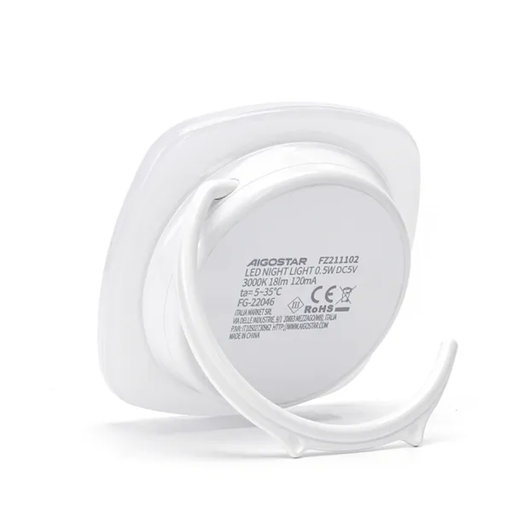
Why This Fits Their Persona: A purpose-built solution for anyone seeking a reliable and rechargeable night light for hallways, stairs, or children's rooms. The focus is on safety and ease of use.
This model is designed as a rechargeable night light and offers pleasant, glare-free illumination with its 3000K warm white light. The additional hanging option (hook) provides an alternative to adhesive-only mounting.
Combined PIR and light sensor for maximum energy efficiency. The warm white light is ideal for nighttime use as it is less disruptive to the sleep cycle.
We have compiled a complete, up-to-date list of products that fully meet these strict selection criteria and German safety regulations.
1. How long does the battery of a cabinet light really last? The actual runtime depends heavily on the frequency of use, battery capacity (mAh), and the set light duration. With average use (a few activations per day), a model with 800-1100 mAh can last from several weeks to a few months. In a rarely used cabinet, the runtime can be even longer. Models with lower capacity in a hallway may need to be charged every 1-2 weeks.
2. Can I mount a drill-free LED light strip on any surface? No, the adhesion of adhesive strips is limited. They generally hold well on smooth, clean surfaces like tiles, metal, or coated wood. On rough surfaces like woodchip wallpaper, untreated wood, or in damp environments (e.g., bathrooms), the adhesive strength can quickly diminish. In such cases, a magnetic mount with a screwed-on or more securely glued metal plate is the more reliable choice.
3. Which sensor is better: motion or dusk-to-dawn? The combination of both is the most efficient solution. A motion-only sensor would also turn on the light in daylight, wasting energy. A good rechargeable motion sensor cabinet light has a PIR sensor for motion detection and an additional photosensor (dusk-to-dawn sensor) that only activates the light when the ambient brightness is low.