
Lieferung heute & morgen

Qualitätsgarantie

Willkommens-Angebote freischalten: KOSTENLOSE Lieferung | Bis zu 80 % RABATT | Kostenlose 30-Tage-JoyPlus-Testphase
App herunterladen
A rechargeable cordless outdoor table lamp should do more than simply look decorative. On a balcony, patio, in the garden or when camping, what matters is the right level of brightness, a battery life you can trust and a housing that shrugs off the odd splash. At the same time, the lamp should be easy to carry and, when needed, serve as a portable table lamp, bedside lamp or emergency light.
Many options look similar at first glance. The important differences often only reveal themselves in use.
The rating IP44 indicates protection against solid objects from 1 millimetre and against splashing water from various directions. An IP44 table lamp is therefore suitable for a sheltered balcony, a patio or light rain. It shouldn’t be left outdoors unprotected for long periods and must never be submerged.
IP67 offers much more comprehensive protection against dust and temporary immersion under the respective test conditions. Even so, caps, battery compartments and charging port covers must be properly closed. So the decisive factor isn’t the word “waterproof” alone, but the exact IP rating.
A quoted runtime of many hours often applies only at minimal brightness. When choosing, you should check:
A dimmable outdoor lamp can cut everyday energy use if you don’t run it at full power all the time. Real-world runtime also depends on temperature, battery age and state of charge.
Slim lamps can topple easily on a garden table. For outdoor use, a low centre of gravity, a non-slip base and a handle that’s easy to grab are practical. The material should also suit the job: metal can feel sturdy, while plastic keeps the weight down. If you’re carrying it further, compact dimensions and moderate weight matter.
Many lamps state brightness in lumens (lm). More lumens generally mean more light, but not automatically a more pleasant ambience. For a dining table or seating area, a softer, more even all-round glow is often better than a tightly focused beam.
A portable LED lamp with multiple levels suits different situations: low light on the bedside table, medium output for dinner, and a brighter setting for paths or practical tasks. With torches and work lights, beam pattern and range are also important.
A higher-capacity battery, for example 4,000 mAh, can enable long use. Capacity alone, however, doesn’t precisely predict how many hours the lamp will run. LED output, electronics and brightness level are just as decisive.
USB charging is handy at home because you can use existing chargers, power banks or USB ports. Touch controls make operation easy, while a mechanical switch can be more practical in the dark or with damp fingers.
Before you buy, match the IP rating to where you plan to use it. Charging ports should be closed when it’s damp, and a lamp shouldn’t be charged when it’s wet. For battery-powered models, check the battery type, replacement options and storage guidance.
A gas camping lamp is not the same as an electric, battery-powered table lamp. Butane models must only be used in well-ventilated outdoor areas and do not belong in bedrooms, living rooms or closed tents.
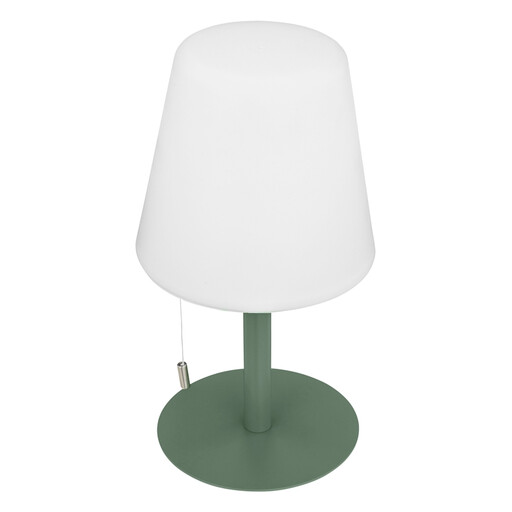
Why this product fits the profile: This 30 cm-tall USB lamp is designed for balconies, patios and gardens, and can run from a power bank or a USB adaptor. Before buying, check whether a battery and charging cable are included.
USB power makes the energy source transparent. For longer sessions, plan on using a power bank with sufficient capacity.
Decorative design, 30 cm height and flexible use away from a fixed socket.

Why this product fits the profile: According to the product details, this outdoor battery table lamp has a 4,000 mAh battery, four touch-controlled brightness levels, USB charging and IP44 splash resistance. It’s also intended for dining areas, bedrooms and camping.
The four brightness levels make the runtime claim easier to interpret. However, IP44 is only splash protection and doesn’t replace a sheltered location.
Up to 80 hours at the lowest brightness according to the product description, touch dimming and 360-degree light distribution.
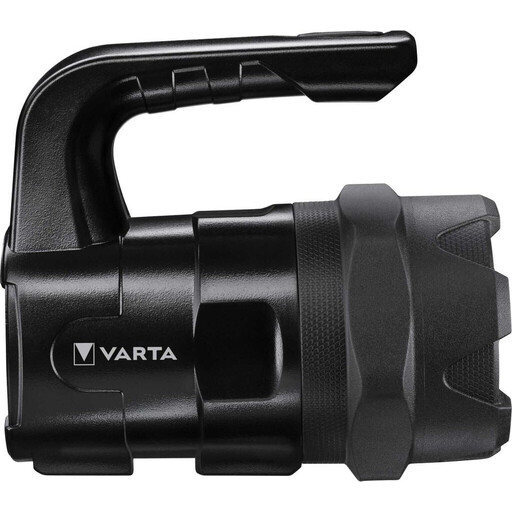
Why this product fits the profile: For workshops, camping and emergencies, ruggedness takes priority here. This model runs on six AA batteries and is therefore not a rechargeable table lamp in the strict sense.
The specs list 400 lumens, up to 85 hours, IP67 and IK08. That makes it clear that ongoing battery costs and a higher weight of 518 grams come with the territory.
400 lumens, up to 400 metres range according to the product description, plus dust and water protection to IP67.
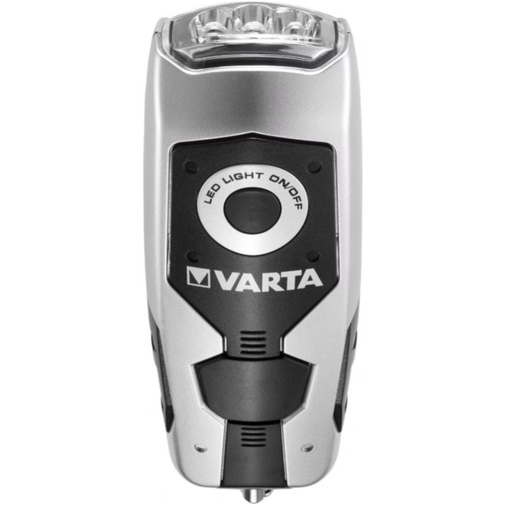
Why this product fits the profile: The hand crank makes this model a useful emergency light for the car, garage, camping or power cuts, when you don’t have access to a socket or spare batteries.
Power is generated via the hand crank. According to the product details, one minute of cranking produces up to 30 minutes of light; this lamp isn’t designed for long-running, mood-setting table lighting.
No batteries required, integrated hand crank, plus a shock-resistant and splashproof ABS body according to the product description.
We’ve put together a complete, continuously updated list of products that fully meet these strict selection criteria and the safety regulations applicable in the EU.
That depends on battery capacity, LED output and brightness level. The maximum runtime is often quoted for the lowest setting. With the Tubicen lamp, up to 80 hours are stated at minimum brightness. For a realistic assessment, ask for the runtime at medium and high brightness or check the product details carefully.
Not every lamp is suitable. IP44 protects against splashes, but not against immersion or prolonged heavy rain. An IP67 lamp is more resistant to dust and water, but must also be properly closed. For long-term storage outdoors, a dry, sheltered spot is advisable regardless of the rating.
With a rechargeable USB table lamp, the main cost is the electricity to charge it. This depends on battery capacity, charging losses and how often you charge, and is usually low in normal use. With a model that uses AA batteries, you’ll have regular replacement costs. For frequent use on the patio or balcony, an integrated battery can therefore be more practical; for occasional emergencies, a hand-crank lamp with no battery purchase can make sense.