
Lieferung heute & morgen

Qualitätsgarantie

Willkommens-Angebote freischalten: KOSTENLOSE Lieferung | Bis zu 80 % RABATT | Kostenlose 30-Tage-JoyPlus-Testphase
App herunterladen
Rising summer temperatures can make daily life a challenge, whether on crowded public transport, in a non-air-conditioned office, or during a study session at the library. A rechargeable handheld fan offers a simple and effective way to get some personal cooling. However, the selection is vast, and the technical specifications can be overwhelming.
This article serves as a guide to help you navigate the options. We will introduce various models and explain the key features you should consider to make an informed decision.
To find the right portable fan for your needs, a few technical aspects are crucial.
The usability of a mobile device depends heavily on its power supply. Pay attention to the battery capacity, which is specified in milliampere-hours (mAh). A higher capacity generally means long battery life. Manufacturer specifications for runtime often refer to the lowest speed setting. Check if the charging options fit your daily routine. A modern USB-C port often allows for faster charging times and is compatible with many current device cables.
A fan for on the go should be compact and lightweight. Pay attention to the weight and dimensions. Some models are foldable, making them easier to transport in a bag or backpack. A sturdy base is useful if you also want to use the fan as a small desk fan. The material and build quality are also indicators of the device's durability.
The cooling performance is determined by the airflow, which depends on the size of the rotor blades and the maximum rotational speed. Multiple speed settings allow you to adapt to any situation. For use in the office, library, or bedroom, a quiet USB fan is a major advantage. The volume is measured in decibels (dB). Values below 50 dB are considered unobtrusive and generally do not disturb concentration or sleep.
Based on objective product features, we have compiled a selection of different models that cater to various needs.
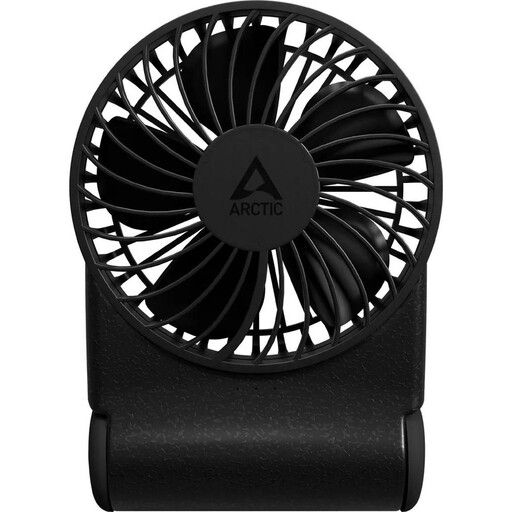
Why This Model Stands Out The ARCTIC Summair 2Go is distinguished by its exceptionally long battery life. According to the manufacturer, the 5000 mAh battery provides up to 77 hours of operation on the lowest setting. Another key feature is the stepless speed control, which allows for very fine adjustment of the airflow from 600 to 4300 RPM.
Benefits at a Glance
Who is This Model For? This travel fan is an excellent choice for users who need maximum independence from power sources, such as for camping, festivals, or long journeys. Its precise control also makes it a great option for your desk.
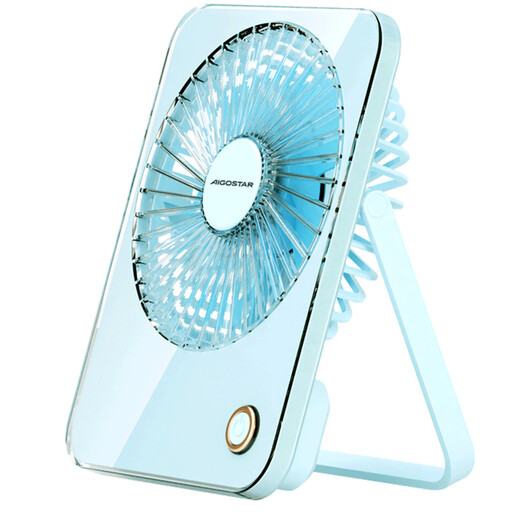
Why This Model Stands Out The design of the Aigostar fan is built for flexibility. Thanks to its 180-degree foldable base, the device can be either stood up or hung. According to the manufacturer, the 5-rotor-blade design is intended to create a softer and more pleasant airflow. With 3600 mAh, the battery offers solid runtime for daily use.
Benefits at a Glance
Who is This Model For? This mini rechargeable fan is particularly suitable for use at the workplace, in a home office, or on a nightstand. Its flexible positioning and compact design make it a practical solution for personal, stationary use.
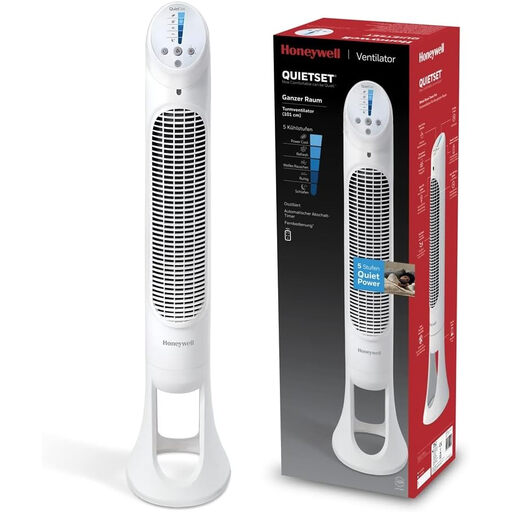
Why This Model Stands Out If you are looking for a more powerful solution for a fixed location like a home office or bedroom, this tower fan is a great alternative. It is not designed for mobile use, but it offers whole-room cooling. With a noise level of 48 dB on its low setting, it operates quietly. The 80-degree oscillation distributes air evenly throughout the room.
Benefits at a Glance
Who is This Model For? This model is intended for users who need quiet and effective cooling for a specific room, like a living room or bedroom, and who value convenience features such as a remote control and a timer. It is not a mobile solution but rather a complement for stationary use.
The models presented cover a range of use cases. If you haven't found the perfect solution for your specific needs, there are many other variations to discover—from ultra-light models for your handbag to devices with additional features like a power bank.
Explore our entire selection of portable rechargeable fans and find the right model for your needs.
The battery life depends heavily on the model, battery capacity (mAh), and the selected speed setting. It can range from a few hours at high power to over 70 hours on the lowest setting for models with very large batteries. A look at the manufacturer's product specifications will provide precise details.
Most modern USB fans support "pass-through charging." This means they can be operated while charging when connected to a power source (e.g., a power bank, laptop, or wall adapter). It is advisable to check the product description of the specific model to confirm this feature.
The noise level is specified in decibels (dB). Models designed specifically for office or bedroom use often operate very quietly. Values below 50 dB on the lower settings are common and are generally not perceived as disruptive, comparable to the noise level in a quiet library.